Rachel writes:
I don't know how else to do this, but I'd like to thank the three men who picked up my partner and cared for him while the ambulance arrived after he suffered a brain haemorrhage on Wickham Road on Monday. They also locked his bike up safely which I retrieved today.
I am incredibly grateful to them for their help. He is making good progress in intensive care. I ask for help because I wasn't there at the time and don't know who they were and therefore how to thank them! My partner's name is Jo and we live on Lewisham Way.

Hunt's Lewisham A&E appeal thrown out
PA reports:
The Court of Appeal ruled today that Health Secretary Jeremy Hunt did not have the power to implement cuts at Lewisham Hospital in south east London.
Three judges announced their decision on the second day of a hearing in London.
Supporters of the highly-regarded hospital cheered when Lord Dyson, the Master of the Rolls, sitting with Lord Justice Sullivan and Lord Justice Underhill, gave their decision in an appeal brought by the Government over a High Court judge's ruling in July.
Good.
Poor place suffers from poverty-related health problems
The 2013 health profile of Lewisham is out! It's not pretty.
We're winning on hip fractures (in your face, Eastbourne) and healthy eating (by virtue of the fact that Lewisham is not in the north of England) but not much else:
We're winning on hip fractures (in your face, Eastbourne) and healthy eating (by virtue of the fact that Lewisham is not in the north of England) but not much else:
- Deprivation is higher than average and about 17,900 children live in poverty
- Life expectancy for both men and women is lower than the England average. Life expectancy is 6.8 years lower for men and 4.6 years lower for women in the most deprived areas of Lewisham than in the least deprived areas
- Over the last 10 years, all cause mortality rates have fallen. The early death rate from heart disease and stroke has fallen and is worse than the England average
- In Year 6, 25.0% of children are classified as obese, worse than the average for England. Levels of teenage England average
- Levels of alcohol related hospital admissions and teenage pregnancy and GCSE attainment are worse than the stays among those under 18, breast feeding and smoking in pregnancy are better than the England average
- The estimated level of adult 'healthy eating' is better than the England average
- Rates of sexually transmitted infections and smoking related deaths are worse than the England average
- The rate of hip fractures is better than the England average
- Priorities in Lewisham include lifestyle and behaviour change, tackling obesity, alcohol and smoking
With thanks to Robert.
Majority of Uninsured American Will Buy Insurance

In a recent report from Gallup Healthcare by Frank Newport and Kyley McGeeney, it was found that 65% of uninsured Americans plan to buy insurance as directed by the Affordable Care Act (ACA) while 25% plan not to buy insurance but to pay the associated fine. Less than half of uninsured Americans (48%) say that they will seek insurance in health insurance exchange programs offered by either their state government or the federal government while 36% of the uninsured said that they will make their insurance purchase through one of the government programs.
In this round, the Gallup Daily Tracking Survey asked Americans about their awareness of provisions in the the ACA, which goes into effect on January 1, 2014. and how they plan to respond to those provisions. Gallup surveyed a nationally representative sample of 5,099 insured and uninsured American adults via landline and cell phone from September 17, 2013 through September 26, 2013.
Read more:
http://www.gallup.com/home.aspx
http://www.gallup.com/tag/Healthcare.aspx
http://www.gallup.com/poll/164696/two-three-uninsured-americans-plan-buy-insurance.aspx
Lewisham and Greenwich create new NHS Trust
A new Lewisham and Greenwich NHS Trust will be formed on 1 October 2013. The Trust will be responsible for Lewisham Hospital and community services in Lewisham, and for Queen Elizabeth Hospital in Greenwich.
Lewisham Healthcare says:
Services are not changing following the merger, and patient appointments are unaffected. Lewisham Healthcare and Queen Elizabeth Hospital serve similar communities, and have much in common in terms of what we do. As a larger organisation, the Trust will be better placed to meet the challenges of the future. Our focus will be on learning from best practice in Lewisham and Greenwich to improve NHS services for local people.
Following the merger Lewisham Hospital and Queen Elizabeth Hospital will continue to provide the same services. We will also continue to run community services in Lewisham, and to provide some services at Queen Mary’s Hospital in Sidcup. If you receive treatment at Lewisham Hospital, Queen Elizabeth Hospital or Queen Mary’s Hospital, it will not be affected by the organisational change.
All services at Lewisham Hospital – including for maternity and emergency care – are running as normal. In July 2013, Government plans to downgrade Lewisham’s emergency and maternity services in two to three years’ time were overturned by the High Court, following a legal challenge by Lewisham Council and the Save Lewisham Hospital campaign. The Department of Health is appealing this decision, and you will be able to find out more on this website as it happens. The judicial review and appeal do not affect the formation of the new Trust, as there is clear distinction between service change and organisational change.
With thanks to Joe for the news.
Health Services for Homeless Population in Michigan

In a recent report of health care provided to homeless members of the community in Michigan, the Michigan Primary Care Association (MPCA) said that Michigan Health Centers provided care to 19,345 homeless individuals in 2011. The majority of individuals who received care (33%) reported living “doubled up” or with other family or individuals while 1.3% of those who received care and were homeless report living on the street.
MPCA presents this data in an interactive map format allowing users to view these and other data by region or Continuum of Care networks and year.
Read more:
http://www.mpca.net/displaycommon.cfm?an=1&subarticlenbr=38#.UiXhDTashcY
http://www.mpca.net/
http://www.thecampaigntoendhomelessness.org/MichigansCampaign/TheData.aspx
The Lewisham Hospital Victory Dance

The Save Lewisham Hospital Campaign are facing more legal costs - the Secretary of State is appealing Mr Justice Silber's decision in favour of the Campaign and Council - so the "Victory Dance" is also a fundraiser.
Ticket prices reduced from the earlier flyers that have gone round and about. £20 still gratefully accepted as a "donation rate", but there's also standard at £10 and concessions are now £5.
Tickets available online - http://www.savelewishamhospital.com/victory-event-rivoli/ but they can also be bought in person at Brockley Market on Saturday 7th September, New Cross Learning and, of course, at the Celebration in Ladywell Fields after the Parade on 14th September.
In 2013, Americans Exercise Less

In a recent report from the Gallup and Healthways survey, Well-Being Index, which tracks well being in the US, it was found that fewer Americans engaged in frequent physical activity in 2013 than in 2012. The report is based on the Well-Being Index that was fielded from June 1 through June 30, 2013 and surveyed 15,235 American adults from all parts of the country.
Gallup and Healthways have been monitoring US adults’ exercise habits since January, 2008, and over time, have found that exercise is seasonal and tends to decline when the weather gets cold, such as in the fall and winter. However in 2012, more Americans reported exercising frequently than previously. This seemed to relate to last year’s unusually warm temperatures. The report proposes that Americans’ exercise behaviors may have returned to normal along with the temperatures.
Read more:
http://www.gallup.com/poll/163718/americans-exercising-less-2013.aspx
http://www.well-beingindex.com/
Lewisham Hospital saved
Amazing, wonderful news. Lawyers acting for the campaign to save Lewisham Hospital from the threat the closure of key services say:
The High Court today (31 July 2013) found that the Secretary of State for Health, Jeremy Hunt MP, had acted outside his powers and therefore unlawfully, in deciding to substantially cut services and close departments at Lewisham Hospital.
In today’s judgment Mr Justice Silber said that the decision of the Secretary of State must be “quashed” as he had acted outside his powers as Secretary of State, and in breach of the National Health Service Act 2006, when he announced to Parliament that services at Lewisham Hospital would be downgraded and closed.
The BBC reports:
The judge gave [Hunt] permission to appeal against the decision. Mr Justice Silber said recommendations of the Secretary of State had to have regard to, or be supported by, GP commissioners. It was quite clear that the Lewisham GP commissioners did not give support to the proposals, said the judge.
He went on: "On the contrary, they strongly opposed them although those GP commissioners in a number of surrounding but different areas were happy with them. I considered that it was the absence of support from the local GP commissioners which constituted an additional reason why the decision of the Secretary of State cannot stand."
Save Lewisham A&E campaign heads to high court
The three-day Judicial Review of Jeremy Hunt's plans to downgrade Lewisham Hospital begins today.
Lawyers from Leigh Day, on behalf of the Save Lewisham Hospital Campaign, will argue that the decision to substantially cut some of Hospital’s services in three years’ time is unlawful and they will ask the Courts to quash it and ask the Secretary of State to reconsider.
The campaigners also point to a report published yesterday by Prof Allyson Pollock, professor of public health research and policy at Queen Mary, University of London, which claims that the major closures, redundancies, sell-offs and service reconfigurations imposed on the hospital, and more widely across the South London Healthcare NHS Trust by the special administrator appointed by the secretary of state, do not serve patient interests whose needs, prof Pollack claims “…have been, at best, down-played and at worst ignored.”
Writing in the Guardian today, campaigner Shannon Hawthorne says:
As a resident of the south London borough of Lewisham, for me, today is a very significant day. After months of fundraising, protesting and petitioning, the community-led Save Lewisham hospital campaign is heading to the high court. The aim? To challenge plans to close the successful, solvent hospital's existing A&E, maternity, adults' and children's acute wards, and critical care unit, all to bail out a failing neighbouring NHS trust.
By approving the cuts at Lewisham, the health secretary sent out a clear message: any hospital, regardless of quality or financial solvency, can be subject to closures if it fits with the government's wider agenda.
Full article here.
New Mental Health Service for Lewisham
Mental health charity, Bromley Mind, launches a new service from 1st July. The Mind Community Support Service in Lewisham is focused on adults affected by mental health problems whose needs are most appropriately met outside of statutory mental health services.
The Mind Community Support Service in Lewisham will work with adults affected by mental health problems for up to six months. It will support individuals to plan for the future given their personal interests and skills, develop life skills including managing finances and access support and new experiences in the local community.
Funders of the service (London Borough of Lewisham and Lewisham Clinical Commissioning Group) have also announced that additional funding has been identified to expand the mental health support team. As a result, the service can provide support to older adults as well as those aged 18-65.
The team of a Service Manager and six Mental Health Advisors will be based in central Lewisham. Referrals from GPs, mental health and social care professionals are being accepted as of 1 July 2013. Adults affected by mental health problems living in Lewisham or registered with a Lewisham GP can approach the service directly to request an assessment to find out if they qualify for support from the service.
For more information about the service, please contact Community Support Service Manager, Antonio Danzi at antonio.danzi@bromleymind.org.uk or 07734 857303.
Volunteers needed for new Lewisham mental health service
Bromley Mind says:
Mental health charity, Bromley Mind, is pleased to announce the launch of a new service, Mind Peer Support in Lewisham. This service will provide activities, connections, opportunities and skills for anyone with a mental health problem living in Lewisham and develop community led groups to meet local needs.
Mental health is a local health priority. Lewisham has a higher rate of mental health problems than the London and England average.
Mind Peer Support in Lewisham is supported by the London Borough of Lewisham’s Communities that Care fund. The service currently provides a weekly reading and creative writing group every Tuesday from 2pm to 4pm at Lee Green Community Centre. Mind Peer Support in Lewisham is seeking more volunteers to help launch more groups.
Ben Taylor, Chief Executive of Bromley Mind said “Peer Support is a great way to harness the energy, enthusiasm and talent of individuals. It is amazing to see what can be done when people come together to find the local solutions to local needs. We are continuously inspired by the dedication of our Peer Support Volunteers. We welcome more people to join us so that together we can provide more opportunities for individuals to access mental health support in Lewisham."
Mind Peer Support in Lewisham provides full training and support to individuals to set up a mental health activity group of their choice in Lewisham. Training sessions will commence on 29th April, and in early June. For more information please contact Megan Jamison on 07850 639811 or megan.jamison@bromleymind.org.uk
Lowest Obesity Levels in Rocky Mountain State for Third Year in a Row
 According to the Gallup-Healthways Well-Being Index, Colorado is the only state in the nation that has obesity levels below 20%, making it the least obese state since 2010. On the other hand, West Virginia boasts the highest obesity rate, with 33.5% of residents surveyed reporting that they are obese. This is more than 7% higher than the national average of 26.2%. With the exception of four states, there was little change in obesity levels from 2011 to 2012. Delaware was the only state that experienced a slight decrease in obesity levels while obesity rates increased in Georgia, New Jersey, and North Carolina.
As expected, Colorado also had the lowest rates of high blood pressure with only 22% of residents reporting high blood pressure, followed by 23.8% of Minnesotans, and 24.6% of Wyoming residents. West Virginia had the highest level of high blood pressure in the country, with 39.7% of residents reporting high blood pressure, followed by 38.4% if Mississippi residents, and 36.4% of residents in Alabama.
Additionally, many of the states with the lowest obesity levels and lowest rates of high blood pressure also had the lowest diabetes rates. Only 6% of Alaskans reported that they were suffering from diabetes, followed by 7.4% Colorado residents, and 8.1% of Montana residents. In Mississippi, 15.4% of residents surveyed reported that they had diabetes, marking the highest diabetes rate for any state. West Virginia came in a close second, with 15.2% of residents suffering from diabetes, followed by 13.6% of residents in Alabama.
Lewisham votes for legal action on A&E and rate hikes
Catford blogger Clare reports that Lewisham Council last night gave the go-ahead to take legal action to prevent the downgrade of Lewisham A&E. She also notes:
Millions of Americans Unable to Afford Prescription Medication
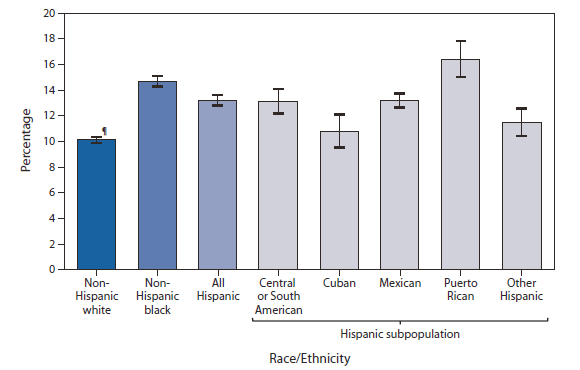
Prescription medicine is often unattainable for millions of Americans simply due to the price of these drugs. The Centers for Disease Control and Prevention’s National Health Interview Survey illustrates the difficulties in accessing medicine that exist for a significant proportion of Americans. In the past year, 10.1% of non-Hispanic white adults reported that drug costs prevented them from buying necessary medications. That percentage jumps to 13.2% for Hispanics and rises further to 14.7% of non-Hispanic blacks. Interestingly, there are significant variations between Hispanic sub-populations: while 16.4% of Puerto Rican adults could not afford prescription drugs in the past year, a comparatively low percentage of Cuban adults (10.8%) were unable to buy necessary drugs.
Cigarette Use Declining in the U.S.

Income, Poverty and Health Insurance Coverage

On Wednesday, the Census released its yearly report on "Income, Poverty, and Health Insurance Coverage in the United States: 2011." Median household income fell for the fourth straight year to $50,054. Men still earn more than women; the median income for men was over $11,000 more than for women. Looking at various ethnicities, Asians possess the highest median household income at $65,129, followed by Whites with $55,412, Hispanics at $38,624, then and Blacks with $32,229.
The recession's impacts on income were wide-ranging, and as a result poverty increased drastically. While the poverty rate fell, it did so only slightly, dropping from 15.1% in 2010 to 15.0% in 2011. Since 1965, the poverty rate jumped above 15.0% for just five years – 1982, 1983, 1993, 2010 and 2011.
Lastly, health insurance coverage improved slightly from 2010; however, over 48 million continue to forego coverage. 15.7% of the population lacks health insurance. This lackluster rate finds its roots in companies' inability to provide employer-based coverage, and in Americans’ inability to simply find a job. With an unemployment rate that has doubled since the start of the recession and businesses around the country struggling to remain profitable while still providing health benefits, 11 million less Americans received health insurance through their jobs in 2011 than in 2000. On the other hand, the number of people relying on government health insurance programs, such as Medicare and Medicaid, has shot upwards more than 31 million in that same timeframe.
Health Spending Represents 17.9% of GDP
 The California Health Care Foundation recently released its 2012 report on health care costs. The report illustrates how America pays for its health care, as well as how these costs have evolved over the past half-century. In 1960, health spending represented just 5.2% of GDP. By 2010, that proportion ballooned to 17.9%. Per capita spending has experienced an even more dramatic increase. In 2000, health spending per capita was $4,878, but after just a decade, that figure rose to $8,402. Compared to other countries, the U.S. spends far more on health care both per capita and as a percentage of its GDP. Switzerland’s $5,270 spent on health care per capita makes the nation a distant second to the U.S. in health spending.
Over the past 50 years, the question of who foots the health care bill has constantly changed. In 1960, the bulk of health care funds came from out-of-pocket spending. Today, however, government programs like Medicare and Medicaid along with private insurance cover the majority of costs, and hospital care, physician and clinical services, and prescription drugs all necessitate far less out-of-pocket spending. For instance, in 1960, nearly all of the money for prescription drug costs (96%) came from the consumers’ pockets. In 2010, out-of-pocket spending accounted for just 19% of the expenditures.
Cigarette Smokers Worldwide
 A recent post on the Economist’s Graphic Detail blog includes a global map of cigarette smokers in 2010, as reported by the American Cancer Society and World Lung Foundation. According to the post, cigarette consumption decreased in Western Europe by 26% from 1990 to 2010 but increased by 57% in the Middle East and Africa over the same time period. Also worth noting is the large disparity between the percentage of males and females that smoke which, according to the post, is largest in China, where 50% of men smoke but only 2% of women smoke.
World's Best Organ Donors

As The Economist points out, however, differences in rates may have more to do with "culture and capacity...than legal regimes." After all, "Spain has an opt-out system and leads the league with around 32 deceased donors per million people; but so does Greece, and it lurks near the bottom with four. Americans, like Britons, have an opt-in system, but also one of the highest total donation rates in the world."


