Majority of Uninsured American Will Buy Insurance
In a recent report from Gallup Healthcare by Frank Newport and Kyley McGeeney, it was found that 65% of uninsured Americans plan to buy insurance as directed by the Affordable Care Act (ACA) while 25% plan not to buy insurance but to pay the associated fine. Less than half of uninsured Americans (48%) say that they will seek insurance in health insurance exchange programs offered by either their state government or the federal government while 36% of the uninsured said that they will make their insurance purchase through one of the government programs.
In this round, the Gallup Daily Tracking Survey asked Americans about their awareness of provisions in the the ACA, which goes into effect on January 1, 2014. and how they plan to respond to those provisions. Gallup surveyed a nationally representative sample of 5,099 insured and uninsured American adults via landline and cell phone from September 17, 2013 through September 26, 2013.
Read more:
http://www.gallup.com/home.aspx
http://www.gallup.com/tag/Healthcare.aspx
http://www.gallup.com/poll/164696/two-three-uninsured-americans-plan-buy-insurance.aspx
Millions of Americans Unable to Afford Prescription Medication
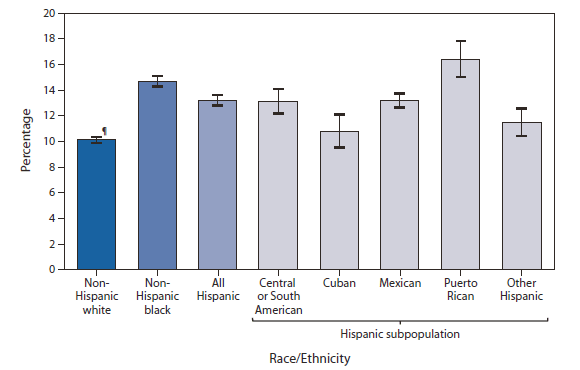
Prescription medicine is often unattainable for millions of Americans simply due to the price of these drugs. The Centers for Disease Control and Prevention’s National Health Interview Survey illustrates the difficulties in accessing medicine that exist for a significant proportion of Americans. In the past year, 10.1% of non-Hispanic white adults reported that drug costs prevented them from buying necessary medications. That percentage jumps to 13.2% for Hispanics and rises further to 14.7% of non-Hispanic blacks. Interestingly, there are significant variations between Hispanic sub-populations: while 16.4% of Puerto Rican adults could not afford prescription drugs in the past year, a comparatively low percentage of Cuban adults (10.8%) were unable to buy necessary drugs.
Income, Poverty and Health Insurance Coverage
On Wednesday, the Census released its yearly report on "Income, Poverty, and Health Insurance Coverage in the United States: 2011." Median household income fell for the fourth straight year to $50,054. Men still earn more than women; the median income for men was over $11,000 more than for women. Looking at various ethnicities, Asians possess the highest median household income at $65,129, followed by Whites with $55,412, Hispanics at $38,624, then and Blacks with $32,229.
The recession's impacts on income were wide-ranging, and as a result poverty increased drastically. While the poverty rate fell, it did so only slightly, dropping from 15.1% in 2010 to 15.0% in 2011. Since 1965, the poverty rate jumped above 15.0% for just five years – 1982, 1983, 1993, 2010 and 2011.
Lastly, health insurance coverage improved slightly from 2010; however, over 48 million continue to forego coverage. 15.7% of the population lacks health insurance. This lackluster rate finds its roots in companies' inability to provide employer-based coverage, and in Americans’ inability to simply find a job. With an unemployment rate that has doubled since the start of the recession and businesses around the country struggling to remain profitable while still providing health benefits, 11 million less Americans received health insurance through their jobs in 2011 than in 2000. On the other hand, the number of people relying on government health insurance programs, such as Medicare and Medicaid, has shot upwards more than 31 million in that same timeframe.
Supreme Court Decision on the Affordable Care Act Projected to Save Federal Government $84 Billion
In an articlefor the New York Times, author Robert Pear dissected the Congressional Budget Office’s revised estimates on the effects of the Affordable Care Act after the landmark Supreme Court decision to uphold the law. A key portion of the decision alters the legislation to permit States to opt out of the proposed Medicaid expansion. The CBO predicts that an additional 3 million people will now go without health insurance due to this new aspect of the law, but the agency also expects the federal government should save approximately $84 billion over the next 11 years. The Affordable Care Act is still projected to provide coverage to 30 million of the 60 million presently uninsured Americans at a price tag of $1.7 trillion over the course of 11 years. The bulk of the cost emerges after 2014, when many provisions of the Affordable Care Act will take effect.