Millions of Americans Unable to Afford Prescription Medication


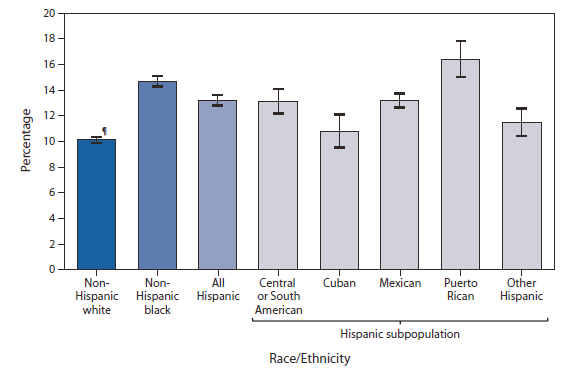
Prescription medicine is often unattainable for millions of Americans simply due to the price of these drugs.  The Centers for Disease Control and Prevention’s National Health Interview Survey illustrates the difficulties in accessing medicine that exist for a significant proportion of Americans.  In the past year, 10.1% of non-Hispanic white adults reported that drug costs prevented them from buying necessary medications.  That percentage jumps to 13.2% for Hispanics and rises further to 14.7% of non-Hispanic blacks.  Interestingly, there are significant variations between Hispanic sub-populations: while 16.4% of Puerto Rican adults could not afford prescription drugs in the past year, a comparatively low percentage of Cuban adults (10.8%) were unable to buy necessary drugs.

Cigarette Use Declining in the U.S.

In the United States, smokers are lighting up less than ever.  Gallup reports that since the 1970s, cigarette smokers that smoke more than a pack a day have steadily decreased, reaching their lowest point yet measured.  This all-time low coincides with this year's tie with 2009 for lowest cigarette usage among American adults; Gallup reports that one in five  lit up in the past week.  To anti-smoking advocates looking forward, these surveys represent success with struggles on the horizon; the study underscores the fact that most smokers know the negative effects of tobacco use, decreasing the usefulness of media campaigns that highlight the negative effects of smoking.  This in turn makes recommendations concerning tobacco control programs being brought to CDC-recommended levels require further analysis.  The question remains as to whether spending more money to bring states into compliance would bring a significant impact on tobacco usage or not.

Demographics of Residential Care Facilities Residents


The U.S. Department Of Health and Human Services recently released a data brief detailing the demographics of Americans living in State-Funded Residential Care Facilities (RCF), such as those living in assisted living communities. In 2010, 733,300 citizens lived in RCF’s. Of those, 91% of were non-Hispanic whites, and 70% were female.  Almost 2 in 10 were Medicaid beneficiaries.  Younger residents, those under 65, were the most likely to have Medicaid, with 56% receiving benefits.  The majority of residents were 85 and older, with 54% falling into the oldest age group.  Chronic medical conditions were highly prevalent as well, with more than three quarters of residents possessing at least 2 of the 10 most common chronic conditions such as high blood pressure, Alzheimer’s disease and other forms of dementia.  More than a quarter of residents suffered from four or more of these chronic illnesses.

Birth Rates Reach All-Time Low among Teens


The Centers for Disease Control and Prevention announced that birth rates for U.S. teens have reached all-time lows across age and ethnic groups. The birth rate fell 9% from 2009 to 2010 among women aged 15 to 19 and the rate dropped 44% from 1991 to 2010. The number of babies born to women aged 15 to 19 was 367,752, the lowest since 1946. From 2007 to 2010, only three states – Montana, North Dakota, and West Virginia – did not experience a decrease in teen birth rates. Birth rates among minorities have dropped off sharply since 1991, but disparities remain, with non-Hispanic black, Hispanic, and American Indian or Alaska Native teens continuing to possess higher birth rates than the national average. This stands in stark contrast, however, to Asian or Pacific Islander teens, whose birth rate was only 10.9 births per 1000 women.

Dealing With the Costs of Health Care in America

MSNBC recently covered the National Center for Health Statistic's (NCHS) report on the financial burden of health care.  The NCHS questioned Americans on how easily they were able to pay medical bills from January to June of 2011.  The estimates show that one in five Americans live in a family that is having problems paying medical bills in the past 12 months.  One in ten Americans are in a family that has medical bills that they are not able to pay.  Also, just over a quarter of Americans live in a family that has medical bills that are being paid over time.  Lastly, one in three Americans lives in a family that is experiencing some kind of financial burden due to medical costs. The full report investigates how various demographics are dealing with medical bills.  The most notable stat within these demographics is the fact that those in the 0-17 age group have the highest probability of experiencing some sort of financial burden stemming from health care bills.  With Barack Obama’s Affordable Care Act still in the process of being integrated into the health care system, it will be interesting to see how these numbers may or may not be affected. 

Blog Archive