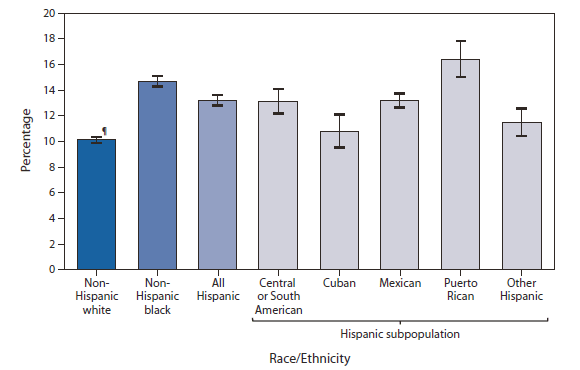
Prescription medicine is often unattainable for millions of Americans simply due to the price of these drugs. The Centers for Disease Control and Prevention’s National Health Interview Survey illustrates the difficulties in accessing medicine that exist for a significant proportion of Americans. In the past year, 10.1% of non-Hispanic white adults reported that drug costs prevented them from buying necessary medications. That percentage jumps to 13.2% for Hispanics and rises further to 14.7% of non-Hispanic blacks. Interestingly, there are significant variations between Hispanic sub-populations: while 16.4% of Puerto Rican adults could not afford prescription drugs in the past year, a comparatively low percentage of Cuban adults (10.8%) were unable to buy necessary drugs.
Hospital Errors Kill 98,000 Americans a Year
Marty Makary, writing for the Wall Street Journal, highlighted the disturbing trend of errors in the medical field and the deadly consequences these errors lead to. Based on data from the Institute of Medicine, hospital errors kill 98,000 patients a year, and 1 in 4 hospitalized patients are harmed in some fashion by hospital errors. If hospital errors were a disease, they would be the sixth leading cause of death in America – ahead of Alzheimers. Surgeons have even been known to operate on the wrong body part as frequently as 40 times per week. The issue of hospital errors is often overlooked due to the fact that hospital performance statistics are difficult to attain, and for the simple fact that the public is more than willing to trust a medical institution.
Why the dangerously high number of errors? Makary's analysis points to a lack of teamwork. Many employees across America’s hospitals report poor levels of teamwork, an aspect of hospital dynamics that makes it difficult to recognize and prevent mistakes. Makary suggests installing cameras, providing patients with online access to medical histories and charts, and simply opening a dialogue on the deadly consequences of medical errors as solutions to the problem.
World's Best Organ Donors
Yesterday's daily chart from The Economist compared organ donation rates across selected countries. The subject of organ donation has been in the news recently, as the British Medical Association suggested this week that Great Britain change from an opt-in system to the opt-out system more commonly featured throughout Europe. The opt-in system gives individuals the opportunity to sign up for organ donation, but does not assume that they are otherwise willing to donate; the opt-out system, on the other hand, assumes individuals are willing to donate their organs unless they opt out.
As The Economist points out, however, differences in rates may have more to do with "culture and capacity...than legal regimes." After all, "Spain has an opt-out system and leads the league with around 32 deceased donors per million people; but so does Greece, and it lurks near the bottom with four. Americans, like Britons, have an opt-in system, but also one of the highest total donation rates in the world."