Partisan Divide at 25-Year High
Debunking Myths About Food Stamps
The article provides fact-based commentary on political strategies regarding welfare, including the following:
- "Though blacks are disproportionately represented among food stamp recipients, far more whites receive such assistance. When recipients identified themselves by race in 2010, 34 percent were white, 22 percent were black and 16 were percent Hispanic, the Agriculture Department said."
- "Food-stamp spending has indeed increased under Obama, but its steady climb began under President George W. Bush."
- "The Center on Budget and Policy Priorities, a nonpartisan think tank, said anti-poverty programs make up about 20 percent of the federal budget, and that's been true over the last three decades when both Republicans and Democrats have been in power."
- "Among the big social safety net expenditures in 2011 are Medicaid ($274 billion) and refundable tax credits, including the earned income tax credit ($102 billion). Food stamps ($71.8 billion) and cash assistance ($6.9 billion) constitute just 2.2 percent of the federal budget, but they pack a bigger wallop when it comes to public perceptions."
The article also quotes Michael Dawson, director of the Center for the Study of Race, Politics and Culture at the University of Chicago, regarding Republican efforts--specifically, those of Newt Gingrich--to bring up welfare as an issue, as saying: "It's a tired tactic but one that's sometimes effective in mobilizing white racial resentment."
Pew: Public's Frustration with Congress Could Cost Republican Incumbents in 2012
The Pew Research Center for the People and the Press reports that "discontent with Congress has reached record levels, and the implications for incumbents in next year’s elections could be stark." Two-thirds of respondents say that "most" congressional members should be voted out of office in 2012, the highest percentage on record. And Americans are not very forgiving of their own; 33 percent say they do not want to see their own representatives reelected. According to Pew, this "matches the all-time high recorded in 2010, when fully 58 members of Congress lost reelection bids – the most in any election since 1948."Survey results suggest that the American public is particularly frustrated with the Republican Party, and that Republican incumbents stand to lose the most from the public's discontent. Pew comments: "A record-high 50% say that the current Congress has accomplished less than other recent Congresses, and by nearly two-to-one (40% to 23%) more blame Republican leaders than Democratic leaders for this." Americans are critical of Republican leaders' political approach: "By wide margins, the GOP is seen as the party that is more extreme in its positions, less willing to work with the other side to get things done, and less honest and ethical in the way it governs. And for the first time in over two years, the Democratic Party has gained the edge as the party better able to manage the federal government."
Americans are not putting all the blame on Republicans, of course; they appear to be dissatisfied with Congress as a whole. Democrats survive with more approval than Republicans, but Americans still do not view them very favorably: "Just 31% approve of how Democratic congressional leaders have performed." Still, comparisons between the two parties do indicate that congressional Democrats are at the very least less-disliked than Republicans. For example, while a minority of Americans approve of Democratic congressmen, an even smaller percentage (21%) say they approve of the job Republican leaders have done. In addition, the Democratic Party has retained more support from its base: "While Democrats approve of the job their party’s leaders are doing by a 60% to 31% margin, only 49% of Republicans approve of the GOP leaders in Congress are doing, while 44% disapprove."
The negative Republican attitude differs from the recent historical trend; in recent election cycles, voters from the political party with a House majority say that a majority of congressional members should be reelected. Now, however, "seven-in-ten Republicans say most members of Congress should be replaced, as do 73% of independents and 60% of Democrats."
Americans largely single out current congressional members, and not the political system in which they serve, as the problem. Pew writes: "In assessing Congress, 55% of the public says they think the system can work fine, it’s the members that are the problem. Just 32% say they think most members have good intentions but the political system is broken. The balance of opinion is virtually identical across party lines."
Independents do not express positive views toward either political party, but they are especially critical of Republicans. "By a 54% to 30% margin they say the Republican Party, not the Democratic Party, is more extreme in its positions, and they are twice as likely to label the Republicans than the Democrats as the less honest and ethical party (42% vs. 21%)."
If congressional members--particularly Republicans--hope to hold onto their jobs come 2012, it seems they will have a lot of work to do.
Among Americans Who Have Heard, Higher Percentage Believe Cain Allegations True
According to Pew Research Center for the People & the Press, Americans who have heard "a lot" or "a little" about the sexual harassment allegations against Herman Cain are more likely than not to believe that those allegations are true. 39 percent of these respondents believe the allegations are true, compared with 24 percent who believe the claims are false; 36 percent say they don't know or refuse to answer. 51 percent of Americans say they have heard of the allegations "a lot," with an additional 24 percent saying they have heard of them "a little."Among those who have heard of the allegations, a plurality (43%) say the media coverage has been fair. 24 percent say coverage has been too tough; 14 percent that it has been too easy; and 18 percent say they don't know or neglect to answer. Unsurprisingly, Pew found that partisanship has an impact on respondents' views on the issue: "Democrats are much more likely than Republicans to say they think the allegations are true." Republicans, however, "are more likely to say media coverage has been too tough."
Interestingly, although there was no noticeable difference in responses based on gender for the total population, responses were visibly different along gender lines among GOP and Republican-leaning respondents. Pew writes that "among Republican and Republican-leaners, women are more likely than men to say they think the allegations are false. Among GOP women who have heard about the story, more say the allegations are false (46%) than true (24%) by nearly a two-to-one margin. Among GOP men, impressions are divided about equally (34% true, 33% false)."NHcf
Religion Continues to Play Significant Role in Party Identification
Gallup interviews conducted over the past four months suggest that "religion remains a significant correlate of political party identification in the U.S. today." As has been the case historically, people who are "very religious" are more likely to identify as Republicans and less likely to identify as Democrats. Survey data shows that 49 percent of very religious Americans identify as Republican or Republican-leaning, as compared with only 30 percent of nonreligious Americans.Gallup categorized respondents as very, moderately, or not religious based on their answers to two questions regarding "the importance of religion and church attendance." For the very religious, "religion is an important part of daily life" and respondents attend their place of worship once every week (or almost every week). The nonreligious do not consider religion to play an important role in their everyday lives, and they seldom attend services. The moderately religious include "all who do not fall into the very religious or nonreligious groups but who provided valid responses on both religion questions ."
The impact of religion on party identification is most clearly visible among whites: 62 percent of very religious whites identify as Republicans, compared with 33 percent of nonreligious whites. Hispanics and Asians are on the whole more affiliated with the Democratic Party than they are with the Republican Party, but "very religious Hispanics and Asians skew less Democratic and more Republican than those who are moderately religious or nonreligious."
According to Gallup, "Very religious Hispanics are more likely to identify as Democrats than as Republicans by 17 points, compared with a 30-point difference among nonreligious Hispanics." And Among Asians, "net Democratic identification rises from 12 points among the very religious to 39 points among [the] nonreligious."
Blacks, however, appear to be the exception to the rule. They are "the most Democratic of the four racial and ethnic groups," and religion appears to make little or no "difference in blacks' political orientation." If anything, more religious blacks tend to affiliate as Democrats with slightly more frequency: 78 percent of very religious blacks identify as Democrats or Democratic-leaning, as compared with 74 percent of nonreligious blacks. Gallup writes on the exception: "The historical ties between blacks and the Democratic Party are so strong that they overwhelm any of the independent impact of religiousness so evident among other racial groups."
NH cf
Gallup: More Americans Blame Economic Woes on Government than Wall Street
A recent Gallup survey shows that Americans are far more likely to blame the federal government than Wall Street for the nation's economic problems. When asked to choose between the two, 64% of respondents say the government is more responsible for economic struggles, while only 30% blame financial institutions on Wall Street. Although Americans tend to blame the government more, as Gallup notes, "There appears to be no shortage of blame for either of these entities."In an earlier poll, Gallup asked respondents to express their opinions on the two institutions separately, and the results were not favorable. Writes Gallup: "More than three-quarters of Americans, in both cases, say these entities deserve a great deal or a fair amount of blame for the economic problems facing the U.S." Even then, however, the federal government came out worse: "Still, reflecting the results of the forced-choice question, the percentage saying the federal government deserves a great deal of blame is 11 points higher than the percentage for financial institutions on Wall Street.
Among partisan groups, Republicans are more likely (82%) to blame the federal government for the nation's economy than Democrats (49%). And while Occupy Wall Street supporters attach more responsibility to Wall Street (54%), on the other side, Tea Party supporters are far more likely to blame the government (82%).
Gallup notes: "These attitudes have significant political implications. Both the Tea Party movement, which has targeted the federal government, and the Occupy Wall Street movement, which has targeted big financial institutions, are in sync with significant segments of the U.S. population." To win political favor, it is likely that politicians who align themselves with one side more--the Tea Party or Occupy Wall Street--will have to reach across the line and appeal to voters from the other side.NH cf
Support for Death Penalty Down from Last Year, but a Majority Still Favors its Use
A recent Gallup poll shows that 61 percent of Americans favor the death penalty for people convicted of murder; another 52 percent believe the dealth penalty is applied fairly through the country's criminal justice system. The approval rate represents a three percent decline from last year, when 64 percent of Americans were in favor of the penalty. According to Gallup, this year's mark indicates "the lowest level of support since 1972, the year the Supreme Court voided all existing state death penalty laws in Furman v. Georgia."Gallup writes that views on the death penalty in murder cases have "varied substantially" over time. In 1936, the first year Gallup began asking respondents about the death penalty, "59% of Americans supported it and 38% opposed it." This was followed by "a period from the late 1950s to the early 1970s when less than a majority of Americans favored it." And "support climbed to its highest levels from the mid-1980s through the mid-1990s, including the all-time high of 80% who favored the death penalty in 1994."
The 52 percent who say they believe the penalty is applied fairly also represents a decline from last year, when the figure stood six points higher, at 58 percent. Additionally, 40 percent of Americans state the dealth penalty is not used enough, "the lowest such percentage since May 2001, when Gallup first asked this question." Further, "twenty-five percent say the death penalty is used too often, the highest such percentage yet that Gallup has measured." 
Americans view the death penalty issue along strongly partisan lines. Nearly three-quarters (73%) of Republicans and Republican-leaning independents approve of the practice, as compared with 46% of Democrats and Democratic-leaning independents. Gallup writes: "Additionally, men, whites, and those living in the South and Midwest are among those most likely to support the death penalty."
Gallup conducted the poll following the controversial execution of Troy Davis, who was put to death in Georgia this past September. Politicians' stances on the death penalty may play a role in the upcoming presidential race; at a recent GOP debate, Governor Rick Perry was asked about his views on the practice--and how it is applied in his home state.
NH cf
Pew: Public Interest Rests with Economy; Limited Attention to, Coverage of Anti-Wall Street Protests
With the public most interested in tracking changes in economic conditions, the recent Wall Street protests have not received much attention--or interest--from people or news organizations. This according to the Pew Research Center for the People & the Press, which conducts a weekly survey called the News Interest Index "aimed at gauging the public’s interest in and reaction to major news events."Over a quarter of respondents (27%) report that their top story last week was the economy. The Wall Street protests came in sixth (7%), also trailing interest in Steve Jobs (14%); the 2012 elections (12%); Amanda Knox (10%); and Afghanistan (8%). Although the percentage of total news coverage dedicated to the economy trailed interest, checking in at only 15%, the amount of coverage on Occupy Wall Street exactly matched news interest, at 7%.
When respondents were asked which news stories they followed very closely last week, the results were similarly slanted toward the economy. 43% say they followed economic news very closely, as compared with only 17% who say the same of Occupy Wall Street protests.
Interest in Occupy Wall Street appears especially weak when compared with interest in the Tea Party in April 2009. Only "17% say they are following the current protests very closely, compared with 27% who followed early Tea Party protests very closely." Nor is there the same partisan disparity as there was with regard to the Tea Party. Back in April 2009, 43% of Republicans followed the Tea Party news very closely, compared with only 18% of Democrats. But interest in Occupy Wall Street is low across all partisan groups, with only 12% of Republicans; 17% of Democrats; and 19% of independents following the story very closely.
NHcfPlurality of Americans Favor Palestinian State, but Sympathy Rests With Israel; Divisions Drawn Along Partisan Lines
A September 15-18 survey administered by the Pew Research Center for the People & the Press and The Washington Post reveals stark partisan differences on the issue of Palestinian statehood and Middle East relations. A plurality of Americans (42%) believe the United States should recognize Palestine as an independent nation, as compared with 26% who oppose U.S. recognition and nearly a third (32%) of respondents who state no opinion.The numbers, however, change within partisan groups. A much higher percentage of Democrats (54%) say they are in favor of U.S. recognition, while only 14% oppose the action; and the numbers are similarly skewed among independents, 45% of whom are in favor of recognition and only 28% opposed. But there are more Republicans (38%) who believe the U.S. should not recognize Palestine than there are those who believe it should (27%).
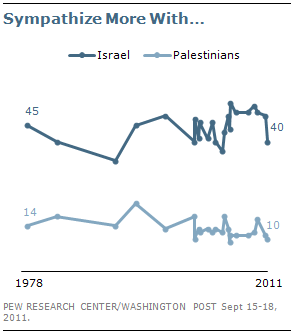
Views similarly fall along partisan lines when respondents are asked with which population they sympathize more. On the whole, 40% of Americans say they sympathize more with Israel, as compared with 10% who sympathize more with Palestinians; 21% say they do not sympathize with either side; and 25% express no opinion. The percentages are nearly unchanged since 1978.
Far more Republicans (62%) sympathize with Israel than with Palestinians (4%), especially when compared to other partisan groups. 27% of Democrats sympathize with Israel and 15% with Palestinians; and among independents, 41% sympathize more with Israel than Palestinians (10%).The report also addresses the "low visibility of the Israel-Palestinian dispute." According to the Pew Research Center’s Project for Excellence in Journalism (PEJ), coverage of the issue has been limited. Pew writes: "Last week, less than 2% of all news coverage was devoted to the debate over Palestinian statehood, far less than the amount of coverage devoted to the U.S. economy (20%) or the 2012 presidential campaign (12%)."
The survey was conducted in anticipation of the planned UN debate on Palestinian statehood this week.
NH cf
Are Moderate Republican Governors Going Extinct?
In a recent FiveThirtyEight blog post, Nate Silver rated each governor's political ideology and the ideology of voters in the governor's state on a scale from liberal to conservative. He found that Republican governors--unlike their Democratic counterparts--are abandoning the middle, and are often taking conservative stances that outpace the more moderate views of the voters who elected them to office.Writes Silver: "Unlike for the Democrats, there is almost no ideological diversity within the group: essentially all of the current Republican governors are quite conservative, taking moderate positions on at most one or two issues. Also unlike the Democrats, there is no correlation between the ideology of the governors and the ideology of the states."
This may be a dangerous development for the Republican party, as "Politics 101 would suggest that you need to be at least somewhat responsive to voters in your state." According to Silver, it is also a fairly recent development. He plots the ideological stances of governors in office a year ago--before the 2010 elections--to show that "there were plenty of moderate Republican governors," many of whom have retired since.

Silver argues that Republican governors' distance from their state's ideology has made them unpopular--and may hurt the G.O.P. in the next election. He writes: "Retribution from the electorate is a strong possibility unless there is a change of course."
NH cf
Pew: Public Divided on Significance of August 2 Debt Limit Deadline, Potential Consequences
According to a July 15-17 survey conducted by the Pew Research Center for the People & the Press, the public is divided on the importance of the August 2 deadline to raise the debt limit. Forty percent of those polled say that - based on what they've read and heard - it is "absolutely essential that the federal debt limit be raised by Aug. 2 to avoid an economic crisis," but 39% believe the deadline could come and go "without major economic problems."Opinions on the subject are correlated to partisan affiliation: while 53% of Republicans believe the deadline could pass without major problems and 30% take the opposite opinion, the percentages are reversed among Democrats; 56% of Democrats believe raising the debt limit is essential, while only 28% do not. A plurality of independents (43%) say the deadline could pass without major economic problems. Republicans who agree with the Tea Party were most likely (65%) to say the deadline could pass without major problems.
Interestingly, "the degree of attention to this issue has only a modest relationship with peoples’ impressions of the seriousness of the Aug. 2 deadline." Both those who are following the issue closely and those who are following it less closely are divided on the importance of the deadline.NH cf
As Shuttle Program Nears End, Majority of Americans See U.S. Leadership in Space as Essential
A timely survey conducted by the Pew Research Center for the People & the Press shows that 58% of Americans believe it is essential that the U.S. continues to be a leader in space exploration. The U.S. space shuttle program begins its final mission today, thirty years after the first shuttle, Columbia, was sent out in 1981. A majority of those polled (55%) say the shuttle program was a good investment, a healthy percentage but lower than figures in the 1980s, when sixty percent or more believed it was a good investment.
Majorities across demographic groups believe continued U.S. space exploration is essential. This holds true for partisan groups as well, although a higher percentage of Republicans (67%) believe it is essential, as compared with independents (57%) and Democrats (54%).
Those with a higher level of education are more likely to view the space shuttle program as a good investment. Approximately two-thirds of college graduates (66%) say it was a good investment, along with 57% of Americans with some college education. The percentage drops among those with lower levels of education, with 47% of Americans with no college education saying the program was a good investment, as compared with 43% who say it was not.Wealthier families--those with annual incomes of $75,000 or more--are more likely to evaluate the program favorably: 67% of those families say it was a good investment, compared with only 27% who say it was not. Families with incomes under $30,000 per year are more divided in their evaluations, with 44% viewing the program favorably and 47% unfavorably.
And while large majorities say the space shuttle program "helped encourage interest in science, led to scientific advances and contributed to feelings of patriotism...no more than about four-in-ten say that the program has contributed 'a lot' in any of these areas."NH cf
More Americans Concerned about Raising Debt Limit than Government Default
An even larger majority (60%) of Republicans fear more that raising the debt limit would lead to higher spending and a larger national debt, and 49% of independents share that view, with only 34% more concerned about a potential government default. Among individuals who identify as Democrats, however, 48% say their main concern is a government default, compared with 38% who take the opposite stance.
And although more Americans say of greater concern is increasing the debt limit, large majorities fear both the consequences of raising the debt limit and failing to raise it. 77% say they are somewhat or very concerned that raising the debt limit would lead to higher spending and debt, while 73% say they are somewhat or very concerned that not raising the limit would cause the government to default and the economy to falter.
NH cf
Country Remains Divided on Abortion Issue
Gallup polling shows that the issue of abortion continues to split Americans down the middle, though for the first time since 2008 a slight majority call themselves "pro-choice" (49%), just eking out those who identify as "pro-life" (45%). But despite this change, a majority of Americans (51%) still believe abortion to be "morally wrong," with only 39% asserting that it is "morally acceptable." Excluding 2006, when results showed Americans to be divided on the moral aspect of the issue, results regarding morality have been "fairly steady since 2002."
50% of Americans answer that abortion should be legal under certain circumstances, but this year's results suggest that more people are taking extreme views on the legality of abortion than they have historically. 27% answered that abortion should be legal in all cases while 22% wanted it to be illegal in all cases. The 49% combined believing in either of the extreme views was the highest since 1992.Americans were fairly consistent in their opinions on abortion across gender. Age and partisan views appear to be a far more likely predictor of an individual's stance on the issue. 49% of adults 55 and older said they were "pro-life," as compared with majorities of those aged 35-54 (53%) and 18-34 (51%) who said they were "pro-choice." And while 68% of Democrats claimed to be "pro-choice," a full 67% of Republicans took the opposite stance, saying they were "pro-life."
Writes Gallup about the results for 2011: "Americans' views on abortion held fairly steady over the past year, with the public still sharply divided over the 'pro-life' and 'pro-choice' labels."NH cf
Pew Survey Finds Majority Believes Homosexuality Should Be Accepted, Increasing Percentage in Favor of Gay Marriage
According to the Pew Research Center for the People & the Press, a majority of Americans (58%) believe homosexuality should be accepted, and not discouraged, by society. This finding becomes magnified the younger the survey population, with 63% of those under 50 years of age and 69% of individuals under 30 years of age saying that society should accept homosexuality. Among those older than 50 years of age, a smaller majority (52%) agrees that it should be accepted.And although a majority of Americans do not favor gay marriage today, the survey shows increased support for the cause, with the 45% today who favor gays and lesbians being legally allowed to marry a large increase from the 35% who took that stance in April 2009. 46% of those surveyed said they were against same-sex marriage, 1% more than those in favor but noticeably less than the 54% who were against same-sex marriage in April 2009. The Pew Center writes: "Opposition to gay marriage has fallen by 19 points (from 65%) since 1996."
Opposition to gay parenting has also fallen in recent years, with the 35% today who say more gay parents is a bad development for society a big decrease from the 50% who viewed the trend negatively four years ago.
Although majorities across most demographic groups were found to support societal acceptance of homosexuality, views toward homosexuality were found to differ significantly based on an individual's religious and political preferences, as well as his/her race and gender. While 67% of Democrats and 63% of independents say homosexuality should be accepted, only 40% of Republicans share that opinion.And while 79% of the religiously unaffiliated, 66% of white Catholics, and 65% of white mainline Protestants believe homosexuality should be accepted, percentages are smaller among other religious groupings. Only 29% of white evangelical Protestants believe homosexuality should be accepted, while 63% believe it should be discouraged by society.
Among races, Hispanics (64%) and whites (58%) were found to be more supportive of homosexual acceptance than African Americans (49%). With regard to gender, women (64%) are more accepting than men (52%).
Findings are from the Pew political typology survey, released earlier this May.
NH cf