 The Economist recently published an article covering climate change policy to mark the beginning of the Doha Climate Change Conference. According to current projections, the outlook appears quite bleak. Although the world needed to decrease greenhouse gas emissions, they have actually increased by 20% just in the past 10 years. This is a major cause for concern, since the UN Environment Programme (UNEP) estimates that by 2020, greenhouse gas emissions must be 11% lower than they are now to guarantee that temperatures do not increase by 2 degrees Celsius. Assuming that greenhouse gas emissions continue to increase at this same pace, by 2020 the world will emit 58 gigatonnes of carbon equivalent (GtCO2e), significantly more than the maximum level of 44 GtCO2e required to prevent temperatures from rising above 2 degrees Celsius. As the Economist explains, if countries planned on making major cuts down the line, then we could potentially avoid this catastrophic temperature increase. However, given the political climate and current policies laid out, this appears unlikely. Even if countries adopted the strictest, conditional pledges, countries wouldn’t even come close to the GtCO2e goal needed to prevent temperatures from rising above 2 degrees Celsius.
 A Bleak Climate Change Forecast
The Economist recently published an article covering climate change policy to mark the beginning of the Doha Climate Change Conference. According to current projections, the outlook appears quite bleak. Although the world needed to decrease greenhouse gas emissions, they have actually increased by 20% just in the past 10 years. This is a major cause for concern, since the UN Environment Programme (UNEP) estimates that by 2020, greenhouse gas emissions must be 11% lower than they are now to guarantee that temperatures do not increase by 2 degrees Celsius. Assuming that greenhouse gas emissions continue to increase at this same pace, by 2020 the world will emit 58 gigatonnes of carbon equivalent (GtCO2e), significantly more than the maximum level of 44 GtCO2e required to prevent temperatures from rising above 2 degrees Celsius. As the Economist explains, if countries planned on making major cuts down the line, then we could potentially avoid this catastrophic temperature increase. However, given the political climate and current policies laid out, this appears unlikely. Even if countries adopted the strictest, conditional pledges, countries wouldn’t even come close to the GtCO2e goal needed to prevent temperatures from rising above 2 degrees Celsius. 
Fighting AIDS Worldwide

On July 19th, The Economist highlighted a report from UNAIDS, a United Nations Agency with the goal of fighting AIDS. AIDS-related deaths surged upwards from 1990 to its peak in 2005 of 2.3 million per year, but since then, the number of those who have lost their lives to the virus have dropped off. The decrease in deaths can be partially attributed to the President’s Emergency Plan for Aids Relief (PREFAR), which President Bush initiated in 2003 and President Obama renewed in 2008. Since then, the number of people receiving antiretroviral medication has dramatically increased; the figure stands at over 8 million in poorer regions of the world. Today, while AIDS remains a serious crisis, the number of AIDS-related deaths has fallen to 1.7 million, a level unseen since 2000.
Female Economic Advancement
 The Economist's recent Graphic Detail post "Where to Be Female" discusses the results of the annual Women’s Economic Opportunity Index recently published by the Economist Intelligence Unit. According to the report published by the Economist Intelligence Unit, "women are a key driver of economic growth" as their entry into the workforce has coincided with GDP growth in both the United States and Europe, yet "nearly one-half of working women are not currently active in the formal global economy." The Women’s Economic Opportunity Index seeks to assess women's entry into the workforce and economic advancement using data released by a variety of major international organizations, including the United Nations and International Monetary Fund. The Index ranges from 0 to 100 (100 being most favorable) and ranks 128 different countries. As the chart from the Economist’s website shows (below), Sweden received the most favorable ranking of 90.4, followed by Norway and Finland at 88.3 and 88.2 respectively. The United States was ranked 14that 78.4, only slightly below the United Kingdom, which was ranked 13that 78.9. Sudan and Chad received the worse ranking (128th and 127th) with scores of 19.2 and 23.3 respectively.
U.S. marriage rate hits a record low
 The Pew Research Center released an analysis of new 2010 U.S. Census data on marriage, which shows a record low in the percentage of married U.S. adults. Only 51% of adults ages 18 and over reported being married, down from 72% in 1960. Over the same 50-year period, divorce or separation has increased from 5% to 14%, and the percent never married increased from 15% to 28%.
The most telling trend in terms of marital trends can be found in the young adult population. Twenty percent of those ages 18 to 29 reported being married, just over one third of the percent married 50 years ago (59%). In addition, the median age of first marriage has increased by roughly six percent over this time period, up to roughly 28 years old.
Though Pew does not definitively explain the declining trends in marriage, they cite the rising share of young adults enrolled in college and “fallout from the Great Recession” as potential contributing factors. Pew also cites a U.N. report on marriage in developed nations between the 1990s and 2000s, quoting: “this was ‘due in part to an increasing acceptance of consensual [cohabiting] unions as a replacement for marital unions,’” which may also contribute to declining percentages in the United States.
Plurality of Americans Favor Palestinian State, but Sympathy Rests With Israel; Divisions Drawn Along Partisan Lines
 A September 15-18 survey administered by the Pew Research Center for the People & the Press and The Washington Post reveals stark partisan differences on the issue of Palestinian statehood and Middle East relations. A plurality of Americans (42%) believe the United States should recognize Palestine as an independent nation, as compared with 26% who oppose U.S. recognition and nearly a third (32%) of respondents who state no opinion.
The numbers, however, change within partisan groups. A much higher percentage of Democrats (54%) say they are in favor of U.S. recognition, while only 14% oppose the action; and the numbers are similarly skewed among independents, 45% of whom are in favor of recognition and only 28% opposed. But there are more Republicans (38%) who believe the U.S. should not recognize Palestine than there are those who believe it should (27%).
Views similarly fall along partisan lines when respondents are asked with which population they sympathize more. On the whole, 40% of Americans say they sympathize more with Israel, as compared with 10% who sympathize more with Palestinians; 21% say they do not sympathize with either side; and 25% express no opinion. The percentages are nearly unchanged since 1978.
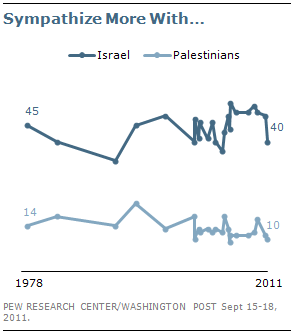 Far more Republicans (62%) sympathize with Israel than with Palestinians (4%), especially when compared to other partisan groups. 27% of Democrats sympathize with Israel and 15% with Palestinians; and among independents, 41% sympathize more with Israel than Palestinians (10%).
The report also addresses the "low visibility of the Israel-Palestinian dispute." According to the Pew Research Center’s Project for Excellence in Journalism (PEJ), coverage of the issue has been limited. Pew writes: "Last week, less than 2% of all news coverage was devoted to the debate over Palestinian statehood, far less than the amount of coverage devoted to the U.S. economy (20%) or the 2012 presidential campaign (12%)."
The survey was conducted in anticipation of the planned UN debate on Palestinian statehood this week.
NH cf


