According to the Pew Center's Project for Excellence in Journalism, Mitt Romney is receiving more negative press coverage than at any other point in the GOP race. Romney, who won the Iowa caucus and New Hampshire primary, will compete against remaining GOP candidates in South Carolina's primary on Saturday.
According to Pew's analysis, this increase in negative coverage for Romney may reflect opponents' efforts to attack the current frontrunner through negative advertisements. In particular, negative discourse regarding Romney revolved around his career at Bain Capital. According to an article on the Politics and Government Blog of the New York Times, GOP candidate opponent Newt Gingrich described Romney's work at Bain as "rich people figuring out clever legal ways to loot a company."
According to the same report, Ron Paul is currently receiving more positive coverage than any other candidate. Almost half of the coverage of Ron Paul over the past week has been positive; according to the report, Paul has been described in many press accounts as "having little chance of winning the nomination."
Of all GOP candidates, Rick Perry currently is criticized the most, with his negative coverage nearly double his positive coverage. Coverage of President Obama from January 9, 2012 to January, 15, 2012 included fewer positive mentions than any of the GOP candidates. Only 10% of coverage regarding Obama was positive. These data come from an analysis of more than 11,000 news websites and mentions on Twitter.
Pew: Public Interest Rests with Economy; Limited Attention to, Coverage of Anti-Wall Street Protests
With the public most interested in tracking changes in economic conditions, the recent Wall Street protests have not received much attention--or interest--from people or news organizations. This according to the Pew Research Center for the People & the Press, which conducts a weekly survey called the News Interest Index "aimed at gauging the public’s interest in and reaction to major news events."Over a quarter of respondents (27%) report that their top story last week was the economy. The Wall Street protests came in sixth (7%), also trailing interest in Steve Jobs (14%); the 2012 elections (12%); Amanda Knox (10%); and Afghanistan (8%). Although the percentage of total news coverage dedicated to the economy trailed interest, checking in at only 15%, the amount of coverage on Occupy Wall Street exactly matched news interest, at 7%.
When respondents were asked which news stories they followed very closely last week, the results were similarly slanted toward the economy. 43% say they followed economic news very closely, as compared with only 17% who say the same of Occupy Wall Street protests.
Interest in Occupy Wall Street appears especially weak when compared with interest in the Tea Party in April 2009. Only "17% say they are following the current protests very closely, compared with 27% who followed early Tea Party protests very closely." Nor is there the same partisan disparity as there was with regard to the Tea Party. Back in April 2009, 43% of Republicans followed the Tea Party news very closely, compared with only 18% of Democrats. But interest in Occupy Wall Street is low across all partisan groups, with only 12% of Republicans; 17% of Democrats; and 19% of independents following the story very closely.
NHcfPlurality of Americans Favor Palestinian State, but Sympathy Rests With Israel; Divisions Drawn Along Partisan Lines
A September 15-18 survey administered by the Pew Research Center for the People & the Press and The Washington Post reveals stark partisan differences on the issue of Palestinian statehood and Middle East relations. A plurality of Americans (42%) believe the United States should recognize Palestine as an independent nation, as compared with 26% who oppose U.S. recognition and nearly a third (32%) of respondents who state no opinion.The numbers, however, change within partisan groups. A much higher percentage of Democrats (54%) say they are in favor of U.S. recognition, while only 14% oppose the action; and the numbers are similarly skewed among independents, 45% of whom are in favor of recognition and only 28% opposed. But there are more Republicans (38%) who believe the U.S. should not recognize Palestine than there are those who believe it should (27%).
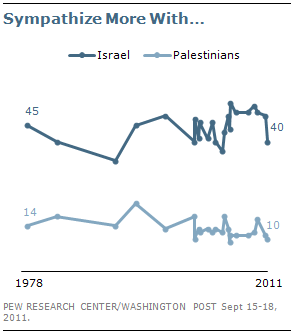
Views similarly fall along partisan lines when respondents are asked with which population they sympathize more. On the whole, 40% of Americans say they sympathize more with Israel, as compared with 10% who sympathize more with Palestinians; 21% say they do not sympathize with either side; and 25% express no opinion. The percentages are nearly unchanged since 1978.
Far more Republicans (62%) sympathize with Israel than with Palestinians (4%), especially when compared to other partisan groups. 27% of Democrats sympathize with Israel and 15% with Palestinians; and among independents, 41% sympathize more with Israel than Palestinians (10%).The report also addresses the "low visibility of the Israel-Palestinian dispute." According to the Pew Research Center’s Project for Excellence in Journalism (PEJ), coverage of the issue has been limited. Pew writes: "Last week, less than 2% of all news coverage was devoted to the debate over Palestinian statehood, far less than the amount of coverage devoted to the U.S. economy (20%) or the 2012 presidential campaign (12%)."
The survey was conducted in anticipation of the planned UN debate on Palestinian statehood this week.
NH cf
Coverage of bin Laden Story Outpaced Interest
According to an article published by the Pew Research Center, the "near-record amount of news coverage" concerning bin Laden's death far outpaced interest in the story. The Pew Research Center's Project for Excellence in Journalism (PEJ) found that 69% of news coverage from May 2-8 concerned the raid in Abbottabad, Pakistan, even reaching 90% of all news on cable television. But a May 5-8 poll conducted by Pew showed that only 42% of people polled said they followed bin Laden's death more closely than any other news story that week.In fact, 20% of those polled said they followed news about severe weather and flooding in the South and Midwest most closely during the same week. And the 42% who said they followed bin Laden's death most closely did not come near the 57% who said in mid-March that they followed the Japan earthquake and nuclear disaster most closely.
Many people recognized the discrepancy between interest and news coverage, as 43% of those polled said the bin Laden story received too much rather than too little coverage, as opposed to only 9% who said the opposite. An additional 42% said the amount of coverage was just right.Concerning the actual bin Laden coverage, 57% said that its most interesting aspect was the chance of a retaliatory terrorist attack on the United States. 74% of the public received its news from a television, and this tendency was especially pronounced for people over 65 years of age, 87% of whom said they received their news from a television.
NH cf