Pew: Public's Frustration with Congress Could Cost Republican Incumbents in 2012

The Pew Research Center for the People and the Press reports that "discontent with Congress has reached record levels, and the implications for incumbents in next year’s elections could be stark." Two-thirds of respondents say that "most" congressional members should be voted out of office in 2012, the highest percentage on record. And Americans are not very forgiving of their own; 33 percent say they do not want to see their own representatives reelected. According to Pew, this "matches the all-time high recorded in 2010, when fully 58 members of Congress lost reelection bids – the most in any election since 1948."

Survey results suggest that the American public is particularly frustrated with the Republican Party, and that Republican incumbents stand to lose the most from the public's discontent. Pew comments: "A record-high 50% say that the current Congress has accomplished less than other recent Congresses, and by nearly two-to-one (40% to 23%) more blame Republican leaders than Democratic leaders for this." Americans are critical of Republican leaders' political approach: "By wide margins, the GOP is seen as the party that is more extreme in its positions, less willing to work with the other side to get things done, and less honest and ethical in the way it governs. And for the first time in over two years, the Democratic Party has gained the edge as the party better able to manage the federal government."

Americans are not putting all the blame on Republicans, of course; they appear to be dissatisfied with Congress as a whole. Democrats survive with more approval than Republicans, but Americans still do not view them very favorably: "Just 31% approve of how Democratic congressional leaders have performed." Still, comparisons between the two parties do indicate that congressional Democrats are at the very least less-disliked than Republicans. For example, while a minority of Americans approve of Democratic congressmen, an even smaller percentage (21%) say they approve of the job Republican leaders have done. In addition, the Democratic Party has retained more support from its base: "While Democrats approve of the job their party’s leaders are doing by a 60% to 31% margin, only 49% of Republicans approve of the GOP leaders in Congress are doing, while 44% disapprove."

The negative Republican attitude differs from the recent historical trend; in recent election cycles, voters from the political party with a House majority say that a majority of congressional members should be reelected. Now, however, "seven-in-ten Republicans say most members of Congress should be replaced, as do 73% of independents and 60% of Democrats."
Americans largely single out current congressional members, and not the political system in which they serve, as the problem.  Pew writes: "In assessing Congress, 55% of the public says they think the system can work fine, it’s the members that are the problem. Just 32% say they think most members have good intentions but the political system is broken. The balance of opinion is virtually identical across party lines."
Independents do not express positive views toward either political party, but they are especially critical of Republicans. "By a 54% to 30% margin they say the Republican Party, not the Democratic Party, is more extreme in its positions, and they are twice as likely to label the Republicans than the Democrats as the less honest and ethical party (42% vs. 21%)."

If congressional members--particularly Republicans--hope to hold onto their jobs come 2012, it seems they will have a lot of work to do.

U.S. marriage rate hits a record low


The Pew Research Center released an analysis of new 2010 U.S. Census data on marriage, which shows a record low in the percentage of married U.S. adults.  Only 51% of adults ages 18 and over reported being married, down from 72% in 1960.  Over the same 50-year period, divorce or separation has increased from 5% to 14%, and the percent never married increased from 15% to 28%.

The most telling trend in terms of marital trends can be found in the young adult population.  Twenty percent of those ages 18 to 29 reported being married, just over one third of the percent married 50 years ago (59%).  In addition, the median age of first marriage has increased by roughly six percent over this time period, up to roughly 28 years old.

Though Pew does not definitively explain the declining trends in marriage, they cite the rising share of young adults enrolled in college and “fallout from the Great Recession” as potential contributing factors.  Pew also cites a U.N. report on marriage in developed nations between the 1990s and 2000s, quoting: “this was ‘due in part to an increasing acceptance of consensual [cohabiting] unions as a replacement for marital unions,’” which may also contribute to declining percentages in the United States.

Obama Job Approval Rating Up; Romney Remains Main GOP Rival

A recent survey from Pew People and the Press shows that support for President Obama is up in November, and that Mitt Romney leads a group of GOP candidates about whom the public is not very excited. A majority of Americans (52%) express a favorable view of President Obama, compared with 45% of Americans who hold an unfavorable view. Americans do not hold GOP candidates in such high esteem: more Americans view Romney negatively than positively (42% unfavorable vs. 36% favorable); the same holds true for Newt Gingrich (48% vs. 31%), Herman Cain (50% vs. 29%) and Rick Perry (50% vs. 25%).

As was the case in October, however, the survey suggests that a race between Obama and Romney would run about even, with Romney's support among independents far exceeding Obama's. 49% of respondents say they would vote for Obama in a head-to-head race with Romney, while 47% say they would vote for Romney. Among independents, Romney is the clear winner, with only 41% saying they would vote for Obama, compared with 53% who choose Romney.

Although Obama's overall numbers are up, a majority of Americans (58%) disapprove of his handling of the economy. Only 35% of Americans say he is doing all he can for the economy, with 61% saying he could be doing more. This is a reversal from March 2009 results, when 60% of Americans said Obama was doing all he could, and only 30% said he could be doing more. Still, more respondents (48%) say that they have been hearing a mix of good and bad economic news--matching the 48% who say news is mostly bad--than in October, when 58% of respondents said economic news was mostly bad, as compared with only 39% who said there was a mix of good and bad news. Obama scores better in foreign policy (46% approve) and on his decision to remove all American combat troops from Iraq by the end of the year (75% approve).

Although the survey suggests that Romney would be a strong challenger to Obama in a head-to-head race, Republican voters remain largely unimpressed with the GOP field. Only 48% say Republican candidates are of excellent or fair quality, compared with 46% who rate the field as only fair or poor. Pew writes: "GOP voters’ ratings of the field have shown little improvement since May and are at least as low as ratings for Republican candidates at comparable points in the 2008 and 1996 campaigns."

Among Americans Who Have Heard, Higher Percentage Believe Cain Allegations True

According to Pew Research Center for the People & the Press, Americans who have heard "a lot" or "a little" about the sexual harassment allegations against Herman Cain are more likely than not to believe that those allegations are true. 39 percent of these respondents believe the allegations are true, compared with 24 percent who believe the claims are false; 36 percent say they don't know or refuse to answer. 51 percent of Americans say they have heard of the allegations "a lot," with an additional 24 percent saying they have heard of them "a little."

Among those who have heard of the allegations, a plurality (43%) say the media coverage has been fair. 24 percent say coverage has been too tough; 14 percent that it has been too easy; and 18 percent say they don't know or neglect to answer. Unsurprisingly, Pew found that partisanship has an impact on respondents' views on the issue: "Democrats are much more likely than Republicans to say they think the allegations are true." Republicans, however, "are more likely to say media coverage has been too tough."
Interestingly, although there was no noticeable difference in responses based on gender for the total population, responses were visibly different along gender lines among GOP and Republican-leaning respondents. Pew writes that "among Republican and Republican-leaners, women are more likely than men to say they think the allegations are false. Among GOP women who have heard about the story, more say the allegations are false (46%) than true (24%) by nearly a two-to-one margin. Among GOP men, impressions are divided about equally (34% true, 33% false)."

NHcf

Pew Study Reveals Hows Well Americans Follow Current Events

Pew Research Center's most recent News IQ survey explores how knowledgeable Americans are regarding current events. The 19-question survey ranged from identifying country maps to recognizing prominent US government officials such as the Secretary of State and Speaker of the House of Representatives. (To test yourself against the results Pew found before reading the summary, follow this link.)


Respondents correctly answered visual questions more often than verbal questions, and scored particularly well when asked to identify prominent political figures. 82% of respondents correctly identified US Secretary of State Hillary Clinton, 79% recognized former Libyan leader Muammar Gadhafi, and 70% recognized Charmain of the Federal Reserve Ben Bernanke.


Respondents performed worst when asked to name the British Prime Minister (only 38% correctly chose David Cameron) and when asked to identify the universal symbol of Islam (42%).

Unlike previous surveys, respondents performed significantly differently depending on partisan affiliation. Pew reports: "On 13 out of the 19 questions, Republicans score significantly higher than Democrats and there are no questions on which Democrats did better than Republicans." Republicans were understandably more able to identify that the Republican Party has a majority in the House of Representatives (59% to Democrat's 40%) and that the elephant is a symbol of the GOP (87% to 69%). Republicans were 17 points more likely to identify Greece's debt troubles and 16 points more likely to identify Israel on a map of the Mideast.

CF

Pew report shows generation gap in 2012 election voting, though not as definitively as is suggested

The Pew Research Center released a report on age and voting trends this week, attempting to shed light on the potential effect of generation on votes in the 2012 presidential election. The unabridged study claims that "Millenial generation voters are inclined to back Barack Obama for reelection by a wide margin in a match-up against Mitt Romney," whereas Silent generation voters strongly back Romney and Generation X and Baby Boomers hold mixed opinions.

The report certainly highlights the current national public opinion amongst varying age groups. However, the graph included in the brief summary presents the data in a misleading format. Although the data points before 2012 show national exit poll data, the 2012 points show "2012 preference based on registered voters." While this may indicate the trend we may observe next year, the predictive 2012 points are misleadingly placed in the same series as more concrete data from past elections. A number of factors (such as get-out-the-vote and campaigning efforts) could influence the so-called "young-old voting gap" in the twelve months leading up to the presidential election. In addition, the Young-Old Gap figures are presented in a confusing, unexplained format. However, Pew's extended report discusses an issue that is at the forefront of much recent election research: divided public opinion in a potential Obama-Romney general election.

CF

One-Word Reactions To GOP Candidates Favor Herman Cain; Perry Draws the Most Ire

A recent survey that asked Americans to describe leading GOP leaders "in a single word" found that Herman Cain was viewed in the most favorable terms. Americans most frequently associated Cain with his proposed "9-9-9" tax plan, followed by his ties to business and 23 respondents who found him "interesting." Romney was most closely associated with his religion, Mormonism, and his work on health care, and Rick Perry was most often identified with his home state of Texas.

While nearly as many (12%) respondents used positive words as negative words (14%) to describe Cain, a higher percentage of respondents used negative words and not positive ones to describe both Romney (21% versus 11%) and Perry (25% versus 6%). But while the negative continued to outweigh the positive for Perry when the respondent group was limited to Republicans and GOP-leaners, with 19% using a negative word and only 9% a positive one, both Cain and Romney received more positive than negative feedback among their party's political base. Still, the support for Romney (18% positive versus 15% negative) was less impressive than that for Cain (22% versus 5%).In addition, the survey found that "many Americans are unable to come up with words to describe the three GOP candidates. Nearly half (46%) did not offer a one-word description of Cain, 44% did not offer a word to describe Perry and 37% did not have a one-word description of Romney." The survey was conducted by the Pew People & the Press and The Washington Post from October 13-16; its respondent population was 1,007 adults.

NH cf

Pew: Public Interest Rests with Economy; Limited Attention to, Coverage of Anti-Wall Street Protests

With the public most interested in tracking changes in economic conditions, the recent Wall Street protests have not received much attention--or interest--from people or news organizations. This according to the Pew Research Center for the People & the Press, which conducts a weekly survey called the News Interest Index "aimed at gauging the public’s interest in and reaction to major news events."

Over a quarter of respondents (27%) report that their top story last week was the economy. The Wall Street protests came in sixth (7%), also trailing interest in Steve Jobs (14%); the 2012 elections (12%); Amanda Knox (10%); and Afghanistan (8%). Although the percentage of total news coverage dedicated to the economy trailed interest, checking in at only 15%, the amount of coverage on Occupy Wall Street exactly matched news interest, at 7%.

When respondents were asked which news stories they followed very closely last week, the results were similarly slanted toward the economy. 43% say they followed economic news very closely, as compared with only 17% who say the same of Occupy Wall Street protests. Interest in Occupy Wall Street appears especially weak when compared with interest in the Tea Party in April 2009. Only "17% say they are following the current protests very closely, compared with 27% who followed early Tea Party protests very closely." Nor is there the same partisan disparity as there was with regard to the Tea Party. Back in April 2009, 43% of Republicans followed the Tea Party news very closely, compared with only 18% of Democrats. But interest in Occupy Wall Street is low across all partisan groups, with only 12% of Republicans; 17% of Democrats; and 19% of independents following the story very closely.
NHcf

Plurality of Americans Favor Palestinian State, but Sympathy Rests With Israel; Divisions Drawn Along Partisan Lines

A September 15-18 survey administered by the Pew Research Center for the People & the Press and The Washington Post reveals stark partisan differences on the issue of Palestinian statehood and Middle East relations. A plurality of Americans (42%) believe the United States should recognize Palestine as an independent nation, as compared with 26% who oppose U.S. recognition and nearly a third (32%) of respondents who state no opinion.

The numbers, however, change within partisan groups. A much higher percentage of Democrats (54%) say they are in favor of U.S. recognition, while only 14% oppose the action; and the numbers are similarly skewed among independents, 45% of whom are in favor of recognition and only 28% opposed. But there are more Republicans (38%) who believe the U.S. should not recognize Palestine than there are those who believe it should (27%).

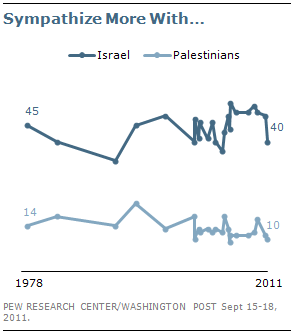
Views similarly fall along partisan lines when respondents are asked with which population they sympathize more. On the whole, 40% of Americans say they sympathize more with Israel, as compared with 10% who sympathize more with Palestinians; 21% say they do not sympathize with either side; and 25% express no opinion. The percentages are nearly unchanged since 1978.Far more Republicans (62%) sympathize with Israel than with Palestinians (4%), especially when compared to other partisan groups. 27% of Democrats sympathize with Israel and 15% with Palestinians; and among independents, 41% sympathize more with Israel than Palestinians (10%).

The report also addresses the "low visibility of the Israel-Palestinian dispute." According to the Pew Research Center’s Project for Excellence in Journalism (PEJ), coverage of the issue has been limited. Pew writes: "Last week, less than 2% of all news coverage was devoted to the debate over Palestinian statehood, far less than the amount of coverage devoted to the U.S. economy (20%) or the 2012 presidential campaign (12%)."

The survey was conducted in anticipation of the planned UN debate on Palestinian statehood this week.

NH cf

Pew: Public Divided on Significance of August 2 Debt Limit Deadline, Potential Consequences

According to a July 15-17 survey conducted by the Pew Research Center for the People & the Press, the public is divided on the importance of the August 2 deadline to raise the debt limit. Forty percent of those polled say that - based on what they've read and heard - it is "absolutely essential that the federal debt limit be raised by Aug. 2 to avoid an economic crisis," but 39% believe the deadline could come and go "without major economic problems."

Opinions on the subject are correlated to partisan affiliation: while 53% of Republicans believe the deadline could pass without major problems and 30% take the opposite opinion, the percentages are reversed among Democrats; 56% of Democrats believe raising the debt limit is essential, while only 28% do not. A plurality of independents (43%) say the deadline could pass without major economic problems. Republicans who agree with the Tea Party were most likely (65%) to say the deadline could pass without major problems. Interestingly, "the degree of attention to this issue has only a modest relationship with peoples’ impressions of the seriousness of the Aug. 2 deadline." Both those who are following the issue closely and those who are following it less closely are divided on the importance of the deadline.

NH cf

As Shuttle Program Nears End, Majority of Americans See U.S. Leadership in Space as Essential

A timely survey conducted by the Pew Research Center for the People & the Press shows that 58% of Americans believe it is essential that the U.S. continues to be a leader in space exploration. The U.S. space shuttle program begins its final mission today, thirty years after the first shuttle, Columbia, was sent out in 1981. A majority of those polled (55%) say the shuttle program was a good investment, a healthy percentage but lower than figures in the 1980s, when sixty percent or more believed it was a good investment.Majorities across demographic groups believe continued U.S. space exploration is essential. This holds true for partisan groups as well, although a higher percentage of Republicans (67%) believe it is essential, as compared with independents (57%) and Democrats (54%).
Those with a higher level of education are more likely to view the space shuttle program as a good investment. Approximately two-thirds of college graduates (66%) say it was a good investment, along with 57% of Americans with some college education. The percentage drops among those with lower levels of education, with 47% of Americans with no college education saying the program was a good investment, as compared with 43% who say it was not.

Wealthier families--those with annual incomes of $75,000 or more--are more likely to evaluate the program favorably: 67% of those families say it was a good investment, compared with only 27% who say it was not. Families with incomes under $30,000 per year are more divided in their evaluations, with 44% viewing the program favorably and 47% unfavorably.And while large majorities say the space shuttle program "helped encourage interest in science, led to scientific advances and contributed to feelings of patriotism...no more than about four-in-ten say that the program has contributed 'a lot' in any of these areas."

NH cf

Does The United States Stand Above All Other Countries?

A recent survey done by the Pew Research Center shows that most people think that the U.S. is among the greatest countries in the world, and 38% believe that the U.S. is the best country in the world. This belief is most common among those 65 and older and among Republicans. Those who are less educated are also slightly more likely to think that the U.S. is better than other countries. Most 18-29-year-olds, Democrats, and Independents believe that the U.S. is among the greatest countries in the world, but not above all others.

When this data was broken down by political affiliation, they found a lot of variation in how different political groups view the United States. Staunch conservatives are the only group where a clear majority believes that the U.S. is better than other countries. This is in stark contrast to the solid liberals, where only 19% believe that the U.S. stands above other countries. Other groups are move divided on the issue, but most groups believe that the U.S. is among the best.

sr cf

More Americans Concerned about Raising Debt Limit than Government Default

More Americans fear the consequences of raising the debt limit than a potential government default, according to the most recent national survey conducted by the Pew Research Center for the People & the Press and The Washington Post from May 19-22. 48% of Americans say their greater concern is that raising the debt limit would increase government spending and lead to higher debt, as compared with 35% who say their greatest concern is that not raising the debt limit would lead to a government default and hurt the economy.

An even larger majority (60%) of Republicans fear more that raising the debt limit would lead to higher spending and a larger national debt, and 49% of independents share that view, with only 34% more concerned about a potential government default. Among individuals who identify as Democrats, however, 48% say their main concern is a government default, compared with 38% who take the opposite stance.But despite most Americans' willingness to take a stance on the issue, survey results show that the debt debate has not resonated with many of them. Only 25% of Americans say they have heard a lot about the debate, with 38% saying they have heard a little and 37% nothing at all. And many Americans do not claim to have a strong understanding of the issue's consequences:"Half of Americans (50%) say they feel like they understand the possible implications of not raising the debt limit very well (18%) or fairly well (32%), though nearly as many (47%) say they do not have a good understanding of what would happen if the debt limit is not raised."

And although more Americans say of greater concern is increasing the debt limit, large majorities fear both the consequences of raising the debt limit and failing to raise it. 77% say they are somewhat or very concerned that raising the debt limit would lead to higher spending and debt, while 73% say they are somewhat or very concerned that not raising the limit would cause the government to default and the economy to falter.
Republicans appear to feel more strongly about the issue than Democrats: 61% of Republicans say they are very concerned about raising the debt limit, as compared with 48% of Democrats who say they are very concerned that not raising the debt limit would lead to a government default.

NH cf
Link

Pew Survey Finds Majority Believes Homosexuality Should Be Accepted, Increasing Percentage in Favor of Gay Marriage

According to the Pew Research Center for the People & the Press, a majority of Americans (58%) believe homosexuality should be accepted, and not discouraged, by society. This finding becomes magnified the younger the survey population, with 63% of those under 50 years of age and 69% of individuals under 30 years of age saying that society should accept homosexuality. Among those older than 50 years of age, a smaller majority (52%) agrees that it should be accepted.

And although a majority of Americans do not favor gay marriage today, the survey shows increased support for the cause, with the 45% today who favor gays and lesbians being legally allowed to marry a large increase from the 35% who took that stance in April 2009. 46% of those surveyed said they were against same-sex marriage, 1% more than those in favor but noticeably less than the 54% who were against same-sex marriage in April 2009. The Pew Center writes: "Opposition to gay marriage has fallen by 19 points (from 65%) since 1996."

Opposition to gay parenting has also fallen in recent years, with the 35% today who say more gay parents is a bad development for society a big decrease from the 50% who viewed the trend negatively four years ago.Although majorities across most demographic groups were found to support societal acceptance of homosexuality, views toward homosexuality were found to differ significantly based on an individual's religious and political preferences, as well as his/her race and gender. While 67% of Democrats and 63% of independents say homosexuality should be accepted, only 40% of Republicans share that opinion.

And while 79% of the religiously unaffiliated, 66% of white Catholics, and 65% of white mainline Protestants believe homosexuality should be accepted, percentages are smaller among other religious groupings. Only 29% of white evangelical Protestants believe homosexuality should be accepted, while 63% believe it should be discouraged by society.

Among races, Hispanics (64%) and whites (58%) were found to be more supportive of homosexual acceptance than African Americans (49%). With regard to gender, women (64%) are more accepting than men (52%).

Findings are from the Pew political typology survey, released earlier this May.

NH cf

Blog Archive