CFP: Cuius Regio, Eius Religio

[We have the following CFP, from Gabriela Grochola, "Leader of the Section of State and Law History, Students Learned Society," Jagiellonian University.]

Jagiellonian University. Collegium Maius. Assembly Hall.  Credit
I am writing to give you information on an international conference Cuius regio, eius religio – history of relationship between Church and State, 14-15th December, 2013. The event is organized by employers, PhD students and members of the Student Learned Society of the Faculty of Law and Administration at the Jagiellonian University.  We would like to invite young researchers of law and the history of law: graduate students, PhD students and PhD graduates. Applications for the conference should be received until the 17th November 2013 on an application form and should include a short summary of main theses (maximum 300 words; methodology, bibliography). The applications will be verified and subsequently a response will be send. What is essential, the positive decision is required to make a payment. A presentation cannot take longer than 20 minutes and texts for publishing cannot exceed the length of 20000 characters. Two languages will be used during the conference: Polish and English. An edited book, composed of verified texts, is expected to be published, likewise antecedent events.

We provide participants with one meal during the conference.  A conference fee is fixed at 70 zlotys (PLN)/18 (euro). Accommodation is not included, nevertheless help with finding hotel or hostel will be provided. Bank account number will be attached to the response to your application.  For more information please contact us via e-mail: konferencjakrakow@gmail.com.  We strongly invite you to come to Krakow.

"Saving the Neigborhood": A Conference at Arizona

We have an announcement of a conference on Richard Brooks and Carol M. Rose’s Saving the Neighborhood: Racially Restrictive Covenants, Law and Social Norms, to be held at the University of Arizona College of Law, in Tucson, Arizona, on January 31, 2014.  Moderators are Robert Glennon and Brent White.  Featured panelists include Robert Gordon, Lani Guinier, Gabriel "Jack" Chin, Risa Goluboff. Gerald Torres, and Price Fishback.  Space is limited; register here.

Richard Bernstein on Thomas Jefferson's Quran: How Islam Shaped the Founders

R.B. Bernstein (New York Law School) has published a review of Denise A. Spellberg’s Thomas Jefferson’s Qur’an: Islam and the Founders in the Daily Beast.  The book is "enlightening," Bernstein
concludes. The author shows that "leading figures as Thomas Jefferson, James Madison, and George Washington spurned exclusionary arguments, arguing that America should be open to Muslim citizens, office-holders, and even presidents."

New Release: "Between Court and Confessional: The Politics of Spanish Inquisitors"

New from Cambridge University Press: Between Court and Confessional: The Politics of Spanish Inquisitors, by Kimberly Lynn. A description from the Press:
Between Court and Confessional explores the lives of Spanish inquisitors, closely examining the careers and writings of five sixteenth- and seventeenth-century inquisitors. Kimberly Lynn considers what shaped particular inquisitors, what kinds of official experience each accumulated, and to what ends each directed his acquired knowledge and experience. The case studies examine the complex interplay of careerism and ideological commitments evident in inquisitorial activities. Whereas many studies of the Spanish Inquisition tend to depict inquisitors as faceless and interchangeable, Lynn probes the lives of individual inquisitors to show how inquisitors' operations in their social, political, religious, and intellectual worlds set the Inquisition in motion. By focusing on specific individuals, this study explains how the theory and regulations of the Inquisition were rooted in local conditions, particular disputes, and individual experiences.
A few blurbs:
"The Inquisitor is a figure engulfed in myth, yet about whom very little is actually known. Kimberly Lynn sets the record straight in this thoroughly researched and well-written book. Showcasing individual portraits of five inquisitors from different parts of the early modern Hispanic empire, she offers a lively and convincing composite biography of a unique - and uniquely complex - figure poised between medieval theocracy and modern bureaucracy." -- James S. Amelang, Universidad Autónoma, Madrid

"This outstanding piece of scholarship demonstrates how little the Spanish inquisitors fit the conventional view of them as insular men in single-minded pursuit of heresy. In a series of exacting and illuminating portraits, Kimberly Lynn reveals them in the full range of their activities, engaged in turf battles, jostling for position at court, moving from post to post, suffering career setbacks and disappointments, and seeking patronage and bestowing patronage - that is, negotiating the complex power structures of early modern Spain like other members of the power elite." -- Miriam Bodian, the University of Texas at Austin 

The Pinkas of the Metz Rabbinic Court, 1771-1790

The Center for Jewish History and YIVO Institute for Jewish Research, 15 West 16th Street, New York, NY 10011, announce a symposium, Hidden from History: The Pinkas of the Metz Rabbinic Court, 1771-1790: Issues and Offshoots, convened by Jay R. Berkovitz, University of Massachusetts, Amherst.
Largely unknown to historians, the much-neglected records of rabbinic courts represent an unusually rich source for the study of the early modern family, community, social and economic life, and jurisprudence. With the approaching publication of the Pinkas of the Metz Beit Din, and following the recent appearance of the Frankfurt rabbinic court diary, “Hidden from History” will explore the range of issues that came before rabbinic courts in the last third of the eighteenth century and the implications of these records for the construction of memory and historical narrative.
Schedule and contacts after the jump.

Read more »

Sunday Book Roundup

This week, the 50th anniversary of the March on Washington brought with it several book reviews on race in America.

NPR has put together a list of "books that bring the civil rights movement to life" here, including two of my favorites - Anne Moody's Coming of Age in Mississippi (Random House, 1992) and the edited volume of personal accounts, Hands on the Freedom Plow: Personal Accounts by Women in SNCC (University of Illinois Press, 2012).

The Washington Post's Jonathan Yardley reviews William P. Jones's The March on Washington: Jobs, Freedom, and the Forgotten History of Civil Rights (Norton). Yardley writes,
"This is the central theme of “The March on Washington”: The powerful economic impulses of the march have been lost to view as historians emphasize the eloquence of King’s speech and its effect on the political climate as the country moved to address the questions of basic civil rights and opportunities that he articulated. Initially the march’s organizers demanded “federal jobs creation, raising the minimum wage, a Fair Employment Practice law, and support for [President John F.] Kennedy’s civil rights bill,” demands that “expanded as new groups joined.”"

This week there are also several reviews of For Discrimination: Race, Affirmative Action, and the Law (Pantheon) by Harvard Law Professor Randall Kennedy, including a lengthy L.A. Times review, a Washington Post review, and a Wall Street Journal review for subscribers.

H-Net has a review of Emily West's Family or Freedom: People of Color in the Antebellum South (University Press of Kentucky), which makes use of enslavement petitions to examine antebellum race and status relationships in the South.

Lewie Reece has tackled two books in a H-Net review titled, "The Lincoln Theme in the Twenty-First Century." The reviewed books are Michael Burlingame's Lincoln and the Civil War (Southern Illinois University Press) and Mark E. Neely's Lincoln and the Triumph of the Nation: Constitutional Conflict in the American Civil War (University of North Carolina Press).  Reece writes:

These two books serve as a reminder that the Lincoln theme, far from being exhausted, continues to be explored in new ways by historians. Pure biography remains a subject of lively interest, but so do efforts to connect Lincoln to issues related to antislavery and the Civil War. Additionally, several works are but marginally connected to history, and instead examine the ongoing impact Lincoln had, and continues to have, on American culture. Moreover, as these two volumes suggest, academic historians continue to widen the parameters of our understanding of Lincoln. 
Mark Neely and Michael Burlingame have written widely not only about Lincoln, but Civil War America as well. Their approach in these volumes is different, yet similar. Neely presents a constitutional and legal history of the Civil War which, despite the title, is only partly about Lincoln. Burlingame has written a compressed history of Lincoln’s presidency and its influence on the Civil War. Both works reveal these historians’ impressive scholarship and wide reading in manuscript sources; both provide insight into the subject. It takes courage to try and do something different and provocative, and both men are to be commended for seeking new approaches.
 n+1 reviews Walter Johnson's River of Dark Dreams: Slavery and Empire in the Cotton Kingdom (Harvard University Press).

Other reviews of interest include Washington Post's review of Higher Education in America (Princeton University Press) by Derek Bok.

HistoryToday asks "How could the first nation to cleave church from state remain so pious?"as it reviews The Creation of the American Soul: Roger Williams, Church and State, and the Birth of Liberty (Duckworth) by John Barry.

The New York Times reviews A Wild Justice: The Death and Resurrection of Capital Punishment in America (Norton) by Evan J. Mandery. (Previously mentioned in the Aug. 18 Book Roundup.)

And Salon has published an excerpt from Estelle B. Freedman's Redefining Rape: Sexual Violence in the Era of Suffrage and Segregation (Harvard University Press).

Weekend Roundup

    David Garland (credit)
  • Over at the Faculty Lounge, Roman Hoyos, reflecting upon Sally Gordon's post on legal historians and the hiring market and an accompanying comment, points out that among our attractions for law faculties is our interest in teaching a variety of high-traffic and required courses.
  • The Law Librarians at the Library of Congress have put together a useful Beginner's Guide to researching Congressional debates.
  • Over at the New Books in Law podcast, David Garland, NYU Law, discusses his book Peculiar Institution: America’s Death Penalty in an Age of Abolition (Harvard University Press, 2010).
Weekend Roundup is a weekly feature compiled by all the Legal History bloggers.

Religious Toleration: The View from Rhode Island

[We have the following conference announcement:]

The Spectacle of Toleration: Learning from the Lively Experiment [is a] conference planned for October 3 – 6, 2013, in Newport and Providence, Rhode Island, organized by the Newport Historical Society, the Rhode Island Historical Society, the Pell Center for International Relations and Public Policy, Salve Regina University, the George Washington Institute for Religious Freedom, the John Carter Brown Library, and Brown University to mark the 350th anniversary of the 1663 Rhode Island Charter.

What is religious toleration? What are its functions, effects, and limits in society? How has it manifested (or not) around the world in human history?

The 1663 Rhode Island Charter stipulated that no person “shall bee any wise molested, punished, disquieted, or called in question, for any differences in opinione in matters of religion.” This charter famously ignited the “lively experiment” that both reflected and shaped religious and political developments in the early modern world and has continued to influence global conversations about the role of toleration and religious freedom. The 350th anniversary of this charter provides a timely point of entry into a thoughtful consideration of a far larger set of questions about religious freedom in particular historical and present day contexts.

Read more »

Growth of the Nonreligious

The new, nationwide survey by the Pew Research Center’s Forum on Religion & Public Life of 4,006 adults conducted March 21-April 8, 2013, asked Americans whether having "more people who are not religious" is a good thing, a bad thing, or doesn't matter for American society.  About half of Americans say the growing number of "people who are not religious" is bad for American society.


Fully a third of U.S. adults say they do not consider themselves a "religious person." And two-thirds of Americans say religion is losing its influence in Americans’ lives. Many more say the growing number of "people who are not religious" is bad than good (48% versus 11%). But about four-in-ten (39%) say it does not make much difference. Even among adults who do not identify with any religion, only about a quarter (24%) say the trend is good, while nearly as many say it is bad (19%); a majority (55%) of the unaffiliated say it does not make much difference for society.


Members of all the major U.S. religious groups with large enough samples for analysis are more inclined to see this development as a bad than good thing for society. White evangelical Protestants are especially likely to say the growing number of people who are not religious is a bad thing, with nearly eight-in-ten (78%) holding this view. Majorities of black Protestants (64%) and white non-Hispanic Catholics (56%) say the same. Fewer than one-in-ten in each of the three groups says this trend is a good thing for society.

The balance of opinion also is lopsided among white mainline Protestants, among whom 45% say the increase in those who are not religious is a bad thing, just 6% say it is a good thing, and 46% say it doesn't make much difference for society.


Among Hispanic Catholics, 36% say it is bad for society, 11% say it is good for society, and about half (48%) say the trend does not matter.

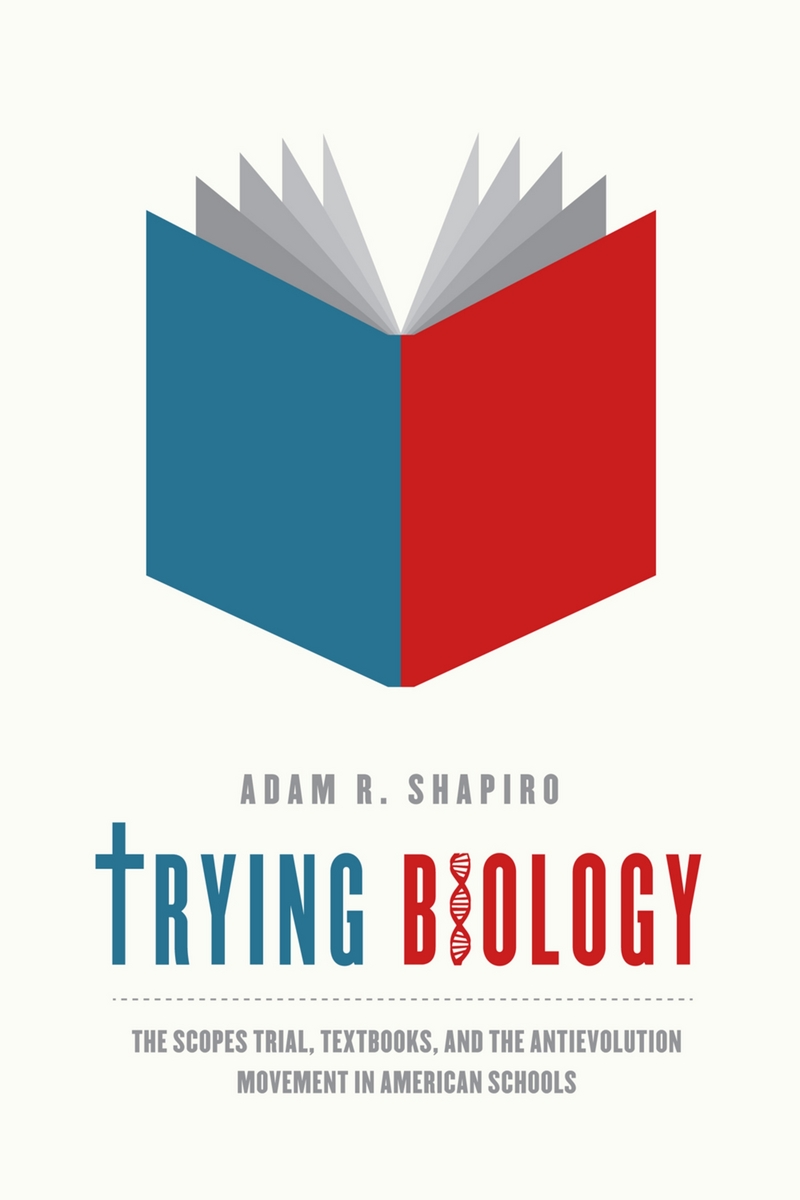
New Release: Shapiro, "Trying Biology: The Scopes Trial, Textbooks, and the Antievolution Movement in American Schools"

New from the University of Chicago Press, Adam R. Shapiro, Trying Biology: The Scopes Trial, Textbooks, and the Antievolution Movement in American Schools (2013). Here's a description from the Press:
In Trying Biology, Adam R. Shapiro convincingly dispels many conventional assumptions about the 1925 Scopes “monkey” trial. Most view it as an event driven primarily by a conflict between science and religion. Countering this, Shapiro shows the importance of timing: the Scopes trial occurred at a crucial moment in the history of biology textbook publishing, education reform in Tennessee, and progressive school reform across the country. He places the trial in this broad context—alongside American Protestant antievolution sentiment—and in doing so sheds new light on the trial and the historical relationship of science and religion in America.

For the first time we see how religious objections to evolution became a prevailing concern to the American textbook industry even before the Scopes trial began. Shapiro explores both the development of biology textbooks leading up to the trial and the ways in which the textbook industry created new books and presented them as “responses” to the trial. Today, the controversy continues over textbook warning labels, making Shapiro’s study—particularly as it plays out in one of America’s most famous trials—an original contribution to a timely discussion.
More information is available here.

Sharia Law


In a recent article in The Economist, a new study by the Pew Research Center reported on the different meaning that sharia law has in different countries. Sharia law is the moral code and religious law of Islam. The survey of 38,000 Muslims conducted in 39 countries examined the opinions that Muslims in predominately Islamic nations expressed on a number of issues related to sharia law, such as religious freedom, the use of religious judges, and the execution of those who leave Islam.

In Morocco 78% of respondents think that non-Muslims are free to practice their faith and 79% of those think this is “a good thing.” Yet 83% of this group wants sharia enshrined in their nation’s law. A majority of Thais (77%) and Pakistanis (84%) yearn for Islamic law too. But most also say that other religions are free to worship (79% and 75% respectively) and they agree that this is “a good thing.” Religious freedom, however, is a slippery term, with implications for individuals and for the collective practice of faith. Muslims in some countries both strongly approve of religious freedom and support the death penalty for apostates from Islam. Three-quarters of Pakistanis who favor sharia agree.  

Views vary over how sharia should be applied. Tunisian backers when asked about specific features of sharia law, support the use of religious judges (62%), but have far less appetite for executing apostates (29%). And those countries where most support sharia are not always its strictest followers, though around three-quarters endorse it in both Indonesia and Egypt. And 74% of Egyptians who favor sharia also think it should apply to non-Muslims, the highest proportion among polled countries. To read the full report, please visit The Pew Forum on Religion and Public Life.

Conference: New World(s) of Faith: Religion and Law in Historical Perspective, 1500-2000

Today and tomorrow the University of Pennsylvania Law School hosts a mini-conference on "New World(s) of Faith: Religion and Law in Historical Perspective, 1500-2000." The event is co-sponsored by the University of Pennsylvania Department of History; the American Society for Legal History; the University of Michigan Law School; the University of Chicago Law School; the University of Minnesota Law School and Department of History; and the University of Illinois School of Law. Here's the line-up:

June 12:
Faith and Outsiders in Spanish America
Kif Augustine-Adams, Brigham Young University
Counting Chinese in a Catholic Country: The 1930 Mexican Census and Religious Difference

Orlando Rivero-Valdés, University of Pittsburgh
Afro-Cuban Religions and Brujería in Post-Colonial Cuba, 1898-1938

Commentators: TBA
Keynote Address and Reception
Dylan Penningroth, Northwestern UniversityFaith and Property in African American History 
June 13:
Faith and Freedom in Nineteenth Century United States
Abigail Cooper, University of Pennsylvania
“A Mere Form”: Marriage Rites and Lived Religion in the Refugee Camps of the American Civil War
Lucas Volkman, University of Missouri
Turmoils and Temporalities: The Slavery Question and Church Property Disputes in Missouri

Christopher Tomlins, University of California, Irvine
Debt, Death, and Redemption: Toward a Soterial-Legal History of the Turner Rebellion

Commentators: William Novak, University of Michigan
Faith and Citizenship in a Secular Polity
Winston Bowman, Brandeis University
A Civil Death: Mormon Disenfranchisement in the Mountain West

Kellen Funk, Princeton Univeristy
“This Stone Which I Erect Shall Be a House of God”: Disestablishment and Religious Corporations in New York, 1784-1854

Jeffrey Perry, Purdue University
“For the Peace of Society”: Baptist Church Discipline and Legalities in Early Kentucky

Commentators: Sarah Barringer Gordon, University of Pennsylvania
Faith and Government in Modern America
Kathleen Holscher, University of Minnesota
School Prayer, Bible Reading, and the Catholic Vocabulary of Religious Freedom in Mid-Century America

Ronit Stahl, University of Michigan
Basic Training: The Unintentional Consequences of the Education Requirements for Military Chaplains

Commentators: Barbara Young Welke, University of Minnesota

Sirico on Franklin and Prayer at the Federal Convention

Louis J. Sirico, Jr., Villanova University School of Law, has posted Benjamin Franklin, Prayer, and the Constitutional Convention: History as Narrative.  Here is the abstract:

Credit: Library of Congress
Anecdotes from the Convention continue to inform contemporary discussions on the Constitution’s meaning. This article discusses an anecdote from the Convention that shows how history and false history shape our laws and cultural traditions.

The article focuses on Benjamin Franklin’s proposal to hire a chaplain and begin each day with a prayer. The Convention deputies showed little interest in the proposal, and it died aborning. However, decades later, a fictional version emerged in which Franklin’s proposal succeeded and saved the Convention from collapse.

The factual and mythical Franklin prayer narratives offer us the opportunity to examine their history and rhetorical use in arguing for integrating religion into America’s public life. This examination also offers the opportunity to reflect on how advocates can use history to fashion a persuasive argument. The history of the narrative demonstrates how writers, government officials, lawyers, and judges have employed it to further their own purposes. As for the continuing popularity of the story, Franklin and the archetype he personifies play a critical role in making the narrative persuasive. And as the narrative shows, histories, both factual and mythical, can support persuasive narrative arguments.

Lytton's "Kosher"

Timothy D. Lytton, the Albert and Angela Farone Distinguished Professor of Law at Albany Law School, has published Kosher: Private Regulation in the Age of Industrial Food, with the Harvard University Press.
Generating over $12 billion in annual sales, kosher food is big business. It is also an unheralded story of successful private-sector regulation in an era of growing public concern over the government’s ability to ensure food safety. Kosher uncovers how independent certification agencies rescued American kosher supervision from fraud and corruption and turned it into a model of nongovernmental administration.

Currently, a network of over three hundred private certifiers ensures the kosher status of food for over twelve million Americans, of whom only eight percent are religious Jews. But the system was not always so reliable. At the turn of the twentieth century, kosher meat production in the United States was notorious for scandals involving price-fixing, racketeering, and even murder. Reform finally came with the rise of independent kosher certification agencies which established uniform industry standards, rigorous professional training, and institutional checks and balances to prevent mistakes and misconduct.

In overcoming many of the problems of insufficient resources and weak enforcement that hamper the government, private kosher certification holds important lessons for improving food regulation, Timothy Lytton argues. He views the popularity of kosher food as a response to a more general cultural anxiety about industrialization of the food supply. Like organic and locavore enthusiasts, a growing number of consumers see in rabbinic supervision a way to personalize today’s vastly complex, globalized system of food production.
A blurb:

Kosher is one terrific book. It’s a wonderfully entertaining account of the squabbles, finger-pointing, and cutthroat competition that turned kosher certification from scandalous corruption to a respectable—and highly profitable—business. Today, if a food is labeled kosher, it is kosher, which is more than can be said of most claims on food labels. You don’t have to be Jewish to appreciate the fun in Timothy Lytton’s presentation of an unusually successful case study in business ethics.—Marion Nestle, New York University, author of Food Politics

 Lytton discusses the subject here. TOC after the jump.
Read more »

CFP: Religious Studies 50 Years after Schempp

[We have the following call for papers.]

The Department of Religious Studies at Indiana University-Bloomington is hosting a conference entitled “Religious Studies 50 Years after Schempp: History, Institutions, Theory” the weekend of September 27-29, 2013.

Fifty years ago the Supreme Court of the United States announced its decision in Abington v Schempp, 374 U.S. 203 (1963). While the case before the Court concerned the constitutionality of mandatory Bible reading in Pennsylvania public schools, the opinions in the case have come to be understood as the authorizing texts for the academic study of religion in public colleges and universities across the U.S. and beyond. The Court wrote that while prescribing religious exercises in public schools violates the establishment clause of the First Amendment to the U.S. Constitution, “a study of comparative religion or the history of religion and its relationship to the advancement of civilization” could be said to be a necessary part of a complete education.

The years following the Schempp decision witnessed a flourishing of departments of religion in public colleges and universities and an intense conversation about the appropriate approach to the academic study of religion in the U.S. context. Now, fifty years later, the anniversary of the decision provides an occasion for an appraisal of Schempp’s role and for a broader assessment of the past, present, and future of the field of religious studies. This conference will explore the impact that Schempp may have had on the comparative and multi-disciplinary nature of the study of religion as well as other significant influences on shifts in the study of religion over that time.

We invite proposals for papers across the disciplines of religious studies. While Schempp provides a focal point for the conference, we invite conferees to propose 20-minute paper presentations that consider the broader history and phenomenology of the study of religion in the multiple locations in which such study takes place, private and public.

Three plenary speakers have been invited to focus our conversations:

Sarah Barringer Gordon, Arlin M. Adams Professor of Constitutional Law and Professor of History at the University of Pennsylvania Law School. Gordon is a widely recognized scholar and commentator on religion in American public life and the law of church and state.

Gerald J. Larson, Rabindranath Tagore Professor Emeritus of Indian Cultures and Civilization, Indiana University, Bloomington, and Professor Emeritus, Religious Studies, University of California, Santa Barbara. Larson, a prominent scholar of Indian religious traditions who helped to shape the study of religion at the University of Tennessee, UC Santa Barbara, and Indiana University, will offer reflections on the place of the study of Asian religions in the academic study of religion.

Charles H. Long, Emeritus Professor of Religious Studies at UC Santa Barbara, and former professor of religion at the University of Chicago, UNC Chapel Hill, Duke University, and Syracuse University. Long, a distinguished historian of religion and leading scholar in the study of American religion, had a direct influence on the development of the academic study of religion in the latter part of the twentieth century.

Applicants are invited to send a proposal with a title, a 300-word abstract, and a two-page CV to the following address by May 1, 2013. Applicants may submit their materials as Word attachments. Send to: Professor David Haberman, Department of Religious Studies, Sycamore 230, Indiana University, Bloomington, IN 47405; dhaberma@indiana.edu with a cc copy to kfrancoe@indiana.edu.

In order to keep track of numbers, we ask that attendees complete a brief registration form. Please download the form here.

The Changing Face of the Catholic Population Around the World

In light of the recently announced resignation of Pope Benedict XVI, the Pew Forum on Religion and Public Life published an analysis detailing how the distribution of Catholics has drastically changed over time. In 1910, 65% of the Catholic population could be found in Europe, while only 24% of Catholics resided in Latin America and the Caribbean, and less than 1% lived in Sub-Saharan Africa. By 2010, the Catholic population significantly decreased in Europe but increased in the developing world. As of 2010, 39% of Catholics lived in Latin America and the Caribbean, followed by 24% in Europe, and 16% in Sub-Saharan Africa. Interestingly, the distribution of Catholics has remained stable in North Africa and the Middle-East over the past 100 years. In 1910, less than 1% of Catholics resided in the Middle East-North African region, and a century later the percentage of Catholics in the region still remains under 1%.

Upon examining the percentage of Catholics within each region, the Pew Research Center also found that Catholics overwhelmingly dominated Latin America. Nearly 72% of the population in Latin America and the Caribbean is Catholic, followed by 35% in Europe, 26% in North America, 21% in Sub-Saharan Africa, 3% in the Asia-Pacific region, and 2% in the Middle East.

Chinese Leaving in Droves for Other Developed Nations


On October 31, the New York Times highlighted China's difficulties in keeping residents from emigrating to other developed nations. While China's economy has experienced robust economic growth in recent years, more and more Chinese continue to leave the nation in search of a new life.  The lack of religious freedom and the lure of a more liberated social and economic environment has driven an increasingly high number of Chinese out of the country. In 2010, 508,000 Chinese departed for one of the 34 developed countries that compose the Organization for Economic Cooperation and Development (OECD). The U.S. welcomed 87,000 permanent residents in 2011, up from 70,000 in 2010.  But this feeling of uncertainty and unrest is not a one-way street.  The lethargic recoveries hampering the economies in the West has driven Chinese students back home in droves. In 2011, the number of students returning to China was up 40% from the previous year. Even still, it appears China is experiencing a sort of "brain drain." The United States' investment-based green card program allows foreigners to obtain a green card if they invest over $500,000 into American businesses. Chinese citizens obtained well over 2,000 of these specialized permits, more than double the investment-based green cards of all other nationalities combined.  

Americans Lacking a Religious Affiliation on the Rise


The Pew Forum on Religion and Public Life reports that although the number of Americans who identify as Atheist or lack a religious affiliation has increased, many of them still believe in God. About 20% of US adults are either Atheist, Agnostic, or lack any religious affiliation. However, of the 46 million adult Americans who are unaffiliated, two-thirds report that they believe in God and one-fifth report that they pray on a daily basis.

Among those 65 and older, 90% are religiously affiliated. Among those 18-29, only 67% have a religious affiliation. Interestingly, the decline has not been uniform among all religions. Protestants have taken the largest hit. Between 1972 and 2010, there was an 11% dip in the number of adult Americans who identified as Protestant. However, those identifying as Catholic remained relatively stable during the same time period, with 26% identifying themselves as Catholic in 1972 compared to 25% in 2010. Moreover, the rise in the number of Americans who identify as religiously unaffiliated could have major implications for future elections. Americans who lack a religious affiliation tend to lean Democrat, with nearly 63% of those registered to vote reporting that they are either Democrat or lean towards the party.

Religious Belief and Crime


In a study covering 67 countries conducted by Azim Shariff at the University of Oregon and Mike Rhemtulla at the University of Kansas, the authors compared crime rates to the proportion of citizens who believed in heaven versus hell.  Citizens of the various countries were asked if they believed in either heaven or hell, and the researchers subtracted the percentage of heaven-believers by the percentage of hell-believers; the following remainder represented the country’s “rate of belief.”  Shariff and Rhemtulla found that a higher rate of belief predicted higher crime rates.  Researchers suggested that the comfort of heaven without the possibility of eternal punishment in hell compels one to commit further wrongdoings.  In Monday’s daily chart, The Economist compiled the data into a graph to display the connection between the two variables.  Countries with low crime rates and low rates of belief more often than not fell in the Middle Eastern and Asian regions, while countries in South America tended to possess higher crime rates and rates of belief.

The Religious Diversity of Asian Americans


The Pew Forum On Religion and Public Life’s publication on Asian American religious affiliations illustrates the wide variety of faiths amongst the Asian demographic.  42 percent of Asian Americans are Christian, an additional 14% are Buddhist, and one in ten practice Hinduism.  Over a quarter of Asians are also religiously unaffiliated.  Inspecting Asian-American subgroups further displays the wide range of beliefs.  For instance, 65% of Filipino Americans are Catholic, 43% of Vietnamese Americans are Buddhist, and 61% of Korean Americans are Protestant. Additionally, one-third of Asian adults no longer ascribe to the religious group of their upbringing.

Blog Archive