More.The inner city deserves a disaster relief plan,” wrote Reverend Jesse Jackson, on the eve of Detroit’s bankruptcy filing and in the wake of Hurricane Sandy. The storm-ravaged coastal communities “all deserve[d] aid,” Jackson emphasized, but in cities around the country a “disaster” was unfolding that was “equally devastating, equally beyond anyone’s fault, and yet essentially ignored at the national level.”1 Readers may disagree about the merits of the analogy or the wisdom of Jackson’s proposal, but the structure of the argument should surprise no one—at least not after reading Michele Landis Dauber’s important new book, The Sympathetic State.
Tani's Jotwell Review of Dauber's "Sympathetic State"
My LHB coblogger Karen Tani has posted on Jotwell a review of Michele Landis Dauber's The Sympathetic State: Disaster Relief and the Origins of the American Welfare State (University of Chicago Press, 2012). It commences:


Sunday Book Roundup
There's also a review of MacArthur's War: The Flawed Genius Who Challenged the American Political System (Berkley) by Bevin Alexander.
The New York Times reviews The Great Escape: Health, Wealth, and the Origins of Inequality (Princeton University Press) by Angus Deaton.
The NYT also takes a look at a few books--including Robert M. Fogelson's The Great Rent Wars: New York, 1917-1929 (Yale University Press)--in a piece titled, "Landlord vs. Tenant: When It All Began."
The LA Review of Books has a thoughtful essay about Karen E. Fields and Barbara J. Fields's Racecraft: The Soul of Inequality in American Life (Verso).
And the LA Times looks at Richard A. Serrano's Last of the Blue and Gray: Old Men, Stolen Glory, and the Mystery that Outlived the Civil War (Smithsonian).
"Serrano, a staff writer in the Los Angeles Times' Washington, D.C., bureau, starts with two main characters: former Union soldier Albert Woolson and onetime rebel soldier Walter Washington Williams. Each man forms a compelling story of becoming caught up in the nation's bloodiest war and its aftermath. By the late 1950s, as the United States neared the centennial of the start of the war, each was feted as the oldest living veteran of his respective army.

But one was a fraud, a scam that would have gone undetected had he not outlived all of his fellow Confederate veterans.
There's not a lot of suspense here. It becomes clear pretty quickly which was the real deal and which a fraud. But suspense isn't the point. Serrano uses the men as a window into the long-playing reverberations of the Civil War, from the reunions to the reenactments to the wounds covered with, in retrospect, tissue paper."
And H-Net adds reviews of three edited volumes of interest, including Knowledge and Power: Essays on Politics, Culture, and War (Society for the Promotion of Science and Scholarship) edited by Bruce A. Thompson, Carolyn Halladay, and Donald Abenheim (here); Joel Isaac and Duncan Bell's Uncertain Empire: American History and the Idea of the Cold War (Oxford University Press) (here); as well as Willibald Steinmetz, Ingrid Gilcher-Holtey, and Heinz-Gerhard Haupt's Writing Political History Today (Campus Verlag) (here).
The Selected Letters of Learned Hand
Recently published by the Oxford University Press is Reason and Imagination: The Selected Correspondence of Learned Hand, edited by Constance Jordan, with a preface by the late Ronald Dworkin. Here is the press’s description:
Preface, Ronald Dworkin
Introduction, Constance Jordan
Prologue: A Better Social Philosophy, 1897-1908
Part I: The United States and Europe, 1909-1920
Part II: In for Democracy, 1921-1931
Part III: World War and World Power, 1932-1946
Part IV: The Bill of Rights, 1947-1958
Epilogue: "Pagan and Puritan," 1959-1961
Here is the TOC:Judge Learned Hand is an icon of American Law. Though he was never nominated to our country's highest court, Hand is nevertheless more frequently quoted by legal scholars and in Supreme Court decisions than any other lower court judge in our history. He was the model for all judges who followed him, setting the standard for the bench with a matchless combination of legal brilliance and vast cultural sophistication.
Hand was also renowned as a superb writer. Now, in Reason and Imagination, Constance Jordan offers a unique sampling of the correspondence between Hand and a stellar array of intellectual and legal giants, including Justice Oliver Wendell Holmes, Theodore Roosevelt, Walter Lippmann, Felix Frankfurter, Bernard Berenson, and many other prominent political and philosophical thinkers. The letters--many of which have never been published before--cover almost half a century, often taking the form of brief essays on current events, usually seen through the prism of their historical moment. They reflect Hand's engagement with the issues of the day, ranging from the aftermath of World War I and the League of Nations, the effects of the Depression in the United States, the rise of fascism and the outbreak World War II, McCarthyism, and the Supreme Court's decisions on segregation, among many other topics. Equally important, the letters showcase decades of penetrating and original thought on the major themes of American jurisprudence, particularly key interpretations of the First, Fifth, and Fourteenth Amendments, and will thus be invaluable to those interested in legal issues.
Most of these letters have never before been published, making this collection a priceless [sic; it costs $39.95] window into the mind and life of one of the giants of American law.
Preface, Ronald Dworkin
Introduction, Constance Jordan
Prologue: A Better Social Philosophy, 1897-1908
Part I: The United States and Europe, 1909-1920
Part II: In for Democracy, 1921-1931
Part III: World War and World Power, 1932-1946
Part IV: The Bill of Rights, 1947-1958
Epilogue: "Pagan and Puritan," 1959-1961
Symposium on Tomlins, "The State and the Unions"
Labor History recently published a symposium in honor of the twenty-fifth anniversary of The State and the Unions, by Christopher L. Tomlins (UC Irvine). The articles are available only to subscribers, but the introduction, by Craig Phelan, is open access, as are the abstracts.
 Here, for example, is the abstract for the contribution by Jean Christian Vinel (Université Paris Diderot) (whose book, The Employee, we mentioned earlier this week):

The thrust of this article is to review the evolution of the historiography of American labor law since the publication of Christopher Tomlins' widely celebrated The State and the Unions (1985). More than an isolated effort, Tomlins' critique of New Deal labor law was part of a broader analytical paradigm which should be called the ‘critical synthesis’. Dominating the field until the mid-1990s, the critical synthesis owed a part of its success to the crisis of labor history. Then, it gradually receded as labor unions continued their steep decline and historians of labor rekindled their faith in American liberalism and the Democratic Party. In analyzing the rise and fall of the critical synthesis, the article thus lays bare all the factors – scientific, social, and political – that contribute to the making and unmaking of analytical paradigms in the political history of labor. Finally, in doing so, the article places the debate on the Employee Free Choice Act in historical perspective.Here is the abstract for Tomlins's response, titled "The State, the Unions, and the Critical Synthesis in Labor Law History: A 25-Year Retrospect":
This article responds to Jean-Christian Vinel’s assessment of the ‘critical synthesis’ whose proponents created labor law history as a new and flourishing field of scholarship in the decade after 1978. Vinel accords my book, The State and the Unions (1985) a key role in the development of this new field. Here, I situate my book in relation to the critical synthesis, and assess the capacity of critical legal scholarship to address the current parlous state of the U.S. labor movement. I look to current labor historians to engage with and build on the work that the labor law historians undertook.
Martin's "Rich People's Movements"
Tax resisters have had their historians, including Carolyn Jones, who contributed a chapter on Viven Kellems to a book I edited with Victor Jew. Now comes Isaac William Martin’s Rich People’s Movements: Grassroots Campaigns to Untax the One Percent (Oxford University Press). Here’s the description:
Introduction: The Riddle of Rich People's Movements
Chapter One: The Revolution of 1913
Chapter Two: Populism against the Income Tax
Chapter Three: The Sixteenth Amendment Repealers
Chapter Four: The Most Sinister Lobby
Chapter Five: The Power of Women
Chapter Six: The Radical Rich
Chapter Seven: Strange Bedfellows
Chapter Eight: The Temporary Triumph of Estate Tax Repeal
Conclusion: The Century of Rich People's Movements
Here’s the TOC:On tax day, April 15, 2010, hundreds of thousands of Americans took to the streets with signs demanding lower taxes on the richest one percent. But why? Rich people have plenty of political influence. Why would they need to publicly demonstrate for lower taxes-and why would anyone who wasn't rich join the protest on their behalf?
Isaac William Martin shows that such protests long predate the Tea Party of our own time. Ever since the Sixteenth Amendment introduced a Federal income tax in 1913, rich Americans have protested new public policies that they thought would threaten their wealth. But while historians have taught us much about the conservative social movements that reshaped the Republican Party in the late 20th century, the story of protest movements explicitly designed to benefit the wealthy is still little known. Rich People's Movements is the first book to tell that story, tracking a series of protest movements that arose to challenge an expanding welfare state and progressive taxation. Drawing from a mix of anti-progressive ideas, the leaders of these movements organized scattered local constituencies into effective campaigns in the 1920s, 1950s, 1980s, and our own era. Martin shows how protesters on behalf of the rich appropriated the tactics used by the Left-from the Populists and Progressives of the early twentieth century to the feminists and anti-war activists of the 1950s and 1960s. He explores why the wealthy sometimes cut secret back-room deals and at other times protest in the public square. He also explains why people who are not rich have so often rallied to their cause.
For anyone wanting to understand the anti-tax activists of today, including notable defenders of wealth inequality like the Koch brothers, the historical account in Rich People's Movements is an essential guide.
Introduction: The Riddle of Rich People's Movements
Chapter One: The Revolution of 1913
Chapter Two: Populism against the Income Tax
Chapter Three: The Sixteenth Amendment Repealers
Chapter Four: The Most Sinister Lobby
Chapter Five: The Power of Women
Chapter Six: The Radical Rich
Chapter Seven: Strange Bedfellows
Chapter Eight: The Temporary Triumph of Estate Tax Repeal
Conclusion: The Century of Rich People's Movements
New Release: Edited Collection on Substantive Law and Procedure in English Legal History
New from Cambridge University Press: Law and Legal Process: Substantive Law and Procedure in English Legal History, edited by Matthew Dyson (University of Cambridge) and David Ibbetson (University of Cambridge).
 The Press explains:
Read more »
 The Press explains:
This collection of papers from the Twentieth British Legal History Conference explores the relationship between substantive law and the way in which it actually worked. Instead of looking at what the courts said they were doing, it is concerned more with the reality of what was happening. To that end, the authors use a wide range of sources, from court records to merchants' diaries and lawyers' letters. The way in which the sources are used reflects the possibilities of legal historical research which are opening up in the twenty-first century, as large databases and digitised images – and even online auction sites – make it a practical possibility to do work at a level which was almost unthinkable only a short time ago.TOC after the jump.
Read more »
Vinel's Political History of "The Employee"
Jean-Christian Vinel, who teaches American history at Université Paris-Diderot, has recently published The Employee: A Political History, with the University of Pennsylvania Press. The book appears in the series Politics and Culture in Modern America, edited by Margot Canaday, Glenda Gilmore, Michael Kazin, and Thomas J. Sugrue.
Explains the press:
Read more »
Explains the press:
TOC and blurbs from Joseph McCartin, Nelson Lichtenstein, and Craig Becker after the jump.In the present age of temp work, telecommuting, and outsourcing, millions of workers in the United States find themselves excluded from the category of "employee"—a crucial distinction that would otherwise permit unionization and collective bargaining. Tracing the history of the term since its entry into the public lexicon in the nineteenth century, Jean-Christian Vinel demonstrates that the legal definition of "employee" has always been politically contested and deeply affected by competing claims on the part of business and labor. Unique in the Western world, American labor law is premised on the notion that "no man can serve two masters"—workers owe loyalty to their employer, which in many cases is incompatible with union membership.
The Employee: A Political History historicizes this American exception to international standards of rights and liberties at work, revealing a little known part of the business struggle against the New Deal. Early on, progressives and liberals developed a labor regime that, intending to restore amicable relations between employer and employee, sought to include as many workers as possible in the latter category. But in the 1940s this language of social harmony met with increasing resistance from businessmen, who pressed their interests in Congress and the federal courts, pushing for an ever-narrower definition of "employee" that excluded groups such as foremen, supervisors, and knowledge workers. A cultural and political history of American business and law, The Employee sheds historical light on contemporary struggles for economic democracy and political power in the workplace.

Read more »
Sunday Book Roundup

"Sometimes, in the absence of copyright, publishers have paid authors and have abstained from reprinting the books of authors they haven’t paid. Ulysses, by James Joyce, considered by some the greatest novel of the twentieth century, lost its copyright protection in America on a technicality soon after it was published. But from the 1930s to the ’90s, Joyce and his estate were paid royalties from its publication in America anyway, thanks to exactly this kind of happy anarchy. In his new scholarly book Without Copyrights, the legal and literary historian Robert Spoo tells the remarkable tale, which Spoo doesn’t necessarily deem a pretty one. Spoo rather sympathizes, in fact, with the character many observers would consider the villain."Salon publishes an excerpt of Thomas Jefferson's Qur'an: Islam and the Founders (Knopf) by Denise A Spellberg, and NPR reviews Jill Lepore's book about a Founding Father's sister, Book of Ages: The Life and Opinions of Jane Franklin (Knopf).
 H-Net adds several works this week, including one of Wolfgang Knobl and Hans Joas's War in Social Thought: Hobbes to the Present (Princeton University Press), another of Robert Cassanello's To Render Invisible: Jim Crow and Public Life in New South Jacksonville (University Press of Florida) (audio interview in last week's post), a third of Nancy Kollmann's Crime and Punishment in Early Modern Russia (Cambridge), and a fourth of Judy Tzu-Chun Wu's Radicals on the Road: Internationalism, Orientalism, and Feminism during the Vietnam Era (Cornell University Press).
"As its title suggests, Radicals on the Road uses the transpacific journeys of anti-Vietnam War activists as a window into radical American and Vietnamese politics and culture in the 1960s. Its principal claim is as multipronged as its intended audience and intervention: in the 1960s American and Vietnamese antiwar activists created a transnational political community, beyond the confines of any nation-state or locality, based on a sustained critique of U.S. policy in Asia."
Read more »
Folgelson's "Great Rent Wars"
We’ll be posting notices of a few legal history related books published this year that only recently have come to our attention. The first is Robert M. Fogelson’s The Great Rent Wars: New York, 1917-1929 (New Haven: Yale University Press, 2013). Here’s the publisher’s squib:
The contents and a preview are here.
Writes Elizabeth Blackmar, Columbia University, author of Manhattan for Rent, 1785–1850: "A powerful history of a remarkable contest over the governance of the housing market in New York City from World War I to the eve of the Great Depression. A highly original contribution to our understanding of American urban politics."Written by one of the country’s foremost urban historians, The Great Rent Wars tells the fascinating but little-known story of the battles between landlords and tenants in the nation’s largest city from 1917 through 1929. These conflicts were triggered by the post-war housing shortage, which prompted landlords to raise rents, drove tenants to go on rent strikes, and spurred the state legislature, a conservative body dominated by upstate Republicans, to impose rent control in New York, a radical and unprecedented step that transformed landlord-tenant relations.
The Great Rent Wars traces the tumultuous history of rent control in New York from its inception to its expiration as it unfolded in New York, Albany, and Washington, D.C. At the heart of this story are such memorable figures as Al Smith, Fiorello H. La Guardia, and Oliver Wendell Holmes, as well as a host of tenants, landlords, judges, and politicians who have long been forgotten. Fogelson also explores the heated debates over landlord-tenant law, housing policy, and other issues that are as controversial today as they were a century ago.

The contents and a preview are here.
Jones on "Narrating Slavery, Freedom, and the Haitian Revolution in Baltimore City"
Martha S. Jones (University of Michigan) has posted "The Case of Jean Baptiste, un Créole De Saint-Domingue: Narrating Slavery, Freedom, and the Haitian Revolution in Baltimore City," which was published in The American South and the Atlantic World (University Press of Florida, May 2013), edited by Brian Ward, Martin Bone, and William A. Link. Here's the abstract:
The story of the widow Volunbrun and her slaves might be told through differing analytic frames: empire, constitution making, anti-slavery constitution making, antislavery movements, political economy, high court pronouncements pronouncements, and biography.8 In this essay the answers lie in the intimate dynamics of a household and the lived experience of the enslaved people in it. Can we understand what the problem of slavery and freedom looked like for those enslaved people whose life itineraries were shaped by the meta-forces of commercial, political, and military conflict and exchange? Being enslaved in 1796 Port-au-Prince differed from being enslaved in 1801 New York City or 1818 Baltimore. Along this Atlantic itinerary, the Volunbrun slaves confronted new rules, rituals, and structures of power. Straining to adopt their perspective, we see the lived dimensions of slavery and law. We learn how enslaved people quietly navigated a complex matrix of courts, attorneys, and reformers. We will also see how the claims of Saint-Domingue's slaves in Maryland, making their lives at the intersection of the Haitian Revolution and an emerging domestic slave trade, shaped the parameters of Southern southern legal culture.The full chapter is available here.
Sunday Book Review Roundup
This week on H-Net, John Sbardellati's J. Edgar Hoover Goes to the Movies: The FBI and the Origins of Hollywood's Cold War (Cornell University Press) is reviewed.
"In J. Edgar Hoover Goes to the Movies, Sbardellati analyzes the FBI’s scrutiny of the film industry from the days of the first Red Scare after World War I through the second Red Scare of the late 1940s. In Sbardellati’s estimation, Hoover’s “sincerely held, if ill-founded” belief that Communist agents had infiltrated the industry and used the screen to spread pro-Communist propaganda to gullible, unsuspecting audiences motivated the investigations (p. 3)."

LHB readers can also listen to a recent interview with author Robert Cassanello about his book, To Render Invisible: Jim Crow and Public Life in New South Jacksonville (University Press of Florida) in the New Books in History Podcast.
For those who read John Paul Stevens's review of Gary May's Bending Toward Justice (Basic Books) included in a July Book Roundup post, Professor Kevin Hoover of Duke replies to Stevens's use of "slave bonus" here in the New York Review of Books. Hoover argues
"John Paul Stevens [“The Court & the Right to Vote: A Dissent,” NYR, August 15] is confused about the history, the arithmetic, and, surprisingly, the constitutional status of the provision counting slaves as three fifths of a person for purposes of the apportionment of the House of Representatives."
 The Washington Post reviews America's Obsessives: The Compulsive Energy that Built a Nation (Grand Central) by Joshua Kendall. Reviewer Megan McDonough writes,
"Control freak. Neurotic listmaker. Successful American icon. Which one of these is not like the others?
None — they all go together, according to Joshua Kendall. In his new book, “America’s Obsessives,” he profiles seven American super-achievers: political visionary Thomas Jefferson, renowned librarian Melvil Dewey, condiment titan Henry Heinz, prominent sexologist Alfred Kinsey, celebrated aviator Charles Lindbergh, cosmetic giant Estée Lauder and baseball legend Ted Williams. Kendall attributes their success to an unexpectedly powerful force: obsessive-compulsive personality disorder."
 Also on the Post is a review of The Blood Telegram: Nixon, Kissinger, and a Forgotten Genocide (Knopf) by Gary J. Bass, as well as a review of America 1933: The Great Depression, Lorena Hickok, Eleanor Roosevelt, and the Shaping of the New Deal (Free Press) by Michael Golay.
Salon has published an excerpt from E. Fuller Torrey's American Psychosis: How the Federal Government Destroyed the Mental Illness Treatment System (Oxford University Press).
And finally, a review accessible to subscribers of the Wall Street Journal: American Founding Son: John Bingham and the Invention of the Fourteenth Amendment (NYU Press) by Gerard N. Magliocca.
Weekend Roundup
- From History News Network: "Elena Kagan: Clinton's Legal Wonk During the '95/'96 Shutdowns." Also a round-up of the historically informed coverage of the shutdown.
- The Wesleyan Connection has posted a notice of David Rabban's Law's History.
- The Massachusetts Historical Society invites researchers to apply for fellowships. (Hat tip: H-Law)
- Thanks to the blog of the European Society for Comparative Legal History, we’ve learned of the advertising of a Legal History position at the University of Fribourg. Deadline for applications: October 15, 2013.
- As we mentioned last week, the bloggers at the Historical Society have started an interesting conversation about whether historians should use new media. The topic of this week's post is "Will Blog Posts and Tweets Hurt Junior Scholars?"
Elena Kagan: Clinton's Legal Wonk During the '95/'96 Shutdowns - See more at: http://hnn.us/article/153480#sthash.WbeIPQxP.dpuf
Elena Kagan: Clinton's Legal Wonk During the '95/'96 Shutdowns - See more at: http://hnn.us/article/153480#sthash.WbeIPQxP.dp
New Release: Gray, "The Massey Murder: A Maid, Her Master and the Trial that Shocked a Country"
Via our friends at the Canadian Legal History Blog, we have word of the latest release from the Osgoode Society: The Massey Murder: A Maid, Her Master and the Trial that Shocked a Country, by Charlotte Gray. Here's a description from the press:
Blogger Mary Stokes (Osgoode Hall Law School) offers this additional information:In 1915 Carrie Davies, an 18-year old servant girl in the home of Charles (Bert) Massey, scion of the famous Massey family, shot and killed her employer as he entered his house after work. Remarkably, she was acquitted, and award winning popular historian Charlotte Gray explains how this happened. Vividly recreating the war time atmosphere, a press war, and conflicts over crime and gender, she highlights the role played by the defence lawyer who exploited the "unwritten law" of an honour killing in a rare Canadian case of jury nullification.

Those familiar with the Osgoode Society's publications will see immediately that this is not our usual style. It's more 'popular' than academic history. This is not to say that it is not the result of excellent research. Merely that while there is a note on sources and an index, there are no footnotes, even for dialogue which the author has reproduced from newspapers and other sources, and there is some creative licence taken. Says the author, "I imagine, but I do not invent....I speculate and I interpret...I do so cautiously, and only when I am confident that I am more likely to be right than wrong..." (xv-xvi). Less value for professional historians than a more conventional treatment would have afforded, but a darn good read for everyone.
Richard Bernstein on Thomas Jefferson's Quran: How Islam Shaped the Founders
 R.B. Bernstein (New York Law School) has published a review of Denise A. Spellberg’s Thomas Jefferson’s Qur’an: Islam and the Founders in the Daily Beast. The book is "enlightening," Bernstein
concludes. The author shows that "leading figures as Thomas Jefferson, James Madison, and George Washington spurned exclusionary arguments, arguing that America should be open to Muslim citizens, office-holders, and even presidents."
Sunday Book Roundup
 In the Chronicle of Higher Education there is a review of The Allure of the Archives (Lewis Walpole Series) in which "the historian Arlette Farge conveys how much life can burst from brittle old pages."
H-Net also has several reviews of interest, including a review of Andreas Wimmer's Waves of War: Nationalism, State Formation, and Ethnic Exclusion in the Modern World (Cambridge University Press) as well as a review of Jo Becker's Campaigning for Justice: Human Rights Advocacy in Practice (Stanford University Press). Andrew E. Busch's Truman's Triumphs: The 1948 Election and the Making of Postwar America (University Press of Kansas) has also been reviewed on H-Net.
"Busch’s purpose in Truman’s Triumphs is straightforward. His goal is to analyze the 1948 election, paying heightened attention to the nomination process, the congressional elections, and public opinion. Joining other scholars, Busch argues that the 1948 election was a validation of the domestic policy of the New Deal, of the foreign policy of containment, and of the federal policy advocating civil rights. Busch contributes the unique interpretation that the 1948 election demonstrated both the “resilience” and “vulnerability” of the New Deal coalition (p. 210). He points out that although Truman trailed in the polls and came from behind, he also had significant advantages such as the New Deal coalition. In addition, Busch proves that although the Democrats suffered from obvious schisms, the Republicans were less noticeably but no less critically divided."

"Although Hutchison and Quigley tackle the larger topic of Southern nationalism from the antebellum era to Reconstruction, they focus on the experience of the Civil War and Confederate nationalism and argue that such nationalism preceded the formation of the Confederacy. Quigley shows the emergence of Southern nationalism “as a variant” and “fringe” of American nationalism. But, by evolving into a mainstream belief, he notes, it was transformed into Confederate nationalism as it struggled to reconcile its two inherent contradictions: first, a slavery based creed needing to appeal to non-slaveholders; and second, a “nationalism that derived its legitimacy from the ostensibly anti-national principle of State rights” (p. 13). Hutchison, by way of using the Confederacy as a case study, seeks to contribute to a wider investigation of the role of various genres of literature in the emerging of political communities. At the same time, Hutchison also wishes to prove his case that literary nationalists helped produce the Confederacy and created a “literary nationalism that was not only internationally minded, but also more durable than its state apparatus” (p. 4)."
 And, here's one we missed a few months back, a review of Rick Baldoz's The Third Asiatic Invasion: Empire and Migration in Filipino America, 1898-1946 (New York University Press), "an important work for historians seeking to bridge the fields of immigration and imperial studies."
The LA Review of Books reviews The Inconvenient Indian: A Curious Account of Native People in North America (University of Minnesota) by Thomas King.
"King’s tone is breezy and light, full of funny stories and self-deprecating jokes, but just below that geniality lies a deep reservoir of bitterness over the treatment of Indians in Canada and the United States that continues on to this day. White North Americans, he argues, prefer their Indians noble, primitive, and safely extinct, and actual, live Indians who stubbornly insist on their rights as an independent people they regard as at best a troublesome nuisance."

Salon again this week publishes an excerpt from a law and history related book, Keeping It Civil: The Case of the Pre-nup and the Porsche & Other True Accounts from the Files of a Family Lawyer by Margaret Klaw (Algonquin Books).
There are a few reviews this week of Year Zero: A History of 1945 (Penguin) by Ian Buruma, here in the New York Times and here in the New York Review of Books.
There's also two reviews of The Collaboration: Hollywood’s Pact with Hitler (Belknap Press) by Ben Urwand, one in the Washington Post, and a second in the Wall Street Journal.
"Signposts," "Westward Bound," "Inside the Castle" Reviewed in the Law & Politics Book Review
The Law & Politics Book Review is out with a new batch of reviews. Items of interest include:
 Walter F. Pratt, Jr. (University of South Carolina School of Law) reviews SIGNPOSTS: NEW DIRECTIONS IN SOUTHERN LEGAL HISTORY (University of Georgia Press, 2013), edited by Sally E. Hadden and Patricia Hagler Minter.
Zvi H. Triger (The Haim Striks School of Law, College of Management Academic Studies, Rishon LeZion, Israel) reviews INSIDE THE CASTLE: LAW AND THE FAMILY IN 20TH CENTURY AMERICA (Princeton University Press, 2011), by Joanna L. Grossman and Lawrence M. Friedman.
Michael Boudreau (Department of Criminology & Criminal Justice, St. Thomas University) reviews WESTWARD BOUND: SEX, VIOLENCE, THE LAW, AND THE MAKING OF A SETTLER SOCIETY (UBC Press, 2011), by Lesley Erickson.
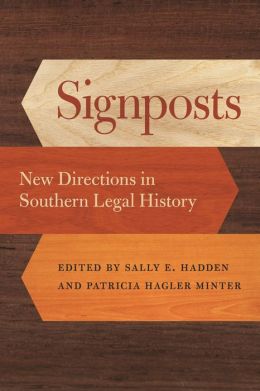 Walter F. Pratt, Jr. (University of South Carolina School of Law) reviews SIGNPOSTS: NEW DIRECTIONS IN SOUTHERN LEGAL HISTORY (University of Georgia Press, 2013), edited by Sally E. Hadden and Patricia Hagler Minter.
Zvi H. Triger (The Haim Striks School of Law, College of Management Academic Studies, Rishon LeZion, Israel) reviews INSIDE THE CASTLE: LAW AND THE FAMILY IN 20TH CENTURY AMERICA (Princeton University Press, 2011), by Joanna L. Grossman and Lawrence M. Friedman.
Michael Boudreau (Department of Criminology & Criminal Justice, St. Thomas University) reviews WESTWARD BOUND: SEX, VIOLENCE, THE LAW, AND THE MAKING OF A SETTLER SOCIETY (UBC Press, 2011), by Lesley Erickson.
New Release: "Between Court and Confessional: The Politics of Spanish Inquisitors"
New from Cambridge University Press: Between Court and Confessional: The Politics of Spanish Inquisitors, by Kimberly Lynn. A description from the Press:
A few blurbs:Between Court and Confessional explores the lives of Spanish inquisitors, closely examining the careers and writings of five sixteenth- and seventeenth-century inquisitors. Kimberly Lynn considers what shaped particular inquisitors, what kinds of official experience each accumulated, and to what ends each directed his acquired knowledge and experience. The case studies examine the complex interplay of careerism and ideological commitments evident in inquisitorial activities. Whereas many studies of the Spanish Inquisition tend to depict inquisitors as faceless and interchangeable, Lynn probes the lives of individual inquisitors to show how inquisitors' operations in their social, political, religious, and intellectual worlds set the Inquisition in motion. By focusing on specific individuals, this study explains how the theory and regulations of the Inquisition were rooted in local conditions, particular disputes, and individual experiences.

"The Inquisitor is a figure engulfed in myth, yet about whom very little is actually known. Kimberly Lynn sets the record straight in this thoroughly researched and well-written book. Showcasing individual portraits of five inquisitors from different parts of the early modern Hispanic empire, she offers a lively and convincing composite biography of a unique - and uniquely complex - figure poised between medieval theocracy and modern bureaucracy." -- James S. Amelang, Universidad Autónoma, Madrid
"This outstanding piece of scholarship demonstrates how little the Spanish inquisitors fit the conventional view of them as insular men in single-minded pursuit of heresy. In a series of exacting and illuminating portraits, Kimberly Lynn reveals them in the full range of their activities, engaged in turf battles, jostling for position at court, moving from post to post, suffering career setbacks and disappointments, and seeking patronage and bestowing patronage - that is, negotiating the complex power structures of early modern Spain like other members of the power elite." -- Miriam Bodian, the University of Texas at Austin
Sunday Book Roundup

The September issue of The Federal Lawyer is out and has reviewed several books of note: The Law of Armed Conflict: An Operational Approach (Wolters Kluwer Law & Business) by Geoffrey Corn, Victor Hansen, Chris Jenks, Richard Hackson, Eric Talbot Jenson, and Hames Schoettler Jr; Rebels at the Bar: The Fascinating, Forgotten Stories of America's First Women Lawyers (NYU Press) by Jill Norgren; Out of Order: Stores from the History of the Supreme Court (Random House) by Sandra Day O'Connor; as well as David O. Stewart's The Lincoln Deception (Kensington). Of the last book, reviewer JoAnn Baca provides an intriguing introduction:
"Lawyer and award-winning author David O. Stewart has written three nonfiction books—on Aaron Burr, Andrew Johnson’s impeachment, and the men who drafted the Constitution. But what happens when a historian comes across a story that cannot be proven by any fact he can uncover, yet it sparks his imagination? For Stewart, the answer is to leave his comfort zone and write a novel, allowing him to theorize and extrapolate, far from established facts, about a part of our history that fascinates many as much today as it did in 1865: the assassination of Abraham Lincoln. The Lincoln Deception is the result of Stewart’s need to explore to his own satisfaction a vague suggestion of duplicity as yet undiscovered in the assassination of the President."H-Net has added many reviews of interest to this week's roundup readers including several books that extend beyond the American context, such as David Lemmings's Crime, Courtrooms, and the Public Sphere in Britain, 1700-1850 (Ashgate) here; and a review of two books including Adam Roberts and Timothy Garton Ash's Civil Resistance and Power Politics: The Experience of Non-violent Action from Gandhi to the Present (Oxford University Press) and Sean Scalmer's Gandhi in the West: The Mahatma and the Rise of Radical Protest (Cambridge University Press). Elizabeth F. Thompson's Justice Interrupted: The Struggle for Constitutional Government in the Middle East (Harvard University Press) is also reviewed. Seth Offenbach writes of Thompson's work:
"In the nearly three years since the Arab uprisings began, the expertise of Middle East historians has been in demand like almost never before, as observers attempt to understand the historical roots underlying the seemingly sudden popular challenges to long-standing authoritarian regimes. The result has been a surge in publications that are broad in their scope and appeal but limited in the depth of their analysis and historical insight. A strong exception to this trend is the recent work of historian Elizabeth F. Thompson, whose study on the rise of constitutionalism in the Middle East swiftly dispenses with the facile explanations of the Arab uprisings, instead offering readers a comprehensive yet nuanced look at the lasting impact of efforts to enshrine and institutionalize the language of justice across the region during the last two centuries. While the study is bookended by a discussion of the implications that these developments hold for the contemporary calls for universal rights, its substantive chapters provide a perceptive and deeply contextualized look at the common thread underlying a struggle that dates back to the premodern era."


The Guardian reviews Churchill's Bomb: How the United States Overtook Britain in the First Nuclear Arms Race (Faber & Faber) by Graham Farmelo.
Maya Jasanoff reviews River of Dark Dreams: Slavery and Empire in the Cotton Kingdom (Harvard University Press) by Walter Johnson in the New York Review of Books. She finds:
"The artistry of River of Dark Dreams lies in the close-up—in Johnson’s mesmerizing attention to the “material” in historical-geographical materialism. In the pointillist style so dexterously displayed in his reconstruction of the New Orleans slave market, Soul by Soul, Johnson zooms in on the “nested set of abstractions” that made the Cotton Kingdom run: money, markets, maps, labor. “If you looked more closely,” he observes, “you would see that each abstraction stood at odds with the physical properties of the object it sought to represent.”River of Dark Dreams delivers spectacularly on the long-standing mission to write “history from the bottom up”: from the soil tangy and pungent with manure, and the Petit Gulf cotton plants rooted into it, and the calloused fingers plucking its blooming, sharp-edged bolls. This is a history of how wilderness became plantations that became states, nations, and empires—of how an overseer’s lashes sliced into a slave’s back turned “into labor into bales into dollars” into visions of America’s future in the world."
 This week readers can also listen to the New Books in History Podcast for a discussion with Tevi Troy, author of What Jefferson Read, Ike Watched, and Obama Tweeted: 200 Years of Popular Culture in the White House (Regnery History).
On HNN, reviewer Bernard von Bothmer finds that American Umpire (Harvard University Press) by Elizabeth Cobbs Hoffman "offers a sweeping, wide-ranging, and remarkably in-depth overview of the history of American foreign relations." HNN also reviews Thurston Clarke's JFK's Last Hundred Days (Penguin).
Salon has published an excerpt from Front Porch Politics: The Forgotten Heyday of American Activism in the 1970s and 1980s (Hill and Wang) by Michael Stewart Foley.
Weekend Roundup
- The September issue of Historically Speaking is out.
- NYC-area readers: On Monday, September 23, Cardozo Law School will host a discussion of Thomas Healey's new book, The Great Dissent: How Oliver Wendell Holmes Changed His Mind – and Changed the History of Free Speech in America. Details are availablehere.
- We've blogged before about the remarkable lawyer Bessie Margolin, drawing in part on Marlene Trestman's Journal of Supreme Court History article "Fair Labor: The Remarkable Life and Legal Career of Bessie Margolin (1909–1996)." In an effort to "set the record straight" about the number of cases Margolin argued before the Supreme Court, Trestman has published this addenda to her article.
New Release: Enayat, "Law, State, and Society in Modern Iran"
Palgrave Macmillan has released Law, State, and Society in Modern Iran: Constitutionalism, Autocracy, and Legal Reform, 1906-1941, by Hadi Enayat. The publisher describes the book as follows:
A few blurbs:Incorporating history, sociology, and rule of law studies, this book sheds light on an understudied but fascinating dimension of modernization in Iran, namely the emergence of a new legal system between the 1906 Constitutional Revolution and the end of Reza Shah's rule in 1941. While Iranian constitutionalism can be seen as part of a global trend of constitutional revolutions at the turn of the twentieth century, in Iran, an unusual institutional and historical background shaped a path to legal reform that was in many ways unique. Among other factors, the scholastic legalism of the Shi'i ulama and the considerable autonomy they enjoyed in administering the civil law in the nineteenth century made legal reform a particularly contested, difficult, and politically charged aspect of state building.

"Law, State, and Society in Modern Iran offers a perceptive examination of the impact of legal reforms on the process of state building and modernization in the first half of twentieth century in Iran. Its use of a wide range of primary source material will be particularly welcomed by historians of the period, and its broad analytical approach should make it indispensable for comparative studies of legal reforms in the wider context of the Middle East and current debates on constitutional development." -- Ali Gheissari
"Legal transformations of codes, institutions, and procedures constituted a crucial motor in the formation of political modernity and the modern state in Iran. This book contains lucid and original accounts and analyses of the events and processes in these transformations, rich in the details of political struggles and ideological contests, not only between the entrenched clerical hierarchy and the modernizing constitutionalists but also within and across both camps. This is key to understanding the subsequent fractured evolution of Iranian state, society, and revolution." -- Sami Zubaida


