Sunday Book Roundup


The Nation reviews Without Copyrights: Piracy, Publishing and the Public Domain (Oxford Univ. Press) by Robert Spoo.
"Sometimes, in the absence of copyright, publishers have paid authors and have abstained from reprinting the books of authors they haven’t paid. Ulysses, by James Joyce, considered by some the greatest novel of the twentieth century, lost its copyright protection in America on a technicality soon after it was published. But from the 1930s to the ’90s, Joyce and his estate were paid royalties from its publication in America anyway, thanks to exactly this kind of happy anarchy. In his new scholarly book Without Copyrights, the legal and literary historian Robert Spoo tells the remarkable tale, which Spoo doesn’t necessarily deem a pretty one. Spoo rather sympathizes, in fact, with the character many observers would consider the villain."
Salon publishes an excerpt of Thomas Jefferson's Qur'an: Islam and the Founders (Knopf) by Denise A Spellberg, and NPR reviews Jill Lepore's book about a Founding Father's sister, Book of Ages: The Life and Opinions of Jane Franklin (Knopf).

H-Net adds several works this week, including one of Wolfgang Knobl and Hans Joas's War in Social Thought: Hobbes to the Present (Princeton University Press), another of Robert Cassanello's To Render Invisible: Jim Crow and Public Life in New South Jacksonville (University Press of Florida) (audio interview in last week's post), a third of Nancy Kollmann's Crime and Punishment in Early Modern Russia (Cambridge), and a fourth of Judy Tzu-Chun Wu's Radicals on the Road: Internationalism, Orientalism, and Feminism during the Vietnam Era (Cornell University Press).
"As its title suggests, Radicals on the Road uses the transpacific journeys of anti-Vietnam War activists as a window into radical American and Vietnamese politics and culture in the 1960s. Its principal claim is as multipronged as its intended audience and intervention: in the 1960s American and Vietnamese antiwar activists created a transnational political community, beyond the confines of any nation-state or locality, based on a sustained critique of U.S. policy in Asia."

Read more »

Folgelson's "Great Rent Wars"

We’ll be posting notices of a few legal history related books published this year that only recently have come to our attention.  The first is Robert M. Fogelson’s The Great Rent Wars: New York, 1917-1929 (New Haven: Yale University Press, 2013).  Here’s the publisher’s squib:
Written by one of the country’s foremost urban historians, The Great Rent Wars tells the fascinating but little-known story of the battles between landlords and tenants in the nation’s largest city from 1917 through 1929. These conflicts were triggered by the post-war housing shortage, which prompted landlords to raise rents, drove tenants to go on rent strikes, and spurred the state legislature, a conservative body dominated by upstate Republicans, to impose rent control in New York, a radical and unprecedented step that transformed landlord-tenant relations.

The Great Rent Wars traces the tumultuous history of rent control in New York from its inception to its expiration as it unfolded in New York, Albany, and Washington, D.C. At the heart of this story are such memorable figures as Al Smith, Fiorello H. La Guardia, and Oliver Wendell Holmes, as well as a host of tenants, landlords, judges, and politicians who have long been forgotten. Fogelson also explores the heated debates over landlord-tenant law, housing policy, and other issues that are as controversial today as they were a century ago.
Writes Elizabeth Blackmar, Columbia University, author of Manhattan for Rent, 1785–1850: "A powerful history of a remarkable contest over the governance of the housing market in New York City from World War I to the eve of the Great Depression. A highly original contribution to our understanding of American urban politics."

The contents and a preview are here.

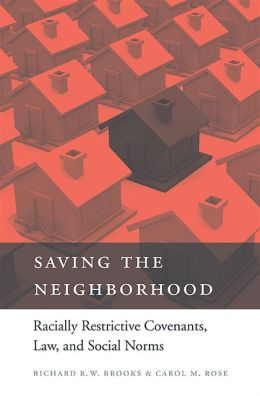
"Saving the Neigborhood": A Conference at Arizona

We have an announcement of a conference on Richard Brooks and Carol M. Rose’s Saving the Neighborhood: Racially Restrictive Covenants, Law and Social Norms, to be held at the University of Arizona College of Law, in Tucson, Arizona, on January 31, 2014.  Moderators are Robert Glennon and Brent White.  Featured panelists include Robert Gordon, Lani Guinier, Gabriel "Jack" Chin, Risa Goluboff. Gerald Torres, and Price Fishback.  Space is limited; register here.

Weekend Roundup

  • The School of Historical Studies at the Institute for Advanced Study invites candidates to apply for a single term or full academic year. (Hat tip: H-Law)
  • Some legal works in Swann's auction of Printed and Manuscript Americana on October 10, including Henry St. George Tucker’s Commentaries on the Laws of Virginia (1836-37); Laws of the State of New-York, Comprising the Constitution, and the Acts of the Legislature since the Revolution (1789); and The Two Principal Arguments of William Wirt, Esquire, on the Trial of Aaron Burr, for High Treason (1803).
  • The Stanford Humanities Center invites applications for the 2014-15 fellowship term. (Hat tip: H-Law)
  • "The Program in Law and Public Affairs (LAPA) at Princeton University invites outstanding faculty members, independent scholars, lawyers, and judges to apply for visiting, residential appointments for the academic year 2014–2015." There is a long and proud tradition of legal historian LAPA fellows, so apply! More information is available here.
Weekend Roundup is a weekly feature compiled by all the Legal History bloggers.

McSweeney on Civil and Common Law in Medieval England

Thomas J. McSweeney, William & Mary Law School, has posted two articles.  The first is Property Before Property: Romanizing the English Law of Land, which appeared in the Buffalo Law Review 60 (2012):
We tend to treat the idea of property as if it is a neutral way to speak about the relationship between people and things. In comparative legal studies, it is easier to compare two different cultures’ approaches to people and things when we assume that both can usefully be spoken of in terms of property. But property has a history. Terms like proprietas and possessio, which give the modern common law a vocabulary for speaking about that relationship, arose in the context of the classical Roman law and were worked into a systematic language of property by medieval Roman law scholars. The early common law, however, did not use the language of property to describe the relationship between people and things.
Image Credit: BC Law Library
In this paper, I will examine the period when English justices first attempted to turn English norms and practices concerning landholding into a law of property. Between 1187 and 1258, several justices tried their hands at writing treatises in which they translated English court practices into a systematic property law on the Roman model. The justices of the twelfth and thirteenth centuries, particularly the justices who wrote the treatise known as Bracton, were heavily invested in the idea that English law was part of the Romano-canonical ius commune. They realized, however, that the practices of the English courts and the landholding norms of the Anglo-Norman landed elite could not be made to fit neatly into a Roman law mold. The authors of Bracton embarked upon what we might consider an early exercise in comparative law scholarship. They created several complicated and contradictory schemes to try to express English landholding in Roman law terms, but ultimately failed in their attempts to create a coherent English law of property. Their failure is useful to us, however, in that it shows us very clearly that the language of property is not natural or essential and in that it helps us to understand a way of talking and thinking about landholding that is alien to us today. We can use the ways the Bracton authors creatively misunderstood the Roman law of property to help us to understand the cultures of landholding they came from: those of the English courts and the Anglo-Norman landed elite of the twelfth and thirteenth centuries.
The second is English Judges and Roman Jurists: The Civilian Learning Behind England's First Case Law, which appeared in Temple Law Review 84 (2012):
This Article looks at a historical problem — the first use of case law by English royal justices in the thirteenth century — and makes it a starting point for thinking about the ways legal reasoning works in the modern common law. In the first Part of the Article, I show that, at its origin, the English justices’ use of decided cases as a source of law was inspired by the work civil and canon law scholars were doing with written authorities in the medieval universities. In an attempt to make the case that English law was on par with civil law and canon law, the justices and clerks of the royal courts began to treat cases as if they were the opinions of great jurists, to apply the same types of dialectical reasoning that were used in civil law discourse to those cases, and to work them into systems of authority. They used cases, as the modern common law does; but they used cases to create systems of the kind we usually associate with civil law. In the second Part of the Article, I turn to the modern common law and, using the methods of medieval case law as a mirror, show that the differences between civil law and common law reasoning are more perceived than real. American lawyers tend to view common law as flexible and creative, whereas they view civil law as ossified and hierarchical. This largely stems from the fact that common lawyers focus on the judicial opinion as the place where legal reasoning takes place. By integrating other texts, like the student outline and the restatement — which seek to create a harmonious system out of judicial opinions — into the picture of common law reasoning, I show that common law reasoning shares quite a bit in common with civil law reasoning.

Hartog's Mitchell Lecture

Hendrik Hartog’s James McCormick Mitchell Lecture at the University at Buffalo Law School in 2012, entitled, Two Stories about Two Currencies of Care, is available on-line from the Buffalo Law Review.  It is based on his book, Someday All This Will Be Yours: A History of Inheritance and Old Age (2012).

Custer on Married Women's Property Acts

Joseph A. Custer, Saint Louis University School of Law, has posted The Three Waves of Married Women's Property Acts in the Nineteenth Century with a Focus on Mississippi, New York and Oregon.  Here is the abstract:
Paper starts with a brief section on early America and social reform that provides a background on why married women's property acts (MWPA's) passed when they did in nineteenth century America. After laying the foundation, the paper delves into the three waves in which the MWPA's were passed in the nineteenth century focusing for the first time in the literature on one specific state for each wave. The three states; Mississippi, New York and Oregon, are examined leading up to passage. Next, the paper will look into the judicial reaction of each State’s highest court. Were the courts supportive of the passed married women’s property acts or did they trend back toward the previous common law approach or equity? In evaluating the courts’ rulings, an examination of the judicial decision-making process is undertaken.

AJLH 53:3

Issue 53:3 (July 2013) of the American Journal of Legal History is out.  Here are the contents:

Wilfred E. Rumble, “Austin in America: The Case of John Chipman Gray”

Robert F. Castro, “Liberty Like Thunder:  Race, Article XI Enforcement, and the Odyssey of
Guadalupe Hidalgo (1848)”

Markus G. Puder, “Uncertain Land Titles in Louisiana's Formative Years:  Colonial Grants,
John Marshall's Foster Opinion, and Lauterpachtian Interplays between Private Law and
International Law”

Vanessa Banni-Viñas, “Correcting a Ballerina's Story: The Truth Behind Makletzova v. Diaghileff”

Gillies's Essays on Vermont Legal History

Paul S. Gillies, a Vermont lawyer, has published Uncommon Law, Ancient Roads, and other Ruminations on Vermont Legal History, with the Vermont Historical Society, which describes it as twenty-five essays that “ examine the foundations of legal thought in Vermont, historical issues ranging from log drives to keeping of sheep and blue laws, the state's legal luminaries, and contemporary issues including ancient roads and Act 250.” As Gillies elaborates in today's Green Mountain Outlook:
All important issues wind up in court. If only courtrooms could speak, they could tell stories about people and their concerns more lurid, more complicated, and more interesting than you would expect, meeting the people on the street. Public and private turmoils stir up controversies that show us the character of the parties and the integrity of the judicial system, and give us the ability to capture a moment in history otherwise lost to memory.
Gillies will preside at a book signing on August. 20, from 4:30 to 6:30 p.m., at the Vermont History Museum, 109 State Street, Montpelier.

Grogan reviews Watson, "Buying America from the Indians"

The Law & Politics Book Review has posted a review of Blake A. Watson, Buying American from the Indians: Johnson v. McIntosh and the History of Native Land Rights (University of Oklahoma Press, 2012). The book "succeeds in giving a new spin to the 1823 Supreme Court case," writes reviewer Susan E. Grogan (St. Mary’s College of Maryland). Here's a bit more:
Scholars of indigenous peoples, even those well beyond the North American continent, are alert to Johnson v. McIntosh as clearly one of the “10 Worst Indian Law Cases Ever Decided,” to use Walter EchoHawk’s (2010) damning characterization. From this perspective, Chief Justice John Marshall’s opinion in Johnson is infamous for at least three reasons. First, it denies to native people legal title to their land, leaving them only a right of occupancy. Second, it vests the legal title to the lands in North America in the European crowns and their successor American governments, elevating the Doctrine of Discovery (that the lands of non-Christian peoples, “discovered” by a European adventurer, belong to his monarch and the successor governments) from a generally, but not universally, accepted understanding in international law to positive domestic law sanctioned by the High Court. Third, in justifying the Doctrine of Discovery, Marshall’s opinion permanently inscribes into the U.S. Reports a disparaging view of the native peoples of North America. They were, Marshall wrote, “fierce savages, whose occupation is war” (21 U.S, 543, 590).

By the end of the book, Watson makes it clear that he subscribes to the “Worst Indian Law Case” assessment and directly calls for Johnson’s repudiation (pp.351-58). How he gets there is what makes this book interesting. . . .
The full review is available here.

Blumm on Schorr on "The Colorado Doctrine"

Michael C. Blumm, Lewis & Clark Law School, has posted Antimonopoly and the Radical Lockean Origins of Western Water Law.  Here is the abstract:
This review of David Schorr's book, The Colorado Doctrine: Water Rights, Corporations, and Distributive Justice on the American Frontier, maintains that the book is a therapeutic corrective to the standard history of the origins of western water law as celebration of economic efficiency and wealth maximization. Schorr's account convincingly contends that the roots of prior appropriation water law -- the "Colorado Doctrine" -- lie in distributional justice concerns, not in the supposed efficiency advantages of private property over common property. The goals of the founders of the Colorado doctrine, according to Schorr, were to advance Radical Lockean principles such as widespread distribution of water to current settlers and avoiding monopolization of the resource by large landowners and corporate speculators. The book explains how western water law doctrines like the abolition of riparian rights, beneficial use as the basis and measure of water rights, the sufficiency principle, the no-injury rule limiting the transferability of rights, and public ownership of water all served these Radical Lockean goals. Schorr generally downplays the significance of temporal priority, thought by many to be the hallmark of western water law, and he explains the early Colorado courts surprising and consistent favoring of small-scale farmers over large-scale corporations like ditch companies.

Schorr also attempts to draw lessons from his careful and detailed history of the rise of prior appropriation law for contemporary concerns like allocating the burdens of climate-change pollution control. Although he overlooks a few matters -- like the motive underlying the rejection of riparian rights as an anti-federal government doctrine and the failure of the founders of the Colorado doctrine to grant limited terms instead of perpetual rights in water -- and his assumption that public property will inevitably be distributed to the wealthy and the well-organized might be questioned -- this book is law and history at its finest and should be read by all serious natural resources and property law teachers and scholars.

Boyd on "Zoning for Apartments"

Marie Boyd (University of South Carolina School of Law) has posted "Zoning for Apartments: A Study of the Role of Law in the Control of Apartment Houses in New Haven, Connecticut 1912-1932." The article is forthcoming in Volume 33 of the Pace Law Review. Here's the abstract:
This article seeks to contribute to the legal and policy debates over zoning by providing a more detailed examination of the impact of apartments on both pre-zoning land use patterns and the zoning process during the formative initial stages of zoning in the United States than has been provided in the literature to date. Specifically, this Article analyzes the impact of apartments on both pre-zoning land use patterns and the zoning process in New Haven, Connecticut. It focuses on the period beginning with the selection of New Haven’s first Zoning Commission in 1922, and concluding with the passage of New Haven’s first zoning ordinance in 1926. Through this detailed historical account of the realities of zoning, this Article demonstrates how — due to delays in the enactment of zoning — New Haven’s first zoning ordinance, rather than shaping the future growth of the regulated area, was instead shaped by existing land use patterns and political considerations.
The full article is available here, at SSRN.

Cavanagh on History and Aboriginal Title

Edward Cavanagh, University of Ottawa and University of the Witwatersrand, has posted Land Rights that Come with Cut-Off Dates: A Comparative Reflection on Restitution, Aboriginal Title, and Historical Injustice.  Here is the abstract:
The doctrine of aboriginal title allows for a distinct form of redress, empowering communities to use the judiciary to take action against the state for foundational acts of historical dispossession. It has not taken root in South Africa, yet in other former settler colonies of the British Empire, it remains important to this day. This article interrogates history and law to explain why this is the case. Such an approach allows for a critical reflection on the system of land restitution that developed in South Africa instead of aboriginal title. by exploring the past and present realities of ‘dispossession’ in South Africa, this article discredits the inclusion of cut-off dates in the Restitution of Land Rights Act. These dates have discriminated between claimant communities irrationally and insensitively – even racially. History should not be mobilised in statute law to obstruct the pathway to redress. It should, instead, be used positively to restore the rights of those formerly dispossessed, and to preserve the rights of those facing dispossessions pending, in South Africa.

Blumm and Wigington on the Oregon and California Forest Lands

Michael C. Blumm and Tim Wigington, Lewis & Clark Law School, have posted The Past as Prologue to the Present: Managing the Oregon and California Forest Lands, which is to appear in the Oregon State Bar Bulletin (July 2013).  Here is the abstract:
credit
This article is a brief review of the convoluted history of what are known as the Oregon and California forest lands, federal lands that were once the subject of a 19th century federal railroad grant, then became the focus of widespread land fraud and official corruption, which led to the Supreme Court halting land sales and Congress taking back the lands, situated in eighteen Oregon counties. Federal management of the lands in the 20th century emphasized timber harvesting, and this dominant use of the lands led to environmental lawsuits and the Endangered Species Act listing of the northern spotted owl in the early 1990s. Since 1994, the lands have been governed by the Northwest Forest Plan, which drastically limited federal timber harvests and associated local county revenues, which were based on those harvests. Several counties in southern Oregon now face public service crises, as their local tax base is insufficient to provide emergency services like fire and police.

In this short version of a larger study -- written for the local bar -- we propose a solution to the funding crisis in southern Oregon that does not involve scuttling the Northwest Forest Plan and returning the lands to dominant timber use. Increasing timber harvests to fund county governments is the subject of a bill co-sponsoring by several Oregon Congressmen, and we explain why this approach would be short-sighted and environmentally unsatisfactory.

Weiner's Worlds of Law

Over on Worlds of Law, Marc Weiner, a former guest blogger, has three interesting posts:
  • Sharp's Numbers, about Blackstone's Commentaries and a book owned by Granville Sharp housed in the Yale rare books collection 
  • Maine Meets Maine, a video reflection on the historical significance of the cattle pound, joining the State of Maine and Henry Sumner Maine.
  • A thread on E.B. White and international law, and more generally about certain characteristics of the midcentury legal imagination.  The final post is "Why International Law is Like Webster's Third Dictionary (at least, for E.B. White)."

Weekend Roundup

  • Although it sounds more in Property than Legal History, but Rick Hills's penetrating post on the Supreme Court's recent exaction decision explains a great deal about the Supreme Court's attempt to police local land use decision since the 1980s (with a look back to the early twentieth century).
  • On the merits of browsing the stacks: in the Chronicle of Higher Education, Julio Alves (Smith College) makes the case for "a greater awareness of what we are losing in overprivileging digital tools, and a better balance of digital practices and traditional ones." 
The Weekend Roundup is a weekly feature compiled by all the Legal History bloggers.

Weekend Roundup

  • If you've never perused the website of the Historical Society of the New York Courts it is worth a look. 
  • Over at H-Law, Kenneth J. Hirsh, Cincinnati Law, plugs the Louis Marshall Papers at the Jacob Rader Marcus Center of the American Jewish Archives at the Cincinnati campus of Hebrew Union College.
  • Lori Clune, an assistant professor of history at California State University, Fresno, makes the case for sparing the Rosenbergs at HNN.
    • The American Academy in Berlin invites applications for its residential fellowships for 2014-2015, as well as early applications for the academic years 2015-2016 and 2016-2017. The deadline is Monday, September 2, 2013 (12 pm EST or 6 pm CET).  More.
      • The University of Pennsylvania Law Review is looking for contributors to “its online companion, Heightened Scrutiny. Essays selected for HS go through the full editorial process and are published to the major databases, in addition to being perpetually available on our website. We typically run shorter pieces with an eye towards more timely commentary on current events in the law.”
      • It's still June, so there's still hope for our summer writing agenda.  If you're feeling the need to be sternly talked to on the subject, try Rachel Toor in the Chronicle of Higher Education: I Don't Write Enough Because ...  Hat tip: Linda Przybyszewski.
      The Weekend Roundup is a weekly feature compiled by all the Legal History bloggers.

      Hoyos reviews Brooks & Rose, "Saving the Neighborhood"

      From JOTWELL's Legal History Section: Roman Hoyos (Southwestern Law School) reviews Richard R.W. Brooks and Carol M. Rose, Saving the Neighborhood: Racially Restrictive Covenants, Law, and Social Norms (Harvard University Press, 2013). Here's the first paragraph of the review:
      One of my favorite cases is Shelley v. Kraemer (1948), which held that racially restrictive covenants (restrictions barring a racial or ethnic group(s) from owning a home in a particular neighborhood) were unenforceable. In fact, I use this case, along with State v. Mann, Commonwealth v. Alger, and Johnson v. M’Intosh, to help frame my Property course. I use Alger and Johnson to get my students to think about the statist dimensions of property. I then bring in Shelley to explore the relationship between courts and the state, pushing them to see how a judicial decision concerning property rights is an allocation of those rights by the state. Richard Brooks and Carol Rose’s book, Saving the Neighborhood, is a wonderful doctrinal history of Shelley that both confirms and complicates the story I tell my students. More importantly for this piece, it also complicates our understanding of an important period in American legal history.
      Read on here.

      Weekend Roundup

      • We Legal History Bloggers are grateful to Joanna Grisinger, Northwestern Legal Studies, for organizing so many legal history panels at the just-concluded annual meeting of the Law and Society Association.  Thanks, Joanna!
      • Via H-Law, we have news of a new exhibit at the Harvard Law School Library, Research Revealed: Six Scholars Explore Historical & Special Collections.  “This exhibit celebrates the relationship between the staff of the Library's Historical & Special Collection and the scholars who visit us to use our collections. It is on view weekdays 9 to 5 in the Caspersen Room, Langdell Hall, through August 9, 2013.”
      • Not only do the Illuminati exist; they read legal history.  Check out the comments to this Jotwell post.  Hat tip: Richard Ross.
        • Hat tip to Michael Widener, Yale Law,  for spotting in The Scout Report, May 31, 2013, the notice "Maps of Private Land Grant Cases of California” and sending the link.  From the Scout Report: “This remarkable collection from the Bancroft Library collects maps that supported private land claim cases from 1850 to approximately 1890. Visitors should first look over the collection's finding aid, which is available in several formats. In total, there are over 1,400 maps here, some of which are exquisitely hand-colored. It's a fascinating way to learn about legal history, geography, and the complex interactions between the United States government and the newly formed U.S. District Courts of California. [KMG]"
          • The latest issue of the Ohio Northern University Law Review has reviews of Scott Douglas Gerber, A Distinct Judicial Power: The Origins of an Independent Judiciary, 1606-1787 (Oxford University Press, 2011), by Stephen Presser and Charles A. Kromkowski. 
          Weekend Roundup is a weekly feature compiled by all the Legal History bloggers.

          Blog Archive