Sunday Book Roundup


The Nation reviews Without Copyrights: Piracy, Publishing and the Public Domain (Oxford Univ. Press) by Robert Spoo.
"Sometimes, in the absence of copyright, publishers have paid authors and have abstained from reprinting the books of authors they haven’t paid. Ulysses, by James Joyce, considered by some the greatest novel of the twentieth century, lost its copyright protection in America on a technicality soon after it was published. But from the 1930s to the ’90s, Joyce and his estate were paid royalties from its publication in America anyway, thanks to exactly this kind of happy anarchy. In his new scholarly book Without Copyrights, the legal and literary historian Robert Spoo tells the remarkable tale, which Spoo doesn’t necessarily deem a pretty one. Spoo rather sympathizes, in fact, with the character many observers would consider the villain."
Salon publishes an excerpt of Thomas Jefferson's Qur'an: Islam and the Founders (Knopf) by Denise A Spellberg, and NPR reviews Jill Lepore's book about a Founding Father's sister, Book of Ages: The Life and Opinions of Jane Franklin (Knopf).

H-Net adds several works this week, including one of Wolfgang Knobl and Hans Joas's War in Social Thought: Hobbes to the Present (Princeton University Press), another of Robert Cassanello's To Render Invisible: Jim Crow and Public Life in New South Jacksonville (University Press of Florida) (audio interview in last week's post), a third of Nancy Kollmann's Crime and Punishment in Early Modern Russia (Cambridge), and a fourth of Judy Tzu-Chun Wu's Radicals on the Road: Internationalism, Orientalism, and Feminism during the Vietnam Era (Cornell University Press).
"As its title suggests, Radicals on the Road uses the transpacific journeys of anti-Vietnam War activists as a window into radical American and Vietnamese politics and culture in the 1960s. Its principal claim is as multipronged as its intended audience and intervention: in the 1960s American and Vietnamese antiwar activists created a transnational political community, beyond the confines of any nation-state or locality, based on a sustained critique of U.S. policy in Asia."

Read more »

Sunday Book Review Roundup


This week on H-Net, John Sbardellati's J. Edgar Hoover Goes to the Movies: The FBI and the Origins of Hollywood's Cold War (Cornell University Press) is reviewed.
"In J. Edgar Hoover Goes to the Movies, Sbardellati analyzes the FBI’s scrutiny of the film industry from the days of the first Red Scare after World War I through the second Red Scare of the late 1940s. In Sbardellati’s estimation, Hoover’s “sincerely held, if ill-founded” belief that Communist agents had infiltrated the industry and used the screen to spread pro-Communist propaganda to gullible, unsuspecting audiences motivated the investigations (p. 3)."
History Today takes a look at Soldier, Sailor, Beggarman, Thief: Crime and the British Armed Services Since 1914 (Oxford University Press) by Clive Emsley (here) and Your Country Needs You: The Secret History of the Propaganda Poster (Scaraband) by James Taylor (here).

LHB readers can also listen to a recent interview with author Robert Cassanello about his book, To Render Invisible: Jim Crow and Public Life in New South Jacksonville (University Press of Florida) in the New Books in History Podcast.

For those who read John Paul Stevens's review of Gary May's Bending Toward Justice (Basic Books) included in a July Book Roundup post, Professor Kevin Hoover of Duke replies to Stevens's use of "slave bonus" here in the New York Review of Books. Hoover argues
"John Paul Stevens [“The Court & the Right to Vote: A Dissent,” NYR, August 15] is confused about the history, the arithmetic, and, surprisingly, the constitutional status of the provision counting slaves as three fifths of a person for purposes of the apportionment of the House of Representatives."
The Washington Post reviews America's Obsessives: The Compulsive Energy that Built a Nation (Grand Central) by Joshua Kendall. Reviewer Megan McDonough writes,
"Control freak. Neurotic listmaker. Successful American icon. Which one of these is not like the others?
None — they all go together, according to Joshua Kendall. In his new book, “America’s Obsessives,” he profiles seven American super-achievers: political visionary Thomas Jefferson, renowned librarian Melvil Dewey, condiment titan Henry Heinz, prominent sexologist Alfred Kinsey, celebrated aviator Charles Lindbergh, cosmetic giant Estée Lauder and baseball legend Ted Williams. Kendall attributes their success to an unexpectedly powerful force: obsessive-compulsive personality disorder."
Also on the Post is a review of The Blood Telegram: Nixon, Kissinger, and a Forgotten Genocide (Knopf) by Gary J. Bass, as well as a review of America 1933: The Great Depression, Lorena Hickok, Eleanor Roosevelt, and the Shaping of the New Deal (Free Press) by Michael Golay.

Salon has published an excerpt from E. Fuller Torrey's American Psychosis: How the Federal Government Destroyed the Mental Illness Treatment System (Oxford University Press).

And finally, a review accessible to subscribers of the Wall Street Journal: American Founding Son: John Bingham and the Invention of the Fourteenth Amendment (NYU Press) by Gerard N. Magliocca.

Woolhandler on Federal Court Abstention in the 1940s and 50s

Ann Woolhandler (University of Virginia School of Law) has posted "Between the Acts: Federal Court Abstention in the 1940s and 50s." Here's the abstract:
The abstention doctrines that developed in the 1940s and 50s, as scholars have noted, reflected certain strands of Progressive and New Deal Legal thought, particularly an emphasis on institutional competencies and judicial restraint. This emphasis in turn was tied to the substantive policy goal of reducing federal court invalidation of progressive legislation. This article, written for New York Law School’s symposium celebrating Martin Luther King, aims to make a modest addition to prior scholarship by showing ways in which the reasoning supporting abstention doctrine corresponded to reasoning with respect to substantive doctrine. This correspondence was not only at the general level of emphasizing institutional competencies and judicial restraint, but also at the more specific level of relying on a social-fact-based jurisprudence, imagining any-state-of-facts that might justify legislation, and balancing governmental interests against formerly more absolute individual rights. Reinforced by such reasoning, abstention doctrine at mid-century appeared to be heading in the direction of requiring exceptional circumstances not to abstain when plaintiffs contested state and local regulation. Justice Douglas, later joined by Justice Brennan and Chief Justice Warren, would play a critical role in resisting abstention, thus helping to usher in the modern civil rights era. Because abstention subsists and continues to evoke academic criticism, it may be easy to forget how pervasive a doctrine abstention once threatened to become.
Read on here.

Edwards to Lecture on “Women, Law, and Culture: Rethinking Legal Change in the Civil War Era"

[Our friends at Oregon Law send us the following announcement.]

The Law, Culture, and Humanities Initiative presents “Women, Law, and Culture: Rethinking Legal Change in the Civil War Era,” with Laura Edwards, Thursday, October 3, 2013, 12:30 – 2:00 p.m., Lewis Lounge, Knight Law Center, University of Oregon.

Laura F. Edwards received her Ph.D. from the University of North Carolina, Chapel Hill and is now Professor of History at Duke University. Her interests focus on race, gender, labor, and law, especially in the nineteenth-century U.S. South. She just completed a legal history of the Civil War and Reconstruction titled A Nation of Rights. Most recently, she is the author of The People and Their Peace: Legal Culture and the Transformation of Inequality in the Post-Revolutionary South (University of North Carolina Press, 2009), which was awarded the American Historical Association’s 2009 Littleton-Griswold prize for the best book in law and society and the Southern Historical Association’s Charles Sydnor prize for the best book in southern history. In addition, she is author of Scarlett Doesn’t Live Here Anymore: Southern Women in the Civil War Era (University of Illinois Press, 2000); and Gendered Strife and Confusion: The Political Culture of Reconstruction (University of Illinois Press, 1997). She has received fellowships from the Newberry Library, the National Humanities Center, the NEH, and the Guggenheim Foundation. She also has been honored with the Howard D. Johnson award for distinguished undergraduate teaching, given by the College Arts and Sciences at Duke University and the Dean’s Award for Excellent Mentoring, given by the Graduate School at Duke University.

RSVP to Sabrina Leathers: leathers@uoregon.edu [ASAP].

Cosponsored by Oregon Humanities Center, Center for the Study of Women in Society, Office of the Vice Provost for Equity and Inclusion, Department of Political Science, School of Law Lectures and Awards, Department of History, and Office of Academic Affairs.

The Law, Culture, and Humanities Initiative was created to facilitate, support, and encourage symposia, lectures, scholarship, and faculty discussion on the relationship between law and other humanistic disciplines. It provides opportunities for faculty to integrate humanistic-based studies with the study of law, and to explore the increasingly diverse and rich scholarships in areas that include (but are not limited to) legal history, law and literature, law and anthropology, and law and philosophy.

The Third Biennial UnCivil Wars Conference

Here is the schedule for the Third Biennial UnCivil Wars Conference, entitled “From Property to Personhood: The Intents and Unintended Consequences of the Reconstruction Amendments.”  It will take place on October 24-26, 2013, at the T.R.R. Cobb House, 157 Hill Street, Athens, GA.

Read more »

Sunday Book Roundup

This week, the 50th anniversary of the March on Washington brought with it several book reviews on race in America.

NPR has put together a list of "books that bring the civil rights movement to life" here, including two of my favorites - Anne Moody's Coming of Age in Mississippi (Random House, 1992) and the edited volume of personal accounts, Hands on the Freedom Plow: Personal Accounts by Women in SNCC (University of Illinois Press, 2012).

The Washington Post's Jonathan Yardley reviews William P. Jones's The March on Washington: Jobs, Freedom, and the Forgotten History of Civil Rights (Norton). Yardley writes,
"This is the central theme of “The March on Washington”: The powerful economic impulses of the march have been lost to view as historians emphasize the eloquence of King’s speech and its effect on the political climate as the country moved to address the questions of basic civil rights and opportunities that he articulated. Initially the march’s organizers demanded “federal jobs creation, raising the minimum wage, a Fair Employment Practice law, and support for [President John F.] Kennedy’s civil rights bill,” demands that “expanded as new groups joined.”"

This week there are also several reviews of For Discrimination: Race, Affirmative Action, and the Law (Pantheon) by Harvard Law Professor Randall Kennedy, including a lengthy L.A. Times review, a Washington Post review, and a Wall Street Journal review for subscribers.

H-Net has a review of Emily West's Family or Freedom: People of Color in the Antebellum South (University Press of Kentucky), which makes use of enslavement petitions to examine antebellum race and status relationships in the South.

Lewie Reece has tackled two books in a H-Net review titled, "The Lincoln Theme in the Twenty-First Century." The reviewed books are Michael Burlingame's Lincoln and the Civil War (Southern Illinois University Press) and Mark E. Neely's Lincoln and the Triumph of the Nation: Constitutional Conflict in the American Civil War (University of North Carolina Press).  Reece writes:

These two books serve as a reminder that the Lincoln theme, far from being exhausted, continues to be explored in new ways by historians. Pure biography remains a subject of lively interest, but so do efforts to connect Lincoln to issues related to antislavery and the Civil War. Additionally, several works are but marginally connected to history, and instead examine the ongoing impact Lincoln had, and continues to have, on American culture. Moreover, as these two volumes suggest, academic historians continue to widen the parameters of our understanding of Lincoln. 
Mark Neely and Michael Burlingame have written widely not only about Lincoln, but Civil War America as well. Their approach in these volumes is different, yet similar. Neely presents a constitutional and legal history of the Civil War which, despite the title, is only partly about Lincoln. Burlingame has written a compressed history of Lincoln’s presidency and its influence on the Civil War. Both works reveal these historians’ impressive scholarship and wide reading in manuscript sources; both provide insight into the subject. It takes courage to try and do something different and provocative, and both men are to be commended for seeking new approaches.
 n+1 reviews Walter Johnson's River of Dark Dreams: Slavery and Empire in the Cotton Kingdom (Harvard University Press).

Other reviews of interest include Washington Post's review of Higher Education in America (Princeton University Press) by Derek Bok.

HistoryToday asks "How could the first nation to cleave church from state remain so pious?"as it reviews The Creation of the American Soul: Roger Williams, Church and State, and the Birth of Liberty (Duckworth) by John Barry.

The New York Times reviews A Wild Justice: The Death and Resurrection of Capital Punishment in America (Norton) by Evan J. Mandery. (Previously mentioned in the Aug. 18 Book Roundup.)

And Salon has published an excerpt from Estelle B. Freedman's Redefining Rape: Sexual Violence in the Era of Suffrage and Segregation (Harvard University Press).

New Release: Hockett on Law, Politics, and Supreme Court Decision Making in Brown

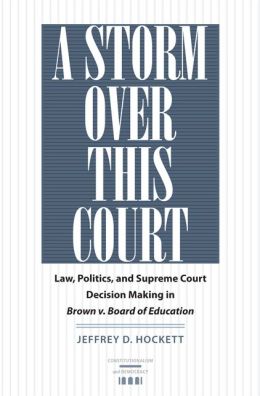
New from the University of Virginia Press: A Storm Over This Court: Law, Politics, and Supreme Court Decision Making in "Brown v. Board of Education," by Jeffrey D. Hockett (University of Tulsa). Here's a description from the publisher:
On the way to offering a new analysis of the basis of the Supreme Court’s iconic decision in Brown v. Board of Education, Jeffrey Hockett critiques an array of theories that have arisen to explain it and Supreme Court decision making generally. Drawing upon justices’ books, articles, correspondence, memoranda, and draft opinions, A Storm over This Court demonstrates that the puzzle of Brown’s basis cannot be explained by any one theory.

Borrowing insights from numerous approaches to analyzing Supreme Court decision making, this study reveals the inaccuracy of the popular perception that most of the justices merely acted upon a shared, liberal preference for an egalitarian society when they held that racial segregation in public education violates the equal protection clause of the Fourteenth Amendment. A majority of the justices were motivated, instead, by institutional considerations, including a recognition of the need to present a united front in such a controversial case, a sense that the Court had a significant role to play in international affairs during the Cold War, and a belief that the Court had an important mission to counter racial injustice in American politics.

A Storm over This Court demonstrates that the infusion of justices’ personal policy preferences into the abstract language of the Constitution is not the only alternative to an originalist approach to constitutional interpretation. Ultimately, Hockett concludes that the justices' decisions in Brown resist any single, elegant explanation. To fully explain this watershed decision—and, by implication, others—it is necessary to employ a range of approaches dictated by the case in question.
A blurb:
Examining oral arguments, Supreme Court memoranda, and the private papers of the justices, Hockett weaves a rich tapestry of the many threads that led the nine Supreme Court justices to unanimously hold school segregation unconstitutional in Brown v. Board of Education. Focusing on the thinking of each justice, Hockett offers a fascinating examination of judicial sausage-making in one of the Court’s most famous decisions. -- Gerald N. Rosenberg
It looks like full text is available to subscribers of Project Muse.

MLK's Speechwriter: "She was angry at me and then I began to be angry at Martin King"

Clarence Jones (Stanford--MLK Institute), the lawyer and speechwriter behind Dr. Martin Luther King's famous "I Have a Dream Speech" has published a book about his adventures with King. The release is Behind the Dream: The Making of the Speech that Transformed the Nation (Palgrave). The publisher's description follows below.

The funny thing about Jones's involvement in King's history-
making speech is that initially, he wanted nothing to do with Dr. King! Jones's wife--or more pointedly, his wife's anger at the lawyer's refusal to assist Dr. King--moved Jones to action. As Jones explained during an NPR interview about the events that led to his involvement with King: "[My wife] was angry at me and then I began to be angry at Martin King [for interrupting our domestic tranquility]." Read about Jones and listen to the interview here.
“I have a dream.” When those words were spoken on the steps of the Lincoln Memorial on August 28, 1963, the crowd stood, electrified, as Martin Luther King, Jr. brought the plight of African Americans to the public consciousness and firmly established himself as one of the greatest orators of all time. Behind the Dream is a thrilling, behind-the-scenes account of the weeks leading up to the great event, as told by Clarence Jones, co-writer of the speech and close confidant to King. Jones was there, on the road, collaborating with the great minds of the time, and hammering out the ideas and the speech that would shape the civil rights movement and inspire Americans for years to come.

September at the Miller Center

Among the upcoming events at the Miller Center for Public Affairs at the University of Virginia in September are the following:

FORUM: Wednesday, September 4      11:00 a.m.
GILBERT KING, Pulitzer Prize-winning historian, on his book, The Devil in the Grove: Thurgood Marshall, the Groveland Boys, and the Dawn of a New America

FORUM: Wednesday, September 11    11:00 a.m.
WILLIAM P. JONES, history professor at the University of Wisconsin-Madison, on his new book, The March on Washington: Jobs, Freedom, and the Forgotten History of Civil Rights

HISTORICAL PRESIDENCY LECTURE SERIES:
Wednesday, September 18   5:00 p.m.
Special Location: Nau Hall, Room 101 ( U.Va. Web Map)
GARY GALLAGHER, senior faculty associate at the Miller Center, and JAMES M. MCPHERSON, professor emeritus of history at Princeton, on Abraham Lincoln and Jefferson Davis as war presidents.

More information here.

Sunday Book Round-up

NPR looks at "when fashion and law collide" in an author interview with Ruthann Robson. Her new book is Dressing Constitutionally: Hierarchy, Sexuality, and Democracy from Our Hairstyles to Our Shoes (Cambridge University Press). Here's an excerpt:
"On local laws that ban 'cross-dressing' 'It often acts as a cipher for other sorts of problems, right. So that if people dress decently, then there won't be gambling, then there won't be theft, then there won't be muggings — as if those two things go together. And of course, people's notions of what's 'decent' really varies across class, varies across time, and varies across age. And one way to look at some of these is really about older people policing the sexuality of younger people."
The new August issue of The Federal Lawyer has a couple of book reviews of interest this week. Michael Ariens reviews Joanna Grossman and Lawrence Friedman's Inside the Castle: Law & the Family in 20th Century America (Princeton University Press, 2011). Louis Fisher reviews Robert Bork's Saving Justice: Watergate, the Saturday Night Massacre, and Other Adventures of a Solicitor General (Encounter Books).

Over at The New Republic Andrew Delbanco has written a review essay of several works on Lincoln and slavery in "Lincoln's Long Game: The morally painful road to slavery's end."

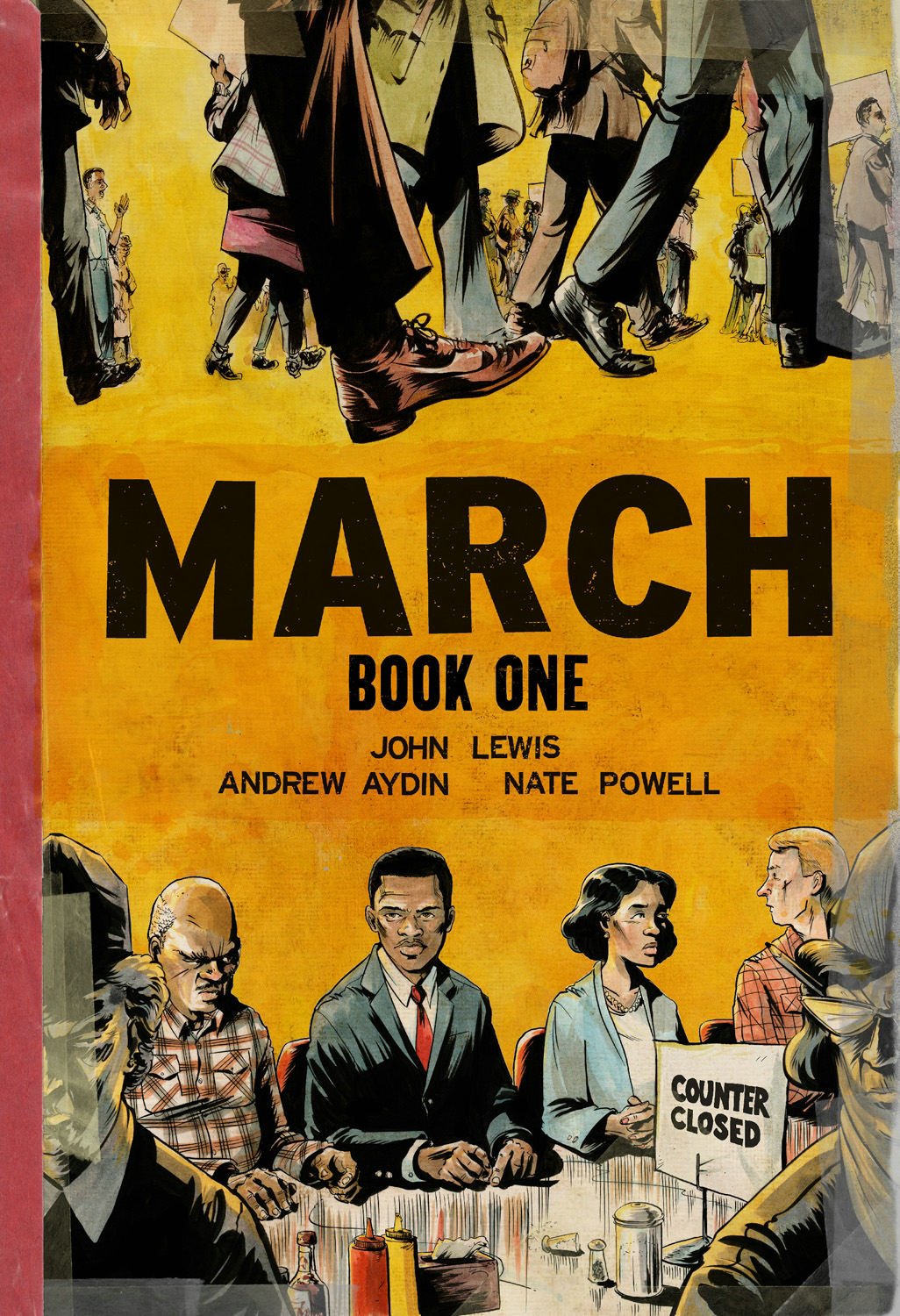
NPR reviews March (Top Shelf) which has been co-written by civil rights activist and member of the U.S. House of Representatives John Lewis, his staffer Andrew Aydin, and graphic novelist Nate Powell. Reviewer Jody Arlington writes:
"And yet March is a fresh and sometimes shocking work, even for those familiar with Lewis' life. Not just for its violence and its graphic re-creation of a dark time, but for its inside look at the leaders of the civil rights movement. In one disturbing scene, they shout insults at each other and enact other indignities as a way to prepare for the resistance and abuse they'll face in public."

The New York Times's David Garrow also takes up the topic of civil rights in his review of William Jones's The March on Washington (Norton). 

Jeannette Cockroft has reviewed Keira V. Williams's Gendered Politics in the Modern South: The Susan Smith case and the Rise of a New Sexism (Louisiana State University Press) for H-Net here.

Excerpts from Evan Mandery's book on death penalty lawyers in the 1960s and 1970s, A Wild Justice (Norton), can be found on Salon here. Salon has also published adapted excerpts from an e-book essay about the history of forced sterilization, For the Public Good (New New South).

This week the Guardian has reviewed another book about American death penalty policy, Injustice: Life and Death in the Courtrooms of America by Clive Stafford Smith.

Finally, John Yoo reviews A Principled Stand: The Story of Hirabayashi v. United States (University of Washington Press) by Gordon K. Hirabayashi in the Wall Street Journal.

Civil Rights Collections at the Library of Congress

In the July-August 2013 edition of the Library of Congress Magazine, Adrienne Cannon, African American history and culture specialist for the Manuscript Division, discusses the scope of the Library’s civil rights collections.

Hat tip: Library of Congress Blog

Civil Rights Act of 1964 Research Grant and Call for Papers

Via H-Law, we have the following announcement:
Civil Rights Act of 1964 Research Grant and Call for Papers
The Center for the Study of Southern Culture (CSSC) and the Southern Foodways Alliance at the University of Mississippi announce a $1,000 research grant to catalyze scholarship on the Civil Rights Act of 1964 and the desegregation of Southern restaurants. The grant of $1,000 is payable in two parts: $500 upon assignment and $500 on the delivery by March 3, 2014, of a scholarly article based on the completed research. The article will undergo the peer-review process, and the Center for the Study of Southern Culture will have first publication rights for the article—planned for the 50th anniversary of the Civil Rights Act—after which the scholar may use it as he or she desires.
Read more »

Call for Submissions: Liberty Legacy Foundation Award

Via H-Law, we have the following call for submissions:
SUBMISSION DEADLINE: OCTOBER 1, 2013
Inspired by OAH President Darlene Clark Hine’s call in her 2002 OAH presidential address for more research on the origins of the civil rights movement in the period before 1954, the Liberty Legacy Foundation Award is given annually by the Organization of American Historians to the author of the best book by a historian on the civil rights struggle from the beginnings of the nation to the present.
Each entry must be published during the period January 1, 2013 through December 31, 2013.
The award will be presented at the 2014 OAH Annual Meeting in Atlanta, Georgia, April 10–13.
Submission Procedures
One copy of each entry, clearly labeled “2014 Liberty Legacy Foundation Award Entry,” must be mailed directly to the committee members listed below. Each committee member must receive all submissions by October 1, 2013.
Bound page proofs may be used for books to be published after October 1, 2013 and before January 1, 2014. If a bound page proof is submitted, a bound copy of the book must be received no later than January 7, 2014. 

Read more »

Morey to Clemson

Congratulations to Clemson University and to Maribel Morey on the former’s hiring of the latter as an Assistant Professor of History.  Morey has just received her Ph.D. in history from Princeton, where her advisers were Hendrik Hartog and Stanley Katz.  Her dissertation is "The Making of An American Dilemma (1944): The Carnegie Corporation, Gunnar Myrdal, and the Unlikely Roots of Modern Civil Rights Discourse."  The holder of a JD from NYU in 2006, she received Fulbright and American-Scandinavian Foundation grants for her dissertation research.  In the 2012-13 academic year she was a Samuel I. Golieb Fellow in Legal History at NYU School of Law.

Goluboff on "Lawyers, Law and the New Civil Rights History"

Risa Goluboff (UVA--Law and History) has published "Lawyers, Law and the New Civil Rights History" in 126 Harvard Law Review 2312 (June 2013).  The piece is a review of Representing the Race: The Creation of the Civil Rights Lawyer by Ken Mack  (Harvard Law). Goluboff's review takes the form of a very useful historiographic essay.  Mack replies with "Civil Rights History Old and New."

Update: I just want to second Tomiko on the importance of this exchange.  It strikes me as the likely point of departure for the legal historiography of the civil rights movement for the foreseeable future.  Further, analogous issues arise in the histories of other fields of law.  DRE

Luff, "Commonsense Anticommunism: Labor and Civil Liberties Between the World Wars"

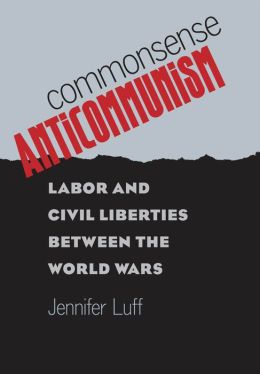
Via Historically Speaking, we've learned that the June 2013 issue of the Journal of the Historical Society features a forum on Commonsense Anticommunism: Labor and Civil Liberties between the World Wars (University of North Carolina Press, 2012), by Jennifer Luff (Kalmanovitz Initiative for Labor and the Working Poor, Georgetown University). Here's the Press's description of the book:
Between the Great War and Pearl Harbor, conservative labor leaders declared themselves America's "first line of defense" against Communism. In this surprising account, Jennifer Luff shows how the American Federation of Labor fanned popular anticommunism but defended Communists' civil liberties in the aftermath of the 1919 Red Scare. The AFL's "commonsense anticommunism," she argues, steered a middle course between the American Legion and the ACLU, helping to check campaigns for federal sedition laws. But in the 1930s, frustration with the New Deal
order led labor conservatives to redbait the Roosevelt administration and liberal unionists and abandon their reluctant civil libertarianism for red scare politics. That frustration contributed to the legal architecture of federal anticommunism that culminated with the McCarthyist fervor of the 1950s.
Relying on untapped archival sources, Luff reveals how labor conservatives and the emerging civil liberties movement debated the proper role of the state in policing radicals and grappled with the challenges to the existing political order posed by Communist organizers. Surprising conclusions about familiar figures, like J. Edgar Hoover, and unfamiliar episodes, like a German plot to disrupt American munitions manufacture, make Luff's story a fresh retelling of the interwar years.
A few blurbs:
"Truly an original piece of scholarship that makes a substantial contribution to the history of communism, anticommunism, labor, and American political history. This well-written and provocative book is evenhanded in its approach to controversial issues--readers will learn a great deal from it."
--Eric Arnesen, George Washington University

"A learned, nuanced, and comprehensive exploration of the role labor conservatives played in constructing the postwar Red Scare. This much needed and painstakingly researched book will be required reading of anyone looking to understand the origins and scope of the Red Scare."
--Ellen Schrecker, Yeshiva University
Here's a sneak peak of what you'll find in the Journal of the Historical Society forum. Luff writes:
I tried to follow the clues that the testimony of John Frey and J. Edgar Hoover gave me. In the end, I came up with Commonsense Anticommunism. The book argues that conservative officials of the American Federation of Labor were the vanguard of American anticommunism in the interwar years. The AFL's antisocialism and ingrained suspicion of state power produced an organic and reflexive opposition to Soviet Communism that pervaded the AFL from the first days of the Bolshevik Revolution. Yet AFL leaders played a paradoxical role, evangelizing against Communism while opposing statutory restrictions on Communist activity, and often clandestinely collaborating with federal repression of Communists while rejecting formal authority for federal repression. In keeping with their longstanding ethos, AFL leaders advocated a voluntarist approach to contain Communism, which relied on private citizens and organizations to identify and repudiate reds in their midst. AFL leaders viewed Communism as an obnoxious but legitimate political movement, not a cultural tendency or a catch-all for all sorts of radicalism, which put them at odds with many other antiradical and patriotic groups in the interwar years. I call their approach “commonsense anticommunism,” and I argue that labor anticommunists were a crucial backstop protecting civil liberties in the 1920s and early 1930s.
 More information about the book is available here.

McAward on McCulloch and the Thirteenth Amendment

Jennifer Mason McAward, Notre Dame Law School, has posted McCulloch and the Thirteenth Amendment, which appeared in the Columbia Law Review 112 (2012).  Here is the abstract:
Section 2 of the Thirteenth Amendment gives Congress the “power to enforce” the ban on slavery and involuntary servitude “by appropriate legislation.” The conventional view of Section 2 regards this language as an allusion to McCulloch v. Maryland’s explication of Congress’s executory powers, and holds that Congress has substantial, and largely unreviewable, power to determine both the ends and the means of Section 2 legislation.

This Essay argues that the conventional view departs from the original meaning of Section 2. It demonstrates that McCulloch preserved a role for judicial review with respect to both the ends and means of federal legislation. This role was clearly part of the understanding and anticipated application of McCulloch by the time the Thirteenth Amendment was ratified and the Civil Rights Act of 1866 enacted. This Essay concludes that Section 2 preserves a role for meaningful judicial review and grants Congress power to regulate conduct that threatens the reinvigoration of slavery or involuntary servitude, but not near-plenary power over all civil or human rights.

Zelden's "Thurgood Marshall"

Just out in Routledge’s Historical Americans series is Thurgood Marshall: Race, Rights, and the Struggle for a More Perfect Union, by Charles L. Zelden, Nova Southeastern University:
Thurgood Marshall was an Associate Justice of the US Supreme Court from 1967 to 1991. He was the first African American to hold that position, and was one of the most influential legal actors of his time. Before being appointed to the Supreme Court by President Lyndon Johnson, Marshall was a lawyer for the National Association for the Advancement of Colored People (NAACP), Federal Judge (1961-1965), and Solicitor General of the United States (1965-1966). Marshall won twenty-nine of thirty-two cases before the Supreme Court - most notably the landmark case of Brown v. Board of Education, which held segregated public schools unconstitutional. Marshall spent his career fighting racial segregation and legal inequality, and his time on the court establishing a record for supporting the "voiceless American." He left a legacy of change that still affects American society today.

Through this concise biography, accompanied by primary sources that present Marshall in his own words, students will learn what Marshall did (and did not do) during his life, why those actions were important, and what effects his efforts had on the larger course of American history.
Table of contents here.

Blog Archive