|
| Edward D. White (LC) |
[Other things to remember when reading a Holmes opinion are here and here.]
|
| Edward D. White (LC) |
 The City Bar of New York held a panel on Thursday, October 3, 2013, on Henry Friendly: Greatest Judge of His Era, by David M. Dorsen, which may now be streamed, here. The other panelists were the Honorable Pierre N. Leval, Senior Circuit Judge, U.S. Court of Appeals for the Second Circuit (and a Friendly clerk); the Honorable Martin Glenn, U.S. Bankruptcy Judge, Southern District of New York (and a Friendly clerk); Louis A. Craco, Willkie, Farr & Gallagher; and Frederick T. Davis, Debevoise & Plimpton (and a Friendly clerk and the recorder of the judge’s oral history). Ira M. Feinberg, Hogan Lovells (and a Friendly clerk) moderated. We notice an earlier panel, at GW Law, here.
Here is the TOC:Judge Learned Hand is an icon of American Law. Though he was never nominated to our country's highest court, Hand is nevertheless more frequently quoted by legal scholars and in Supreme Court decisions than any other lower court judge in our history. He was the model for all judges who followed him, setting the standard for the bench with a matchless combination of legal brilliance and vast cultural sophistication.
Hand was also renowned as a superb writer. Now, in Reason and Imagination, Constance Jordan offers a unique sampling of the correspondence between Hand and a stellar array of intellectual and legal giants, including Justice Oliver Wendell Holmes, Theodore Roosevelt, Walter Lippmann, Felix Frankfurter, Bernard Berenson, and many other prominent political and philosophical thinkers. The letters--many of which have never been published before--cover almost half a century, often taking the form of brief essays on current events, usually seen through the prism of their historical moment. They reflect Hand's engagement with the issues of the day, ranging from the aftermath of World War I and the League of Nations, the effects of the Depression in the United States, the rise of fascism and the outbreak World War II, McCarthyism, and the Supreme Court's decisions on segregation, among many other topics. Equally important, the letters showcase decades of penetrating and original thought on the major themes of American jurisprudence, particularly key interpretations of the First, Fifth, and Fourteenth Amendments, and will thus be invaluable to those interested in legal issues.
Most of these letters have never before been published, making this collection a priceless [sic; it costs $39.95] window into the mind and life of one of the giants of American law.
This Note presents the first detailed analysis of the Supreme Court’s only published jury trial, Georgia v. Brailsford (1794). It examines the case’s hitherto unstudied oral arguments and list of potential jurors, and argues that the "special jury" the Court employed was a Mansfieldian special jury of merchants. Brailsford has fascinated scholars both for the intriguing prospect of the Supreme Court presiding over a jury trial, and for the case’s provocative language on the power of juries to find the law. But for all of this interest, the case remains ill-understood. This Note’s conclusion that the Supreme Court used a special jury of merchants offers insights into both of these puzzles.The full article is available here, at SSRN.
 |
| Credit |
The object of this article is to examine the events that led to the creation of the Fatal Accidents Act and Lord Campbell’s part in them. It will therefore first briefly review his life and career, and then look in more detail at the old law, its replacement by the new law contained in the Fatal Accidents Act, and the extent of the reform.
 |
| Credit |
The text describes Robert Jackson’s life path, including his two years (1917-1918) living and practicing law in Buffalo near what is today the Jackson Courthouse site in the heart of downtown Niagara Square; his late 1918 confidence that leaving Buffalo, one of the nation’s great cities, to live and practice law in much smaller Jamestown, New York, would work out for the best; his legacy today in special places and buildings, including courthouses throughout the U.S. and internationally, including in Nuremberg, Germany; and his high regard, expressed in 1937 to a friend who was a new Judge of the United States District Court for the Western District of New York, for the significant work of U.S. District Judges.
This file includes photographs of Jackson’s former office and apartment buildings in Buffalo, him with his son and WDNY Judge Harold P. Burke, and the new Jackson Courthouse.
 |
| Credit: Wikimedia Commons |
The abstention doctrines that developed in the 1940s and 50s, as scholars have noted, reflected certain strands of Progressive and New Deal Legal thought, particularly an emphasis on institutional competencies and judicial restraint. This emphasis in turn was tied to the substantive policy goal of reducing federal court invalidation of progressive legislation. This article, written for New York Law School’s symposium celebrating Martin Luther King, aims to make a modest addition to prior scholarship by showing ways in which the reasoning supporting abstention doctrine corresponded to reasoning with respect to substantive doctrine. This correspondence was not only at the general level of emphasizing institutional competencies and judicial restraint, but also at the more specific level of relying on a social-fact-based jurisprudence, imagining any-state-of-facts that might justify legislation, and balancing governmental interests against formerly more absolute individual rights. Reinforced by such reasoning, abstention doctrine at mid-century appeared to be heading in the direction of requiring exceptional circumstances not to abstain when plaintiffs contested state and local regulation. Justice Douglas, later joined by Justice Brennan and Chief Justice Warren, would play a critical role in resisting abstention, thus helping to usher in the modern civil rights era. Because abstention subsists and continues to evoke academic criticism, it may be easy to forget how pervasive a doctrine abstention once threatened to become.Read on here.
 |
| Credit: LC |
Introduction
Melvin I. Urofsky
Slouching Towards Roth: Obscenity and the Supreme Court, 1945-1957Hat tip: H-Law
Whitney Strub
Tom Clark under Fire: The Consequences of Congressional Investigations of Supreme Court Justices
Craig Alan Smith
Tom Clark’s Transition from Attorney General to Supreme Court Justice
Alexander Wohl
October Term 1963: “The Second American Constitutional Convention”
L.A. Powe, Jr.
Inventing Democratic Courts: A New and Iconic Supreme Court
Judith Resnik and Dennis Curtis
Addenda to “Fair Labor: The Remarkable Life and Legal Career of Bessie Margolin”: A Discussion of Methodology on Tallying Margolin’s Supreme Court Argument Record as Well as Those of Other Pioneer Female Advocates Mabel W. Willebrandt, Helen R. Carloss and Beatrice Rosenberg
Marlene Trestman
The Judicial Bookshelf
Donald Grier Stephenson Jr.
We tend to treat the idea of property as if it is a neutral way to speak about the relationship between people and things. In comparative legal studies, it is easier to compare two different cultures’ approaches to people and things when we assume that both can usefully be spoken of in terms of property. But property has a history. Terms like proprietas and possessio, which give the modern common law a vocabulary for speaking about that relationship, arose in the context of the classical Roman law and were worked into a systematic language of property by medieval Roman law scholars. The early common law, however, did not use the language of property to describe the relationship between people and things.
 |
| Image Credit: BC Law Library |
In this paper, I will examine the period when English justices first attempted to turn English norms and practices concerning landholding into a law of property. Between 1187 and 1258, several justices tried their hands at writing treatises in which they translated English court practices into a systematic property law on the Roman model. The justices of the twelfth and thirteenth centuries, particularly the justices who wrote the treatise known as Bracton, were heavily invested in the idea that English law was part of the Romano-canonical ius commune. They realized, however, that the practices of the English courts and the landholding norms of the Anglo-Norman landed elite could not be made to fit neatly into a Roman law mold. The authors of Bracton embarked upon what we might consider an early exercise in comparative law scholarship. They created several complicated and contradictory schemes to try to express English landholding in Roman law terms, but ultimately failed in their attempts to create a coherent English law of property. Their failure is useful to us, however, in that it shows us very clearly that the language of property is not natural or essential and in that it helps us to understand a way of talking and thinking about landholding that is alien to us today. We can use the ways the Bracton authors creatively misunderstood the Roman law of property to help us to understand the cultures of landholding they came from: those of the English courts and the Anglo-Norman landed elite of the twelfth and thirteenth centuries.The second is English Judges and Roman Jurists: The Civilian Learning Behind England's First Case Law, which appeared in Temple Law Review 84 (2012):
This Article looks at a historical problem — the first use of case law by English royal justices in the thirteenth century — and makes it a starting point for thinking about the ways legal reasoning works in the modern common law. In the first Part of the Article, I show that, at its origin, the English justices’ use of decided cases as a source of law was inspired by the work civil and canon law scholars were doing with written authorities in the medieval universities. In an attempt to make the case that English law was on par with civil law and canon law, the justices and clerks of the royal courts began to treat cases as if they were the opinions of great jurists, to apply the same types of dialectical reasoning that were used in civil law discourse to those cases, and to work them into systems of authority. They used cases, as the modern common law does; but they used cases to create systems of the kind we usually associate with civil law. In the second Part of the Article, I turn to the modern common law and, using the methods of medieval case law as a mirror, show that the differences between civil law and common law reasoning are more perceived than real. American lawyers tend to view common law as flexible and creative, whereas they view civil law as ossified and hierarchical. This largely stems from the fact that common lawyers focus on the judicial opinion as the place where legal reasoning takes place. By integrating other texts, like the student outline and the restatement — which seek to create a harmonious system out of judicial opinions — into the picture of common law reasoning, I show that common law reasoning shares quite a bit in common with civil law reasoning.
There have been three print editions since 1989 of Honorable Justice: The Life of Oliver Wendell Holmes by Sheldon Novick: the first hardcover edition from Little Brown, a trade paperback edition from Dell Publishing, and a collectible leather-bound edition from Legal Classics Library. The text of successive print editions was unchanged. A new ebook edition from Plunkett Lake Press has been revised and corrected, redesigned for digital readers, and a new preface has been added bringing the book up to date. This article includes the text of the preface.
In summary: Interest in Justice Holmes continues, especially with regard to his First Amendment jurisprudence. He has also become a major figure in debates over originalism. As portrayed in this biography, Holmes was a champion of the common law, particularly as common-law privileges were the basis of the Bill of Rights. He viewed the Supreme Court as a common-law court bound by its precedents, and engaged in the process of defining the principles "transplanted from foreign soil" found in those precedents The New Originalists argue that the original understanding of the text of the Constitution is authoritative in cases arising under the Constitution, and that fidelity to the original understanding trumps any precedents that depart from it. Holmes, the champion of an evolving common law, accordingly has become the target of originalist criticism, criticism that the author of this preface claims he stoutly withstands.
 |
| Senate Judiciary Committee Considers the Court-Packing Bill (Credit: LC) |
President Franklin D. Roosevelt’s 1937 Court-packing bill would have permitted him to appoint six additional justices to the Supreme Court, thereby expanding its membership to fifteen immediately. Throughout the ultimately unsuccessful campaign to enact the measure, Roosevelt was presented with numerous opportunities to compromise for a measure authorizing the appointment of fewer additional justices. The President rejected each of these proposals, and his refusal to compromise often has been attributed to stubbornness, overconfidence, or hubris. Yet an examination of the papers of Attorney General Homer S. Cummings reveals why FDR and his advisors believed that he required no fewer than six additional appointments in order to secure a liberal working majority on the Court. Those sources also help to clarify why the substitute Court bill introduced by Senate Majority Leader Joseph Robinson in July of 1937 took the form that it did, and why Robinson’s untimely death that month not only made passage of the bill impossible, but also made it unnecessary. Though Roosevelt’s refusal to compromise can be seen as more rational than is commonly thought, in retrospect one can see that his Court-packing proposal was an entirely unnecessary misadventure through which the President ultimately lost far more than he gained.Update
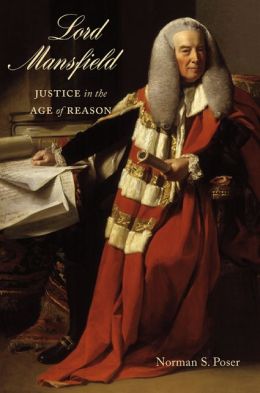
A few blurbs:In the first modern biography of Lord Mansfield (1705-1793), Norman Poser details the turbulent political life of eighteenth-century Britain's most powerful judge, serving as chief justice for an unprecedented thirty-two years. His legal decisions launched England on the path to abolishing slavery and the slave trade, modernized commercial law in ways that helped establish Britain as the world's leading industrial and trading nation, and his vigorous opposition to the American colonists stoked Revolutionary fires. Although his father and brother were Jacobite rebels loyal to the deposed King James II, Mansfield was able to rise through English society to become a member of its ruling aristocracy and a confidential advisor to two kings. Poser sets Mansfield's rulings in historical context while delving into Mansfield's circle, which included poets (Alexander Pope described him as "his country's pride"), artists, actors, clergymen, noblemen and women, and politicians. Still celebrated for his application of common sense and moral values to the formal and complicated English common law system, Mansfield brought a practical and humanistic approach to the law. His decisions continue to influence the legal systems of Canada, Britain, and the United States to an extent unmatched by any judge of the past. An illuminating account of one of the greatest legal minds, Lord Mansfield presents a vibrant look at Britain's Age of Reason through one of its central figures.
"I read this book with much pleasure and instruction. It admirably fills a major gap in the body of legal historical literature - the absence of a comprehensive biography of arguably the most famous and influential Anglo-American judge of the modern era." -- Simon Devereaux"A remarkable portrait of both a man and a legal age. I enjoyed the book tremendously, learned so much, and am deeply grateful. A master work." -- Kent Syverud
Anthony Alfieri, "He is the Darkey with the Glasses On”: Race Trials Revisited
Richard Delgado, Precious Knowledge: State Bans on Ethnic Studies, Book Traffickers (Librotraficantes), and a New Type of Race Trial
Cynthia Lee, Making Race Salient: Trayvon Martin and Implicit Bias in a Not Yet Post-Racial Society
Kevin R. Johnson and Joanna E. Cuevas Ingram, Anatomy of a Modern-Day Lynching: The Relationship Between Hate Crimes Against Latina/os and the Debate Over Immigration Reform
Gabriel J. "Jack" Chin, Cindy Hwang Chiang, and Shirley S. Park, The Lost Brown v. Board of Education of Immigration Law
Ariela Gross, & Alejandro De La Fuente, Slaves, Free Blacks, and Race in the Legal Regimes of Cuba, Louisiana, and Virginia: A Comparison
Martha S. Jones, Hughes v. Jackson: Race and Rights Beyond Dred Scott
Steven Lubet, Execution in Virginia, 1859: The Trials of Green and Copeland
Alfred L. Brophy, The Nat Turner Trials
Jury practice in the state and federal courts evolved dramatically in the nineteenth and early twentieth century. Around the time of the ratification of the Bill of Rights in 1791, important legal thinkers praised the civil jury as a bulwark against judicial tyranny. By the advent of the Federal Rules of Civil Procedure in 1938, many commentators regarded the civil jury as an antiquated nuisance. Diminishment of the jury and open exercise of judicial power, encouraged in the Federal Rules by procedures such as summary judgment, would not have been possible without earlier changes in jury practice. Two major changes were the rise of directed verdict procedure and the related judgment notwithstanding the verdict. These mechanisms allowed a judge to give a binding instruction to a jury, or to enter a judgment contrary to the jury’s decision.Lerner's discovery that a reform (directed verdicts) first championed by a business interest (railroads) later won the support of legal progressives (Charles E. Clark and other academic progenitors of the FRCP) has a counterpart in the public utility commission, which was first championed by legal progressives (such as Charles Evans Hughes) and later gained the support of business interests (railroads et al.) Three cheers for Robert Wiebe's Businessmen and Reform!
This Study reveals that railroads revolutionized the law of jury control. Changes in directed verdict were part of a larger program of jury reform beginning in the mid-nineteenth century in England, the states, and the federal government. Because of growing numbers of complicated personal injury suits against railroads, and because of perceived jury bias in those cases, many judges sought to control juries more efficiently. Directed verdicts began to replace new trials. Opposition arose, but the overall trend was toward greater judicial control of juries. The striking changes in jury practice described in this Article suggest difficulties in maintaining a consistent jury trial right by constitutional requirement.
 Just up on the website of the Historical Society of the DC Circuit is a video of Women in the Life and Law of the DC Circuit Courts, a program the Society sponsored in June. The website explains:
Led by the moderator, Professor Barbara Babcock, panelists Justice Ruth Bader Ginsburg, Judge Gladys Kessler, Judge Royce Lamberth, Nancy Mayer-Whittington, Michele Roberts, Judge Patricia Wald, and Helgi Walker assessed the role of women in the life and law of the Courts. In so doing, they described their professional and personal experiences while providing insights into the participation of women in the Courts of the Circuit, hurdles encountered and remaining, and the impact of women participating in increasing numbers in the judicial process.