[We have the following announcement for the conference "The Law and the Child in Historical Perspective, 1400-2000," to be held June 1-2, 2014, at the University of Minnesota Law School, 229 19th Ave. South, Minneapolis, MN 55455.]
The study of the history of children, youth and childhood has grown dramatically in the last two decades, making age a new category of historical analysis. The Law and the Child will focus on law's central role in changing understandings of childhood and children's experiences, considering among other things selfhood, family, market relations, society, and state. Our hope is for a broad reach geographically and chronologically, from the Medieval World to the Twenty-First Century, and for papers that consider the multiple sources that intersect in the legal construction of childhood and in children's lived legal experiences. These include race, class, gender, disability, sexuality, ethnicity, psychology, dependency, agency, citizenship, and (il)legitimacy. We also hope papers will address topics in both civil and criminal law. The conference, one of a series begun in 2007, is intended to showcase the work of junior scholars working the field of legal history and to bring them into conversation with senior scholars. It is co-sponsored by the University of Minnesota Law School and History Department, the Childhood and Youth Studies Across the Disciplines IAS Research Collaborative at the University of Minnesota, the Indiana University School of Law, the University of Pennsylvania Law School and History Department, the University of Illinois College of Law, the University of Michigan Law School, and the University of Chicago Department of History.
Interested participants should submit a proposal of no more than 300 words, in Word format, accompanied by a cv of no more than 3 pages to Barbara Welke at welke004@umn.edu. All proposals are due by 20 December 2013. Applicants will be notified by email no later than 17 February 2014 whether their proposals have been accepted for presentation. No previously published work will be accepted, as the conference is designed to provide a forum for productive and supportive discussion of works in progress.
Accepted participants will be required to submit a full paper, in Word format, of no more than 10,000 words by 1 May 2014. All papers will be pre-circulated on a password-protected website, and read by all participants. A modest travel and accommodations budget will be provided for all presenters.

Sunday Book Roundup
 In the Chronicle of Higher Education there is a review of The Allure of the Archives (Lewis Walpole Series) in which "the historian Arlette Farge conveys how much life can burst from brittle old pages."
H-Net also has several reviews of interest, including a review of Andreas Wimmer's Waves of War: Nationalism, State Formation, and Ethnic Exclusion in the Modern World (Cambridge University Press) as well as a review of Jo Becker's Campaigning for Justice: Human Rights Advocacy in Practice (Stanford University Press). Andrew E. Busch's Truman's Triumphs: The 1948 Election and the Making of Postwar America (University Press of Kansas) has also been reviewed on H-Net.
"Busch’s purpose in Truman’s Triumphs is straightforward. His goal is to analyze the 1948 election, paying heightened attention to the nomination process, the congressional elections, and public opinion. Joining other scholars, Busch argues that the 1948 election was a validation of the domestic policy of the New Deal, of the foreign policy of containment, and of the federal policy advocating civil rights. Busch contributes the unique interpretation that the 1948 election demonstrated both the “resilience” and “vulnerability” of the New Deal coalition (p. 210). He points out that although Truman trailed in the polls and came from behind, he also had significant advantages such as the New Deal coalition. In addition, Busch proves that although the Democrats suffered from obvious schisms, the Republicans were less noticeably but no less critically divided."

"Although Hutchison and Quigley tackle the larger topic of Southern nationalism from the antebellum era to Reconstruction, they focus on the experience of the Civil War and Confederate nationalism and argue that such nationalism preceded the formation of the Confederacy. Quigley shows the emergence of Southern nationalism “as a variant” and “fringe” of American nationalism. But, by evolving into a mainstream belief, he notes, it was transformed into Confederate nationalism as it struggled to reconcile its two inherent contradictions: first, a slavery based creed needing to appeal to non-slaveholders; and second, a “nationalism that derived its legitimacy from the ostensibly anti-national principle of State rights” (p. 13). Hutchison, by way of using the Confederacy as a case study, seeks to contribute to a wider investigation of the role of various genres of literature in the emerging of political communities. At the same time, Hutchison also wishes to prove his case that literary nationalists helped produce the Confederacy and created a “literary nationalism that was not only internationally minded, but also more durable than its state apparatus” (p. 4)."
 And, here's one we missed a few months back, a review of Rick Baldoz's The Third Asiatic Invasion: Empire and Migration in Filipino America, 1898-1946 (New York University Press), "an important work for historians seeking to bridge the fields of immigration and imperial studies."
The LA Review of Books reviews The Inconvenient Indian: A Curious Account of Native People in North America (University of Minnesota) by Thomas King.
"King’s tone is breezy and light, full of funny stories and self-deprecating jokes, but just below that geniality lies a deep reservoir of bitterness over the treatment of Indians in Canada and the United States that continues on to this day. White North Americans, he argues, prefer their Indians noble, primitive, and safely extinct, and actual, live Indians who stubbornly insist on their rights as an independent people they regard as at best a troublesome nuisance."

Salon again this week publishes an excerpt from a law and history related book, Keeping It Civil: The Case of the Pre-nup and the Porsche & Other True Accounts from the Files of a Family Lawyer by Margaret Klaw (Algonquin Books).
There are a few reviews this week of Year Zero: A History of 1945 (Penguin) by Ian Buruma, here in the New York Times and here in the New York Review of Books.
There's also two reviews of The Collaboration: Hollywood’s Pact with Hitler (Belknap Press) by Ben Urwand, one in the Washington Post, and a second in the Wall Street Journal.
"Signposts," "Westward Bound," "Inside the Castle" Reviewed in the Law & Politics Book Review
The Law & Politics Book Review is out with a new batch of reviews. Items of interest include:
 Walter F. Pratt, Jr. (University of South Carolina School of Law) reviews SIGNPOSTS: NEW DIRECTIONS IN SOUTHERN LEGAL HISTORY (University of Georgia Press, 2013), edited by Sally E. Hadden and Patricia Hagler Minter.
Zvi H. Triger (The Haim Striks School of Law, College of Management Academic Studies, Rishon LeZion, Israel) reviews INSIDE THE CASTLE: LAW AND THE FAMILY IN 20TH CENTURY AMERICA (Princeton University Press, 2011), by Joanna L. Grossman and Lawrence M. Friedman.
Michael Boudreau (Department of Criminology & Criminal Justice, St. Thomas University) reviews WESTWARD BOUND: SEX, VIOLENCE, THE LAW, AND THE MAKING OF A SETTLER SOCIETY (UBC Press, 2011), by Lesley Erickson.
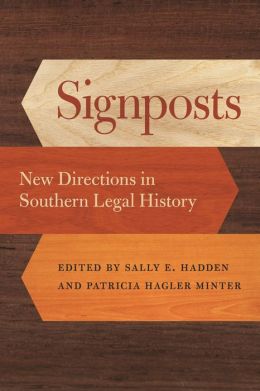 Walter F. Pratt, Jr. (University of South Carolina School of Law) reviews SIGNPOSTS: NEW DIRECTIONS IN SOUTHERN LEGAL HISTORY (University of Georgia Press, 2013), edited by Sally E. Hadden and Patricia Hagler Minter.
Zvi H. Triger (The Haim Striks School of Law, College of Management Academic Studies, Rishon LeZion, Israel) reviews INSIDE THE CASTLE: LAW AND THE FAMILY IN 20TH CENTURY AMERICA (Princeton University Press, 2011), by Joanna L. Grossman and Lawrence M. Friedman.
Michael Boudreau (Department of Criminology & Criminal Justice, St. Thomas University) reviews WESTWARD BOUND: SEX, VIOLENCE, THE LAW, AND THE MAKING OF A SETTLER SOCIETY (UBC Press, 2011), by Lesley Erickson.
Hartog's Mitchell Lecture
Hendrik Hartog’s James McCormick Mitchell Lecture at the University at Buffalo Law School in 2012, entitled, Two Stories about Two Currencies of Care, is available on-line from the Buffalo Law Review. It is based on his book, Someday All This Will Be Yours: A History of Inheritance and Old Age (2012).
Sunday Book Roundup
 The Washington Post this week has a review of The Road to War: Presidential Commitments Honored and Betrayed (Brookings Institution Press) by Marvin Kalb. "In his timely book, “The Road to War,” veteran journalist and diplomatic correspondent Marvin Kalb explores the tangled history of the foreign policy commitments that modern presidents have made and the knots these leaders have turned themselves into trying to rationalize or escape their words."
The Post also notes the presence of Harvard Law's Kenneth Mack and others at the National Book Festival's History & Biography Pavilion this week.
Salon has published an excerpt from Karen Dunak's new book As Long as We Both Shall Love: The White Wedding in Postwar America (NYU Press) about "The secret history of gay marriage" and the "same-sex weddings [that] were happening in this country for decades before the Supreme Court permitted it."
"On October 10, 1987, nearly 7,000 people witnessed a wedding on the National Mall in Washington, DC. Men and women cheered and threw rice and confetti as family, friends, and community members took part in the largest mass wedding in American history. After the celebrants exchanged rings and were pronounced newlywed, guests released hundreds of balloons into the air. Brides and grooms, dressed in formal wedding attire, cried and embraced after an “emotional and festive” ceremony. Like so many brides and grooms, participants identified the wedding day as one of the happiest, most meaningful days of their lives.

But this was no ordinary wedding. And these were not typical brides and grooms. This wedding held special significance for its participants. Beyond the “mass” nature of the celebration, something else was unique. The newlyweds that fall Saturday paired off as brides and brides, grooms and grooms. “The Wedding,” as it came to be known, marked the symbolic beginning of nearly 2,000 same-sex marriages."

This week H-Net has several new reviews in law and history: Keith Altavilla finds a "Printer, Democrat, and Soldier" in Robert Grandchamp' Colonel Edward E. Cross, New Hampshire Fighting Fifth: A Civil War Biography (McFarland & Company, Inc.), and Rachel T. Van reviews Emily Clark's The Strange History of the American Quadroon: Free Women of Color in the Revolutionary Atlantic World (University of North Carolina Press).
 David Siemers also reviews for H-Net The Forgotten Presidents: Their Untold Constitutional Legacy (Oxford University Press) by Michael J. Gerhardt.
"Quick. What do William Howard Taft, Calvin Coolidge, and Jimmy Carter have in common? The answer, or one answer at least, is that they are the twentieth-century presidents placed alongside many of their nineteenth-century counterparts in Michael J. Gerhardt’s The Forgotten Presidency: Their Untold Constitutional Legacy. In this book, Gerhardt underscores that even the presidents we know least well had a major impact on governance and on the shape of their office. In this he is largely successful, with interesting tales told along the way. Scholars of the presidency will find that the book does not break substantial new ground, but lay readers interested in the presidency and wanting a broad tour of presidential history will profit from the book."More reviews after the jump...
Read more »
Fleckner on the Peculium
Andreas M. Fleckner, Max Planck Institute for Comparative and International Private Law, has posted The Peculium: A Legal Device for Donations to Personae Alieno Iuri Subiectae? Here is the abstract:
The peculium was the estate of sons, slaves, and other persons who were subject to the authority of someone else (personae alieno iuri subiectae). The peculium has two distinct facets: for those who were subject to another’s authority, the receipt of a peculium gave some degree of financial independence and autonomy, while for those who exerted authority, granting a peculium offered the prospect of participating indirectly, and therefore at lower risk, in business ventures that the recipient may elect to conduct. So far so good – that is the basic concept that emerges from the sources. But what was the peculium’s role, if any, in ancient society? Over the last couple of decades, one aspect of the peculium’s second facet – allowing the grantor of the peculium to team up with others and share in larger business ventures of the recipient – has become a more and more popular explanation. This assumption, however, faces two objections: first, no sources have come down to us that support the idea that the peculium was indeed used to organize larger business ventures, and second, the peculium’s legal regime seems less than optimal and in some respects even ill-suited to fund such enterprises. Therefore, if investing in business ventures is not the prime factor that drove the peculium’s development, its first facet comes back to the fore: was the peculium primarily a legal device for donations to personae alieno iuri subiectae?
New Release: Denial, "Making Marriage: Husbands, Wives, and the American State in Dakota and Ojibwe Country"
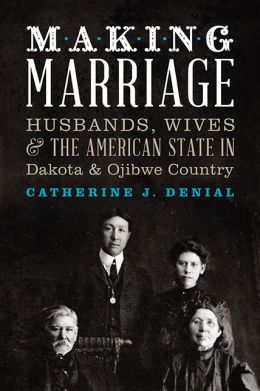
The debate over the meaning of marriage in the United States and specifically in Minnesota is not a recent development. From 1820 to 1845, when the first significant numbers of Americans arrived in the region now called Minnesota, they carried the belief that good government and an orderly household went hand in hand. The territorial, state, and federal governments of the United States were built upon a particular vision of civic responsibility: that men, as heads of households, enter civic life on behalf of their dependents—wives, children, servants, and slaves. These dependents were deemed unfit to make personal decisions or to involve themselves in business and government—and they owed labor and obedience to their husbands, fathers, and masters.
These ideas clashed forcibly with the conceptions of kinship and social order that existed among the Upper Midwest's long-established Dakota, Ojibwe, and mixed-heritage communities. In resisting the new gender and familial roles advocated by military personnel, Indian agents, and missionaries, the region’s inhabitants frustrated American attempts to transform Indian country into a state. Indeed, many Americans were forced to compromise their own beliefs so that they could put down roots.
Through the stories of married—and divorcing—men and women in the region, Catherine J. Denial traces the uneven fortunes of American expansion in the early nineteenth century and the nation-shaping power of marital acts.
Penningroth on African American Divorce, 1865-1930
Dylan C. Penningroth, Northwestern University, has posted an item from his backlist, African American Divorce in Virginia and Washington, D.C., 1865-1930, which appeared in the Journal of Family History 33 (January 2008): 21-35. Here is the abstract:
This article explores the dynamics of divorce among African Americans from 1865 through the early years of the Great Migration. It builds on recent socio-legal scholarship that sees law as local, experiential, and improvised; drawing on local court records from Virginia and Washington, D.C. By focusing on divorce, a legal proceeding in which the litigants were nearly always of the same race, the article recovers under-examined dimensions of African American life, and suggests ways of moving beyond familiar dyads of race relations. Far from avoiding southern lower courts, African Americans pressed hundreds of suits; and participated vigorously in the legal process as litigants, clients, and witnesses. The legal process also involved translating popular notions, including those of gender and race, into legal categories. Black women who ended their marriages had to navigate a treacherous “politics of respectability." Finally, African American divorce was linked in complex ways to the Great Migration.
Mintz on the Historians' Briefs in Windsor
Over at Inside Higher Ed, Steven Mintz asks, Does History Matter?
At a time when many question the relevance of history, it is noteworthy that the U.S. Supreme Court case that prohibited the federal government from undercutting a state’s decision to extend "the recognition, dignity and protection" of marriage to same-sex couples, hinged on arguments advanced by professional historians.
More
New Release: Onwuachi-Willig, "According to Our Hearts: Rhinelander v. Rhinelander and the Law of the Multiracial Family"

This landmark book looks at what it means to be a multiracial couple in the United States today. According to Our Hearts begins with a look back at a 1925 case in which a two-month marriage ends with a man suing his wife for misrepresentation of her race, and shows how our society has yet to come to terms with interracial marriage. Angela Onwuachi-Willig examines the issue by drawing from a variety of sources, including her own experiences. She argues that housing law, family law, and employment law fail, in important ways, to protect multiracial couples. In a society in which marriage is used to give, withhold, and take away status—in the workplace and elsewhere—she says interracial couples are at a disadvantage, which is only exacerbated by current law.One of of the blurbs on the book's webpage comes from our very own Tomiko Brown-Nagin:
"According to Our Hearts is a fascinating—and sobering—account of interracial relationships in America. Onwauchi-Willig persuasively argues that the “mono-racial” family remains the social and legal standard by which all others are measured. Anyone interested in race, gender and the law will find the book an absorbing and enlightening read."More information is available here. It looks like excerpts and the TOC will be available soon.
Historians Weigh in on the Marriage Equality Decisions
George Chauncey has an op-ed in the New York Times (hat tip: H-Law)
Mary Dudziak comments at Balkinization.
Readers may also be interested in these articles from the History News Network:
Mary Dudziak comments at Balkinization.
Readers may also be interested in these articles from the History News Network:
Blokhuis to Lecture on Students Rights at the Kluge Center
On Thursday, June 27, at 12 p.m., Kluge Fellow J.C. Blokhuis discusses “Student Rights and the ‘Special Characteristic of the School Environment’ from a Jurisprudential Perspective” in the Woodrow Wilson Room (LJ-113), Thomas Jefferson Building, Library of Congress. 10 First St. S.E., Washington, D.C.
Until 1966, constitutional rights were not for children. Minors and other legally incompetent persons had custodial interests, not liberty interests. Public educational authority in general and compulsory schooling laws in particular had been predicated on an expansive conception of the duty of the State as parens patriae to safeguard and promote the custodial interests of children.Webcasts of Kluge lectures go up approximately two months after the date of the program, here.
The Supreme Court wrestled with the custodial implications until 1995, when the ‘special characteristics of the school environment’ were defined in a manner that explained why the constitutional rights of pupils could not be coextensive with those of adults. Professor Blokhuis addresses the difficulties associated with unqualified ascriptions of constitutional rights to minors, particularly in contexts designed to be custodial in the present and liberating in the future.
Abrams on the History of the Derivative Domicile Rule
Kerry Abrams, University of Virginia School of Law, has posted Citizen Spouse, which appears in California Law Review 101 (2013): 407. Here is the abstract:
Marriage and citizenship have a complicated relationship to one another. Marriage is often the primary way in which a person can exercise and demonstrate his or her identity under law, by claiming legal benefits and by performing legal obligations. This Essay examines the history of one particularly salient example of marriage-as-citizenship — the derivative domicile rule — and uses this history to consider how the relationship between marriage and citizenship has changed and developed over time. The derivative domicile rule linked a woman’s domicile, and her state citizenship along with all the rights and obligations it carried, with her husband’s domicile by operation of law. This happened regardless of where she actually lived or what state she subjectively owed allegiance to. Derivative domicile remains pertinent today because many states still use it to determine state citizenship for married people, either as a presumption rebuttable by a married woman or as a rule that applies to both spouses and links their domicile by presuming they will each regard one single place as their home. The history and current application of the derivative domicile rule demonstrate that these presumptions fail to accurately reflect the preferences of many married people whose domiciles do not match their spouses’. This Essay argues that derivative domicile illustrates the dangers of uncritically eliding marriage and citizenship.
The Backhouse Backlist
[We're moving up this updated post.]
 Constance B. Backhouse, a Distinguished University Professor on the University of Ottawa's Faculty of Law and an immediate Past President of the ASLH, has posted some of her backlist:
"Pleasing Appearance...Only Adds to the Danger": The 1930 Insanity Hearing of Violet Hypatia Bowyer, Canadian Journal of Women and the Law 17:1 (2005) 1-13
The state's legal authority to detain individuals within insane asylums in early twentieth-century Canada was deeply influenced by factors of gender, class, and race. Violet Hypatia Bowyer, a working-class, white woman who was just twenty-two years old in 1928, was initially incarcerated in Ontario for leading a 'dissolute' life. Wrongly diagnosed as 'insane' by prison officials, she tried valiantly, but failed, to secure her release through legal challenge. The expert testimony of the prison officials, the psychiatric 'experts,' and the decision of the court all testify to the terrifying coerciveness of law in Canadian history.'Don't You Bully Me - Justice I Want If There is Justice to Be Had': The Rape of Mary Ann Burton, London, Ontario, 1907, in People and Place: Historical Influences on Legal Culture, ed. Jonathan Swainger and Constance Backhouse (Vancouver: University of British Columbia Press, 2003), 60-94.
In 1907, Mary Ann Burton launched a complaint of rape against Joseph Gray in London, Ontario. Judicial decisions and literature at the time claimed that rape was “an accusation easily to be made”, despite the common knowledge that rape was underreported. Mary Ann Burton's case sets no legal precedent; she was treated with suspicion and hostility, and the charges were ultimately dismissed by the court. Yet Mrs. Burton resisted the antagonism she experienced – namely tactics by defence counsel to attack her character, her image as a “worthy victim”, her credibility, and her recollection of every finite detail of the incident. She remained resolute in her testimony and her right to be protected from rape, in the face of pernicious commentary from acquaintances, and a courtroom that systematically discredited and ultimately dismissed her based largely on her gender and class.The Doctrine of Corroboration in Sexual Assault Trials in Early Twentieth-Century Canada and Australia, Queen's Law Journal 26 (2001): 297-338.
The author compares two early twentieth century criminal cases, one Australian and one Canadian, involving carnal knowledge of a child. The cases illustrate the parallel development of the doctrine of corroboration in sexual assault cases in the two countries – a doctrine which was based on the belief that the testimony of women and girls in such cases was inherently suspect. By requiring that corroborating evidence be independent of the complainant's testimony, and by interpreting that requirement in an extremely rigid way to exclude particular items of evidence that strongly supported the complaints, the courts in both cases imposed unjustified obstacles to the conviction of men accused of sexual offences. This misuse of the doctrine of corroboration contradicted the ideals of evenhanded justice and gender equality in both Canada and Australia.'I Was Unable to Identify with Topsy' - Carrie M. Best's Struggle Against Racial Segregation in Nova Scotia, 1942, Atlantis 22 (Spring 1998) 16-26.
This paper describes a court case that was buried in Canadian legal archives for fifty-six years. In 1942, Carrie Best brought a civil action for damages against a Nova Scotia theatre, claiming that the owners were enforcing a racially-segregated seating policy. The action was ultimately dismissed. Dr. Best, an African-Canadian who was a teacher, journalist, and founder of The Clarion (a newspaper that she began publishing in 1945) had been a long-time advocate for human rights and activist against racial discrimination and segregation in Nova Scotia. Carrie Best's decorated career as a journal and activist is public knowledge, but the history of her unsuccessful litigation calls for scrutiny. Such cases help us understand Canadian history to be deeply marked with racism.Read more »
Tsoukala reviews Kang'ara, "Beyond Bed and Bread"
Over at JOTWELL, Philomila Tsoukala (Georgetown University Law Center) has posted a review that may be of interest. She covers Sylvia Wairimu Kang'ara, "Beyond Bed and Bread: Making the African State through Marriage Law Reform -- Constitutive and Transformative Influences of Anglo-American Legal Thought." The article appeared in Volume 9 of the Hastings Race & Poverty Law Journal (2012) and is available online at Comparative L. Rev. Here's an excerpt from Tsoukala's review:
The Article begins by analyzing the central role that the invalidation of customary marriages in Africa played in colonial administration. During the initial legal encounter between common law and African customary laws, judges invalidated large swaths of prior legal relations. In a (professed) effort to align colonial practices with English morality, colonial administrations superimposed a classical legal scheme of thinking about the family and the market at a moment when most of the African economy depended upon a different household model. Instead of the separate spheres ideology that characterized family law of the classical legal tradition, African customary marriages were based on an economically active household—often composed of polygamous units engaging in economically important exchanges of property through marriage, such as the bride-price. Starting from an assumption that individual free will was the building block for any civilized legal system, colonial judges invalidated customary marriages as repugnant to English colonial morality. They looked hard, but did not seem to find any African subjects capable of becoming “individual holders of exclusive and absolute rights” in the classical legal tradition. Critically, customary marriage’s failure to cultivate subjects that were suitable rightsholders marked the first step toward property expropriation in the name of empire building.
In this way, Kang’ara shows that, far from being an act with merely moral significance, “defining marriage was an important act of conquest and a corner stone of the market oriented state” that emerged via colonialism. . . .Read on here.
L&HR 31:2 (May 2013)
 Law and History Review’s 31:2 issue (May 2013) is up on the Cambridge Journals website. Here are the articles
Protective Labor Legislation in the Courts: Substantive Due Process and Fairness in the Progressive Era, by Claudio J. Katz
Constitutional Principle, Partisan Calculation, and the Beveridge Child Labor Bill, by Logan Everett Sawyer
“Equals of the White Man”: Prosecution of Settlers for Violence Against Aboriginal Subjects of the Crown, Colonial Western Australia, by Amanda Nettelbeck
Jews or Germans? Nationality Legislation and the Restoration of Liberal Democracy in Western Europe after the Holocaust, by David Fraser and Frank Caestecker
“Our Militancy is in Our Openness”: Gay Employment Rights Activism in California and the Question of Sexual Orientation in Sex Equality Law, by Katherine Turk
Book reviews after the jump.
Read more »
Schwier on Native-European Relations in Indiana
Ryan T. Schwier, Indiana University-Purdue University Indianapolis Law, has posted According to the Custom of the Country”: Indian Marriage, Property Rights, and Legal Testimony in the Jurisdictional Formation of Indiana Settler Society, 1717-1897. Here is the abstract:
This study examines the history of Indian-settler legal relations in Indiana, from the state’s pre-territorial period to the late-nineteenth century. Through a variety of interdisciplinary sources and methods, the author constructs a broad narrative on the evolution and co-existence of Native and non-Native customary legal systems in the region, focusing on matters related to marriage, property rights, and testimony. The primary thesis - which emphasizes reciprocally formative relations, rather than persistent conflict - suggests that Indiana’s pre-modern legal past involved an ad hoc yet highly effective process of cultural brokerage, reciprocity and inter-personal accommodation. That the American Indians lost much of their self-governing status following the period of contact is clear; however, a closer look at the ways in which nations historically defined, exercised, asserted, and shared jurisdiction, reveals a more intricate story of influence, authority, and concession. During the French and British colonial and American territorial periods, settler society adjusted to and often accommodated Native concepts of law and justice. Through a complex order of social obligations and community-based enforcement mechanisms, a shared set of rules and jurisdictional practices merged, forming a hybrid system of Indian-settler norms that bound these individuals across the cultural divide.
When Indiana entered the Union in 1816, legal pluralism defined jurisdictional practice. However, with the nineteenth-century rise of legal positivism - the idea of law as the sole command of the nation-state, a sovereign entity vested with exclusive authority - territorial jurisdiction and legal uniformity became guiding principles. Many jurists viewed the informal, pre-existing custom-based regulatory structures with contempt. With the shift to a state-centered legal order, lawmakers established strict standards for recognizing the law of the “other,” ultimately rejecting the status of the tribes as equal sovereigns and forcing them to concede jurisdiction to the settler polity.


