[We have the following CFP for the conference, "The Corpse of Evidence: Cadavers and Proofs in Early Modern European Forensic Medicine."]
We invite scholars to submit abstracts for a proposed volume on the history of early modern European forensic medicine. At the center of the volume is the cadaver, observed, dissected and manipulated to provide answers to the questions of doctors, lawyers, theologians. How did the practices of interrogation of the dead body evolve in the different European countries and how did the concept of proof change?
Proposals are encouraged which, while based on specific case studies, can provide ample stimulus for reflection and allow for comparisons between countries with different cultural, and particularly scientific, traditions.
We welcome submissions on the following subjects:
- Medical-legal Literature
- Dissection practices and narratives
- Resistance to dissection
- Postmortem phenomena
- The corpse in the history of mentalités
- Comparative analyses between the various European legal systems
- Comparisons of doctors, lawyers and theologians
- Pathological anatomy and teratology
- Processes of beatification and sanctification in the Catholic Church
Those interested should submit a 300 word abstract describing the essay they propose to write. Authors should include a short cv, affiliation and contact information with their abstracts, which should be sent electronically to Dr. Francesco Paolo de Ceglia: francescopaolo.deceglia@uniba.it
The deadline for submission is November 1, 2013.."]
We invite scholars to submit abstracts for a proposed volume on the history of early modern European forensic medicine. At the center of the volume is the cadaver, observed, dissected and manipulated to provide answers to the questions of doctors, lawyers, theologians. How did the practices of interrogation of the dead body evolve in the different European countries and how did the concept of proof change?
Proposals are encouraged which, while based on specific case studies, can provide ample stimulus for reflection and allow for comparisons between countries with different cultural, and particularly scientific, traditions.
We welcome submissions on the following subjects:
- Medical-legal Literature
- Dissection practices and narratives
- Resistance to dissection
- Postmortem phenomena
- The corpse in the history of mentalités
- Comparative analyses between the various European legal systems
- Comparisons of doctors, lawyers and theologians
- Pathological anatomy and teratology
- Processes of beatification and sanctification in the Catholic Church
Those interested should submit a 300 word abstract describing the essay they propose to write. Authors should include a short cv, affiliation and contact information with their abstracts, which should be sent electronically to Dr. Francesco Paolo de Ceglia: francescopaolo.deceglia@uniba.it
The deadline for submission is November 1, 2013.

Wesson, "A Death at Crooked Creek"
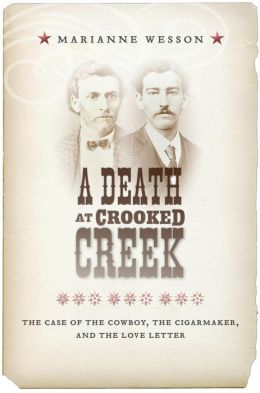
As Dan mentioned in the last Weekend Roundup, the Spring 2013 edition of H-Law's "New Books in U.S. Constitutional/Legal History" is now out. (We owe a big thanks to Timothy S. Huebner, Rhodes College, for the yeoman service of compiling the list.) One title that caught my eye was Marianne Wesson's A Death at Crooked Creek: The Case of the Cowboy, the Cigarmaker, and the Love Letter (New York University Press, 2013). Intrigued, I looked up a fuller description. Here it is:
For more information, including access to the book's Introduction, follow the link.One winter night in 1879, at a lonely Kansas campsite near Crooked Creek, a man was shot to death. The dead man’s traveling companion identified him as John Hillmon, a cowboy from Lawrence who had been attempting to carve out a life on the blustery prairie. The case might have been soon forgotten and the apparent widow, Sallie Hillmon, left to mourn—except for the $25,000 life insurance policies Hillmon had taken out shortly before his departure. The insurance companies refused to pay on the policies, claiming that the dead man was not John Hillmon, and Sallie was forced to take them to court in a case that would reach the Supreme Court twice. The companies’ case rested on a crucial piece of evidence: a faded love letter written by a disappeared cigarmaker, declaring his intent to travel westward with a “man named Hillmon.”
In A Death at Crooked Creek, Marianne Wesson re-examines the long-neglected evidence in the case of the Kansas cowboy and his wife, recreating the court scenes that led to a significant Supreme Court ruling on the admissibility of hearsay evidence. Wesson employs modern forensic methods to examine the body of the dead man, attempting to determine his true identity and finally put this fascinating mystery to rest.
This engaging and vividly imagined work combines the drama, intrigue, and emotion of excellent storytelling with cutting-edge forensic investigation techniques and legal theory. Wesson’s superbly imagined A Death at Crooked Creek will have general readers, history buffs, and legal scholars alike wondering whether history, and the Justices, may have misunderstood altogether the events at that bleak winter campsite.
Schwier on Native-European Relations in Indiana
Ryan T. Schwier, Indiana University-Purdue University Indianapolis Law, has posted According to the Custom of the Country”: Indian Marriage, Property Rights, and Legal Testimony in the Jurisdictional Formation of Indiana Settler Society, 1717-1897. Here is the abstract:
This study examines the history of Indian-settler legal relations in Indiana, from the state’s pre-territorial period to the late-nineteenth century. Through a variety of interdisciplinary sources and methods, the author constructs a broad narrative on the evolution and co-existence of Native and non-Native customary legal systems in the region, focusing on matters related to marriage, property rights, and testimony. The primary thesis - which emphasizes reciprocally formative relations, rather than persistent conflict - suggests that Indiana’s pre-modern legal past involved an ad hoc yet highly effective process of cultural brokerage, reciprocity and inter-personal accommodation. That the American Indians lost much of their self-governing status following the period of contact is clear; however, a closer look at the ways in which nations historically defined, exercised, asserted, and shared jurisdiction, reveals a more intricate story of influence, authority, and concession. During the French and British colonial and American territorial periods, settler society adjusted to and often accommodated Native concepts of law and justice. Through a complex order of social obligations and community-based enforcement mechanisms, a shared set of rules and jurisdictional practices merged, forming a hybrid system of Indian-settler norms that bound these individuals across the cultural divide.
When Indiana entered the Union in 1816, legal pluralism defined jurisdictional practice. However, with the nineteenth-century rise of legal positivism - the idea of law as the sole command of the nation-state, a sovereign entity vested with exclusive authority - territorial jurisdiction and legal uniformity became guiding principles. Many jurists viewed the informal, pre-existing custom-based regulatory structures with contempt. With the shift to a state-centered legal order, lawmakers established strict standards for recognizing the law of the “other,” ultimately rejecting the status of the tribes as equal sovereigns and forcing them to concede jurisdiction to the settler polity.


