Freedman, "Redefining Rape"

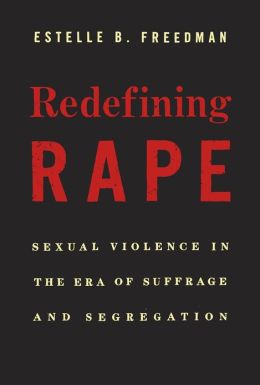
In last Sunday's book review round-up, Emily mentioned Estelle B. Freedman's new book, Redefining Rape: Sexual Violence in the Era of Suffrage and Segregation (Harvard University Press). A fuller description seemed worth posting. From the Press:
Rape has never had a universally accepted definition, and the uproar over "legitimate rape" during the 2012 U.S. elections confirms that it remains a word in flux. Redefining Rape tells the story of the forces that have shaped the meaning of sexual violence in the United States, through the experiences of accusers, assailants, and advocates for change. In this ambitious new history, Estelle Freedman demonstrates that our definition of rape has depended heavily on dynamics of political power and social privilege.
The long-dominant view of rape in America envisioned a brutal attack on a chaste white woman by a male stranger, usually an African American. From the early nineteenth century, advocates for women's rights and racial justice challenged this narrow definition and the sexual and political power of white men that it sustained. Between the 1870s and the 1930s, at the height of racial segregation and lynching, and amid the campaign for woman suffrage, women's rights supporters and African American activists tried to expand understandings of rape in order to gain legal protection from coercive sexual relations, assaults by white men on black women, street harassment, and the sexual abuse of children. By redefining rape, they sought to redraw the very boundaries of citizenship.
Freedman narrates the victories, defeats, and limitations of these and other reform efforts. The modern civil rights and feminist movements, she points out, continue to grapple with both the insights and the dilemmas of these first campaigns to redefine rape in American law and culture.

Read more »

Smith on the Regulation of Prostitution in New Orleans

Simon Stern has drawn our attention to the following (gated) article: Elizabeth Parish Smith, “In a Bar Room Called the ‘Fifteen Amendment’”: Reconstruction and the Women of New Orleans’s Demimonde, South Atlantic Quarterly 112 (2013): 473-479.  Here is the abstract:
This essay examines the experiences of three women—one Creole, one black, one white—in New Orleans’s Reconstruction-era demimonde. Enacted just months after the end of the Civil War and surviving in various forms for fifty-two years, a regulatory system governed the sex trade in this, the largest and most cosmopolitan city of the former Confederacy. Postwar regulation made no racial distinctions among women in the trade, and prostitutes’ lives were thus often remarkably similar. Women worked and resided in the same parts of town, even on the same notorious block; faced similarly explosive, dangerous bursts of violence; and exploited the physical intimacy of their work to steal from clients.

In large measure due to their similar legal treatment under regulation, many prostitutes shared W. E. B. Du Bois’s common “economic condition and destiny” across racial lines. Nevertheless, Du Bois uses prostitution in Black Reconstruction as a rhetorical device representing capitalism’s moral corruption, not as a practice affecting real women’s lives. Reading the experiences of three New Orleans prostitutes against the larger racial and economic politics of the period allows us to see how some of the most radical and far-reaching changes of Reconstruction occurred among women living at the law’s edges.

Heins reviews Braukman on the Johns Committee in Florida, 1956-1965

Via our friends at H-Law, we have a review of Stacy Lorraine Braukman, Communists and Perverts under the Palms: The Johns Committee in Florida, 1956-1965 (University Press of Florida, 2012). Here's an excerpt, from reviewer Marjorie Heins (New York University):
When the Florida legislature created a committee in 1956 to investigate organizations that advocated violations of state law, the clearly understood purpose was to brand the NAACP, the state’s leading proponent of ending segregation, as communist-run and un-American. Using anticommunism to discredit the civil rights movement was hardly a new tactic during the McCarthy era, but the Florida Legislative Investigation Committee (FLIC), or Johns Committee (named in honor of its sponsor, state senator Charley Johns) was conspicuously unsuccessful in its efforts to stigmatize or intimidate the NAACP.
So, seeking to maintain its political credibility and its funding, the committee soon turned its attention from the assumed evils of communism and race-mixing to those of homosexuality. It initiated a witch hunt that was unique in U.S. history for its combination of prurience, invasion of privacy, twisted moralism, and psychological ignorance. Stacy Braukman’s Communists and Perverts under the Palms, despite its questionable title, provides a useful, straightforward account of the campaign.
The full review is available here.

[Like what you see? H-Net recently issued a plea for donations so that it can continue providing content like this free of charge and without commercial advertising. Follow the link for more information.]

Dubrow Wins Mellon New Directions Fellowship

According to the North Adams Transcript, "Sara Dubow, associate professor of history at Williams College, has been awarded a New Directions Fellowship from the Andrew W. Mellon Foundation to develop research projects that focus on the legal history of reproductive and sexual politics."  More.

L&HR 31:2 (May 2013)

Law and History Review’s 31:2 issue (May 2013) is up on the Cambridge Journals website.  Here are the articles

Protective Labor Legislation in the Courts: Substantive Due Process and Fairness in the Progressive Era, by Claudio J. Katz

Constitutional Principle, Partisan Calculation, and the Beveridge Child Labor Bill, by Logan Everett Sawyer

“Equals of the White Man”: Prosecution of Settlers for Violence Against Aboriginal Subjects of the Crown, Colonial Western Australia, by Amanda Nettelbeck

Jews or Germans? Nationality Legislation and the Restoration of Liberal Democracy in Western Europe after the Holocaust, by David Fraser and Frank Caestecker

“Our Militancy is in Our Openness”: Gay Employment Rights Activism in California and the Question of Sexual Orientation in Sex Equality Law, by Katherine Turk

Book reviews after the jump.
Read more »
Gay Men More Likely to Have Survived Cancer

A new article in the journal Cancer finds that gay men are nearly twice as likely to report being cancer survivors than straight men are. However, sexual orientation is not part of cancer surveillance information, so researchers relied on self-reported health from the California Health Interview survey. As a result, it is still unclear why there are a disproportionately high number of gay cancer survivors. Either gay men are more likely to develop cancer in the first place (as some media headlines have seemed to suggest) or they are more likely to survive a cancer diagnosis. The BBC explains that "further research would be needed to determine if homosexual men were actually getting more tumors or had greater survival rates." The authors of the study, however, seem to lean towards the idea that gay men are more likely to get cancer than straight men (or than lesbian women, who have no significantly higher rate of cancer than straight women). The article notes that HIV infection -- substantially higher in gay men -- can lead to increased susceptibility to cancer and that HPV infection -- also high in gay men -- can lead to anal cancer.

Among those men who did survive cancer, there was no statistically significant difference in self-reported health between homosexual men and heterosexual men. However, bisexual women were 2.0-2.3 times more likely to report poor or fair health than heterosexual women.

ZM cf

Blog Archive