Belt Wins American Studies Award
Rabia Belt, a doctoral candidate in the University of Michigan’s Department of American Culture and a Research Academic Fellow at the Georgetown University Law Center has won the American Studies Association’s Gene Wise-Warren Susman Prize, for “the best paper to be presented by a graduate student at the annual meeting” of the ASA. Her paper is entitled “What Does Citizenship Mean for People with Mental Disabilities?”

New Release: Smith, "Freedom's Frontier: California and the Struggle over Unfree Labor, Emancipation, and Reconstruction""
New from the University of North Carolina Press: Freedom's Frontier: California and the Struggle over Unfree Labor, Emancipation, and Reconstruction, by Stacey L. Smith (Oregon State University). A description from the Press:
Most histories of the Civil War era portray the struggle over slavery as a conflict that exclusively pitted North against South, free labor against slave labor, and black against white. In Freedom's Frontier, Stacey L. Smith examines the battle over slavery as it unfolded on the multiracial Pacific Coast. Despite its antislavery constitution, California was home to a dizzying array of bound and semibound labor systems: African American slavery, American Indian indenture, Latino and Chinese contract labor, and a brutal sex traffic in bound Indian and Chinese women. Using untapped legislative and court records, Smith reconstructs the lives of California's unfree workers and documents the political and legal struggles over their destiny as the nation moved through the Civil War, emancipation, and Reconstruction.

Smith reveals that the state's anti-Chinese movement, forged in its struggle over unfree labor, reached eastward to transform federal Reconstruction policy and national race relations for decades to come. Throughout, she illuminates the startling ways in which the contest over slavery's fate included a western struggle that encompassed diverse labor systems and workers not easily classified as free or slave, black or white.
A few blurbs:
"A real winner: ambitious, thoughtful, and splendidly rendered. Smith peels back history to rework the labor landscapes of nineteenth-century California and reintroduce the state into dynamic, Reconstruction-era political and social debates."--William Deverell
"A brilliant and long overdue examination of late-nineteenth-century California's complicated race and labor history. By comparing the stories of bound Native American, African American, Chinese, Latino, and Hawaiian workers, Smith reveals the complexities of California's racial and labor histories and goes even further to demonstrate the larger implications for the California experience for understanding national stories of abolition, emancipation, Reconstruction, and immigration."--Michael Magliari
More information is available here.
Barreyre reviews Weil, "The Sovereign Citizen"

Sometimes the narrow end of things provides the best perspective. At times, the fringe or the borderline case sheds more light on a notion than facing it squarely. This is what Patrick Weil does in his latest work. Through the analysis of a rather recent and rare phenomenon—the loss of nationality—he offers a new vision of citizenship, a central notion in American history already addressed in an extensive historiography. [footnote omitted]
Chin, Chiang and Park on Lee Kum Hoy
Gabriel J. Chin, UC Davis Law, Cindy Hwang Chiang and Shirley S. Park have posted The Lost Brown v. Board of Education of Immigration Law, which appears in the North Carolina Law Review 91 (2013). Here is the abstract:
This Article proposes that in 1957, the Supreme Court came close to applying Brown v. Board of Education to immigration law. In Brown, the Supreme Court held that school segregation was unconstitutional. Ultimately, Brown came to be understood as prohibiting almost all racial classifications. Meanwhile, in a line of cases exemplified by Chae Chan Ping v. United States and Fong Yue Ting v. United States, the Supreme Court held that Congress enjoyed plenary power to discriminate on any ground, including race, in immigration law. These holdings have never been formally overruled. Immigration, then, is said to be an exception to the general rule of Brown and Bolling v. Sharpe.
In 1957, however, the Supreme Court granted certiorari in United States ex rel Lee Kum Hoy v. Murff, to resolve the question of the permissibility of race discrimination in the immigration context. The case involved a policy under which immigration officials tested the blood of Chinese people immigrating as children of U.S. citizens to determine whether they were related to their claimed parents, but not the blood of similarly situated members of other races. The Second Circuit, over the dissent of Judge Jerome Frank, upheld the discriminatory policy, so the Court had no reason to take the case unless it thought the decision was incorrect. While the Supreme Court ultimately granted the petitioners relief on other grounds, records of the Court and the short per curiam opinion suggest that the Court may have been prepared to hold at least this form of discrimination in immigration unconstitutional.
Weekend Roundup
- From the Philadelphia Inquirer: "Student's simple stand made history in Abington v. Schempp" (Hat tip: History News Network).
- Over at the Faculty Lounge, Roman Hoyos, reflecting upon Sally Gordon's post on legal historians and the hiring market and an accompanying comment, points out that among our attractions for law faculties is our interest in teaching a variety of high-traffic and required courses.
 |
| David Garland (credit) |
- The Law Librarians at the Library of Congress have put together a useful Beginner's Guide to researching Congressional debates.
- Over at the New Books in Law podcast, David Garland, NYU Law, discusses his book Peculiar Institution: America’s Death Penalty in an Age of Abolition (Harvard University Press, 2010).
- From Unredacted: Migration Declassified.
New Release: Fleegler, "Ellis Island Nation"
New from the University of Pennsylvania Press: Ellis Island Nation: Immigration Policy and American Identity in the Twentieth Century, by Robert L. Fleegler (University of Mississippi). The Press describes the book as follows:


Though debates over immigration have waxed and waned in the course of American history, the importance of immigrants to the nation's identity is imparted in civics classes, political discourse, and television and film. We are told that the United States is a "nation of immigrants," built by people who came from many lands to make an even better nation. But this belief was relatively new in the twentieth century, a period that saw the establishment of immigrant quotas that endured until the Immigrant and Nationality Act of 1965. What changed over the course of the century, according to historian Robert L. Fleegler, is the rise of "contributionism," the belief that the newcomers from eastern and southern Europe contributed important cultural and economic benefits to American society.More information, including the TOC, is available here. It looks like you can see full content here, at Project Muse (subscribers only).
Early twentieth-century immigrants from southern and eastern Europe often found themselves criticized for language and customs at odds with their new culture, but initially found greater acceptance through an emphasis on their similarities to "native stock" Americans. Drawing on sources as diverse as World War II films, records of Senate subcommittee hearings, and anti-Communist propaganda, Ellis Island Nation describes how contributionism eventually shifted the focus of the immigration debate from assimilation to a Cold War celebration of ethnic diversity and its benefits—helping to ease the passage of 1960s immigration laws that expanded the pool of legal immigrants and setting the stage for the identity politics of the 1970s and 1980s. Ellis Island Nation provides a historical perspective on recent discussions of multiculturalism and the exclusion of groups that have arrived since the liberalization of immigrant laws.
Tirres reviews Hirota on the State Origins of Federal Plenary Power
JOTWELL's Legal History Section has posted some new content: JOTWELL contributor Allison Tirres (DePaul University College of Law) encourages readers to check out Hidetaka Hirota's "The Moment of Transition: State Officials, the Federal Government, and the Formation of American Immigration Policy," which appeared in Volume 99 of the Journal of American History (March 2013). Here's the first paragraph of Tirres's review:
Where does federal plenary power over immigration come from? For a long time now, scholars have pinpointed the definitive starting point in the 1889 Supreme Court case of Chae Chan Ping v. U.S. (aka The Chinese Exclusion Case), which announced that immigration control was “an incident of sovereignty” and thus a matter for Congressional—not state or judicial—power. In an excellent new article, historian Hidetaka Hirota challenges this basic assumption. He argues convincingly that federal plenary power arose not only from the Court’s reading of international and constitutional law, but also from a long history of state practices of migrant policing and control. The federal government took political, administrative, and procedural cues from the state immigration regimes that predated Chinese Exclusion, particularly those in the influential states of New York and Massachusetts.Read on here.
AALS Workshop on Poverty, Immigration, and Property
The Association of American Law Schools has announced a workshop on Poverty, Immigration and Property, to be held June 10-12 in San Diego. From the AALS:
For more information, follow the link. You may register online here.
Why Attend? The recent Arizona SB 1070 decision, the pending Hazleton litigation, and the state bar licensing cases for undocumented applicants all implicate property rights. Since the infamous alien land laws, most immigration scholars have not addressed this historical issue. Related issues are surfacing again that affect property rights of non-citizens. These developments present a challenge to immigration scholars to examine the intersection between immigration and property. This new lens also can provide us with new insight on other issues of concern to immigrants and immigration policy, such as access to justice. The workshop brings together two communities of scholars: immigration and property. For immigration scholars, the workshop presents a special opportunity to interact with property law scholars around these intersections. For example, State v. Shack, 277 A.2d 369 (N.J. 1971), a forty-year old case, is enjoying a renaissance and spike in scholarly attention among property scholars. In Shack, perhaps the most progressive decision found in the property law canon, the New Jersey Supreme Court recognized the right of migrant workers to receive visitors over the objections of the property owner. The court’s expansive opinion declared, “Property rights serve human values. They are recognized to that end and are limited by it.” Though narrowly the holding in Shack relates to property owners’ right-to-exclude, the case invites consideration of the nature of property, the rights of immigrant/vulnerable workers, and how seemingly neutral legal principals impact the poor. In addition to exploring emerging themes in property law scholarship, this workshop offers an opportunity to interact with leading immigrant law scholars.Legal historian Allison Brownell Tirres (DePaul) will be speaking at the opening plenary, entitled "What Lies at the Intersection of Poverty, Immigration and Property." The title of her talk is "Immigrants and Property Rights: Taking the Long View."
For more information, follow the link. You may register online here.
Weekend Roundup
- On June 27, 2013, Morehead State University will host a Federalism Symposium featuring "academic presentations of research from scholars across the nation with expertise on federalism and intergovernmental relations." For information on how to submit a proposal, follow the link. (Hat tip: H-Law)
- The latest issue of the Journal of Legal Education contains several reviews of interest: Laurie L. Levenson (Loyola Law School, Los Angeles) reviews The People's Courts: Pursuing Judicial Independence in America, by Jed Handelsman Shugerman; Mónica Pinto (University of Buenos Aires Law School) reviews The Human Rights Culture: A Study in History and Context, by Lawrence M. Friedman; and Thomas E. Baker (Florida International University College of Law) reviews Five Chiefs: A Supreme Court Memoir, by John Paul Stevens.
- Via the Historical Society: "The New York City Municipal Archives has put on-line more than 800,000 images." Check them out here.
- All you doctoral students working on immigration law and related topics: "The Immigration and Ethnic History Society announces its first annual award for an outstanding dissertation in the field of immigration and ethnic history." Follow the link for more. (Hat tip: H-Law)
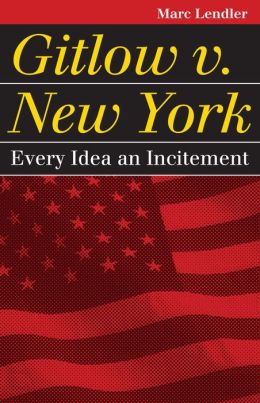
- Marc Lender discusses his book on Gitlow v. New York in Kansas's Landmark Law and American Society series here.
- From the new Environment, Law and History blog: a post on environmental history and capitalism in the Supreme Court's recent patent decision (Monsanto v. Bowman).
- "In a meadow on the banks of the Thames a King and his barons made peace on June 15th, 1215 through a great charter or "Magna Carta." Little did they know that they were laying the foundation for future democracies through a simple but unbreakable idea that would endure for centuries: that no one, not even a King, is above the law of the land." Want more of the same? Go to London this summer on Pepperdine Law's week-long study abroad program, English Legal History in the 800th Anniversary of the Magna Carta"

Lindsay, "Immigration, Sovereignty, and the Constitution of Foreignness"
Matthew J. Lindsay (University of Baltimore - School of Law) has posted "Immigration, Sovereignty, and the Constitution of Foreignness," which was published in Volume 45, No. 3 of the Connecticut Law Review (2013). Here's the abstract:
Hat tip: bookforum
It is a central premise of modern American immigration law that immigrants, by virtue of their non-citizenship, are properly subject to an extra-constitutional regulatory authority that is inherent in national sovereignty and buffered against judicial review. The Supreme Court first posited this constitutionally exceptional authority, which is commonly known as the “plenary power doctrine,” in the 1889 Chinese Exclusion Case. There, the Court reconstructed the federal immigration power from a form of commercial regulation rooted in Congress’s commerce power, to an instrument of national self-defense against invading hordes of economically and racially degraded foreigners.The full article is available for download here, at SSRN.
Today, generations after the United States abandoned overtly racist immigration policies, such as Chinese exclusion and national origins quotas, the Supreme Court continues to reaffirm Congress and the President’s virtually unchecked authority over the admission, exclusion, and removal of non-citizens, as though such authority were a logical concomitant of national sovereignty. Accordingly, modern judicial defenders of the plenary power doctrine generally turn a blind eye to the indecorous racial reasoning deployed by its architects. This Article argues that although the language of race and invasion has been purged from the vocabulary, and perhaps worldview, of most modern policymakers and judges, the logic of foreign aggression remains indispensible in accounting for a power unmoored from the Constitution and shielded from judicial scrutiny.
Throughout the nation’s first century, the Supreme Court found nothing constitutionally exceptional about a statute that governed foreigners engaged in the process of immigration. Immigrants’ non-citizenship was incidental to the nature of the regulatory authority to which they were subject. Non-citizenship became a trigger for extra-constitutional authority only in the final decades of the nineteenth century, as Chinese and “new” European migrants alike increasingly became understood as fundamentally and permanently alien to the national character. This Article demonstrates that it was precisely this perception of immigrants’ essential, indelible foreignness — their racial difference, their inability to assimilate, their corrosive effect on American citizenship — that gave substance to the metaphor of racial invasion, and thus to the Court’s analogy between immigration regulation and war. The Court’s intemperate defense of American citizenship against invading foreign races cannot, therefore, be swept aside as anachronistic dicta cluttering the otherwise logically sound foundation of immigration exceptionalism; rather, it is the cornerstone of the entire edifice.
Hat tip: bookforum


