Gallup reports that Americans continue to retain an unfavorable view of Congress. Congress’ approval rating is 12%, up from an all-time low of 10% in February, but remaining at 15% or less since last August. Americans’ unfavorable view of Congress is even more apparent when taking into account that 82% now disapprove of Congress. In addition, Gallup also notes that while in the past, party differences could be seen in Congress’ approval ratings, today, both Republicans and Democrats view Congress with a similarly unenthusiastic 12% approval rating.
Obama Starts New Year with 46% Job Approval
Gallup polling in early January finds that President Obama's job approval rating is at 46 percent, an improvement over most data since August 2011, when his approval typically scored in the low 40 percent range. Obama recorded "monthly approval averages of 41% in August, September, and October, and 43% in November and December." According to Gallup's Jeffrey M. Jones, "The current 46% rating for Obama, based on Jan. 2-4 polling, is one percentage point below his recent high three-day averages of 47% in Dec. 29-Jan. 3 and Dec. 21-23 tracking." The rating is still lower than last January, however, when Obama averaged 49 percent approval over the month.
Jones writes, "Obama's approval rating will be a critical indicator of his re-election chances this year. If he can sustain higher approval ratings through early November, his odds of winning a second term will increase." Historical data has shown "that all presidents since Eisenhower with approval ratings above 50% have won re-election easily." More recently, "George W. Bush was re-elected in 2004 with 48% approval at the time of the election." But Obama would not have to fall very far for Jones to anticipate trouble: "If Obama's approval rating reverts to the low 40% range, he would have a difficult time defeating a Republican in a two-candidate race."
Jones identifies independents as a key group Obama must target if he hopes to increase his approval rating. "Currently, 81% of Democrats, 42% of independents, and 10% of Republicans approve of Obama. By comparison, last January, when he had an overall monthly average of 49%, Obama's approval rating was 83% among Democrats, 47% among independents, and 13% among Republicans."
One potential reason for the modest uptick in Obama's rating this month "could be the improvement in Americans' economic confidence in recent days." But Jones says " it is unclear whether that will last." Further, "January brings challenges for Obama to maintain higher approval ratings, given that much of the political focus will be on the Republican nomination contest, with the GOP candidates seeking to point out Obama's shortcomings as president in order to help their chances of winning the nomination."
Obama does, however, have the State of the Union address January 24, which according to Jones presents "a unique opportunity for him to directly state his case for re-election to Americans."
Congressional Approval Rate Falls to 17%
According to June 9-12 polling by Gallup, Congress' approval rate has dropped seven points since May, to 17%. A rate of 17% is closer to poll results in March and April, when it was at 18% and 17%, respectively, and it continues--as it has since January 2010--to register below 25%. Although the survey was conducted during the Anthony Weiner scandal, Gallup proposes that the decline "more likely reflects the end of the rally in support for the government after the death of Osama bin Laden."Gallup has been measuring American approval of Congress since 1974; in that time, the smallest percentage of Americans who approved of Congress' job performance was recorded this past December, when the approval rate fell to 13%. Since 1974, the congressional approval rate has only fallen below 17% three times, all in the past three years and a signal, according to Gallup, of "the recent negative turn in Americans' views of Congress."
At 25%, Democrats are more likely to approve of Congress than Republicans (14%) or independents (13%), but approval rates are low among all three groups. Writes Gallup: "Unless conditions in the United States improve and Americans become more charitable in their ratings of Congress, the 2012 elections may result in another shake-up in Congress' membership, although with divided control of the legislative branch, it is not clear which party would be hurt more."NH cf
Obama's Higher Approval Rating Not Translating into Improved 2012 Prospects
As has already been mentioned on this blog, polling three days after the death of Osama Bin Laden revealed a six-percent increase in President Obama's approval rating. But according to a recent Gallup article, increased approval of President Obama's job performance has not improved the President's chances at re-election in 2012. Among registered voters, 43% said they were more likely to vote for President Obama over an unnamed Republican, while 40% said they were more likely to choose the Republican over Obama. These results are essentially unchanged--the difference being statistically insignificant--from the 41% of registered voters who said in April that they were more likely to vote for Obama.
Because Republicans--and to a lesser degree independents--provided most of the boost in Obama's approval rating following Bin Laden's death, more registered voters may approve more highly of Obama without lending him their support over a Republican in the 2012 election. According to Gallup, while Bin Laden's death improved many Republicans' views of the President, it "convinced few in this largely conservative voting bloc to switch sides in the 2012 general election."
NH cf
Because Republicans--and to a lesser degree independents--provided most of the boost in Obama's approval rating following Bin Laden's death, more registered voters may approve more highly of Obama without lending him their support over a Republican in the 2012 election. According to Gallup, while Bin Laden's death improved many Republicans' views of the President, it "convinced few in this largely conservative voting bloc to switch sides in the 2012 general election."NH cf
Following Death of Bin Laden, Obama's Approval Rating Up
According to Gallup, "the six-percentage-point increase in Obama's approval rating is fairly typical for a rally event," a term that refers to major international events that boost presidential approval. The increase in popular support came exclusively from Republicans and Independents, with 12% more Republicans and 9% more Independents voicing their approval.
If President Bush's experience following the September 11 attacks is any guide, however, President Obama's approval rating will likely fall back to its pre-rally event levels in the coming months.
NH cf
Not Just the Economy, Stupid
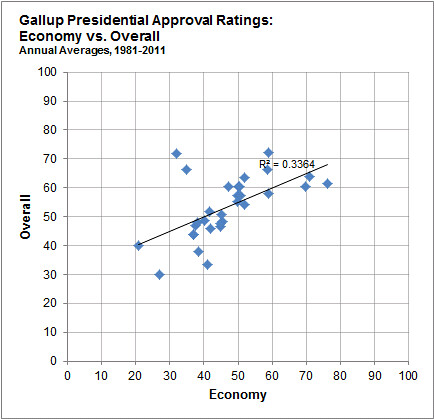
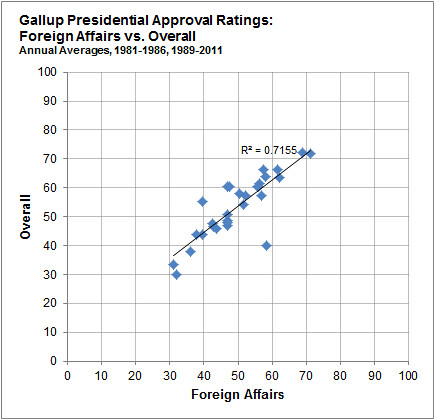
The conventional wisdom of American politics – indeed the conventional wisdom on electoral democracy in general – was captured by James Carville nineteen years ago: “It’s the economy, stupid.” The trope has serious evidence behind it. The importance of the economy in determining voting behavior has a half-century of empirical political science behind it. To try to delve into it would require a footnote alone too long for a blog post. But is it just the economy, stupid, as Carville no doubt wished (his candidate ran against an incumbent whose management of war in Kuwait was far more successful than his management of the recession at home)? Nate Silver, an electoral (and sports) statistician at the New York Times, doesn’t think so. He ran regressions on the correlation between a President’s approval rating overall and on foreign policy, as well as regressions on the correlation between approval on handling on the economy and overall approval. Shockingly, he found that approval of foreign policy was a more significant predictor of overall approval rating than approval of handling of the economy. For the former, the r2=0.72, while for the later r2=0.34. In lay terms: both approval of handling of the economy and handling of foreign affairs are significant predictors of a President’s overall approval ratings, but foreign affairs are a better predictor. Silver is careful to note that correlation does not imply causation, and that it is difficult to determine whether support for the President on certain issues causes or is caused by support for the President overall (the political science literature suggests most voters are shockingly unsophisticated about politics). While it is hard to determine exactly how the relationship between these three variables work, he provides powerful evidence that voters can, as Silver says, “walk and chew gum at the same time.”
ZM cf