Business Subsidies throughout the US

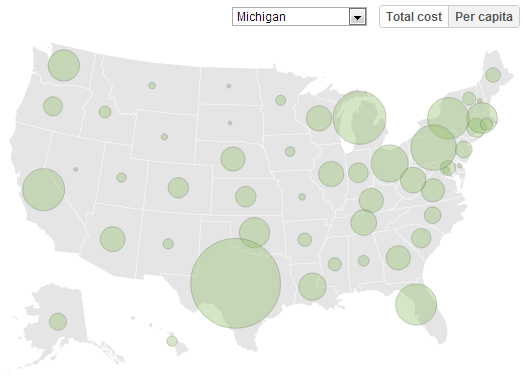
The New York Times compiled a database of incentives granted by cities, counties, and states to businesses.  Across the country, various levels of government granted $80.4 billion across 1,874 programs created to promote business.  The state with the highest percentage of business incentives per dollar in the state budget was Texas, with $0.51 for every dollar going to business incentives.  The states with the largest spending per capita were Alaska, West Virginia, and Nebraska (with $991, $845, $763 per capita respectively -- Texas ranked close with $759 per capita).

In addition, this resource lists the programs that each states employ and the companies that receive the most from these programs (to begin by looking at Texas, click here).  The New York Times also compiled a list of the 48 companies that gained more than $100 million since 2007 due to these programs; companies that topped the list of 48 were GM, Shell, and Ford, although some 5,000 more companies received more than $1 million in grants in the same time frame.

Wages Drop


On June 28th the Bureau of Labor Statistics released its County Employment and Wages Fourth Quarter 2011 report.  The report states that the average weekly wage decreased by 1.7% to $955 from the fourth quarter of 2010 to the fourth quarter in 2011.  This decrease marks only the fifth wage loss since the Census began tracking the figure in 1978.  Olmsted, Minnesota experienced the greatest decrease in weekly wages amongst large counties, with pay dropping 21.3%.  In Olmsted the education and health services industries faced the most severe losses with a total wage decline of $287.3 million (-29.1%).

The large counties (population of at least 75,000) leading the way in employment gains were Kern, California; Fort Bend, Texas; Weld, Colorad; Williamson, Tennessee; and Utah County, Utah.  These counties had the highest percentage increase in employment, all of them seeing gains of at least 4.3%.  On a grander scale, the U.S. added 1.8 million jobs since December 2010, putting the national employment at 131.3 million.

Census Figures Tell Story of Dramatic Decline in the County Hit Hardest by Recession

An article in the New York Times focused on the county where, according to census figures published Thursday, "the falloff of the economy...was the steepest in the country." Greenwood county, a district of nearly 70,000 in South Carolina, saw its poverty rate double to 24 percent from 2007 to 2010, "the largest increase for any county in the nation."

Residents pointed at the closing of textile mills as one of the central causes of the decline. The Times writes: "The number of workers in manufacturing alone fell by a quarter in the county from 2005 to 2009, according to a census survey of employers." The mills were not alone responsible for the devastating decline, however, as layoffs from "a foundry, restaurants and construction companies [also] pummeled the county’s residents." According to the Times, the "decline also engulfed the middle class." Median household income fell by 28 percent over the period--a loss of nearly $12,000 in annual earnings.
A closer look at the county's social demographic characteristics might worry people around the country, as by many indications Greenwood residents are not so different from the average American. Over a quarter of residents had at least some college education in 2009, close to the 27 percent nationally. And Greenwood contains a number of institutions that can be as sprouting--or having sprouted--from economic success; the county "has a public university, which grants four-year degrees, a museum and a shopping mall."

But the economy does not appear to be improving in Greenwood. Unless it does, residents will be forced to do what they can to stay afloat. Writes the Times: "Apache Pawn and Gun, a pawn shop in town, is packed with items sold by people trying to make ends meet."

NH cf
Blog Archive