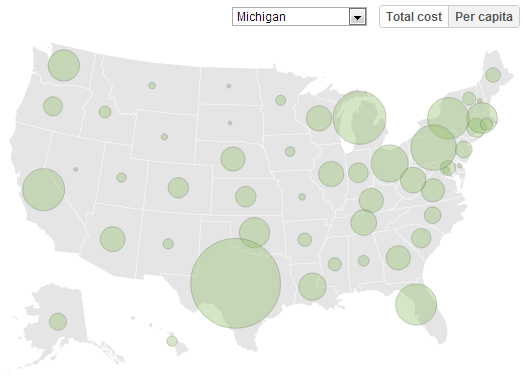
The New York Times compiled a database of incentives granted by cities, counties, and states to businesses. Across the country, various levels of government granted $80.4 billion across 1,874 programs created to promote business. The state with the highest percentage of business incentives per dollar in the state budget was Texas, with $0.51 for every dollar going to business incentives. The states with the largest spending per capita were Alaska, West Virginia, and Nebraska (with $991, $845, $763 per capita respectively -- Texas ranked close with $759 per capita).
In addition, this resource lists the programs that each states employ and the companies that receive the most from these programs (to begin by looking at Texas, click here). The New York Times also compiled a list of the 48 companies that gained more than $100 million since 2007 due to these programs; companies that topped the list of 48 were GM, Shell, and Ford, although some 5,000 more companies received more than $1 million in grants in the same time frame.
For First Time, China's Urban Residents Outnumber Rural
The Economist's daily chart focuses on the movement of China's people into urban areas. At the end of 2011, and according to data from the National Bureau of Statistics, 1.35 billion, or 51.3 percent of China's residents lived in cities, meaning that for the first time the country's "city-dwellers now outnumber its rural residents." According to The Economist, as recently as "1980 less than a fifth of China’s population lived in cities, a smaller proportion than in India."
In the ten years that followed, the Chinese government "remained wary of free movement, even as it made its peace with free enterprise." It "sought industrialisation without urbanisation," only to ultimately realize that "it could not have one without the other." And although the percentage of city-dwellers is on the rise, it seems that the Chinese government's wariness toward urban development has slowed the movement of its citizens to cities. The Economist notes, "Even now, its ratio of city-dwellers is, if anything, low for an economy at its stage of development."