Sunday Book Roundup


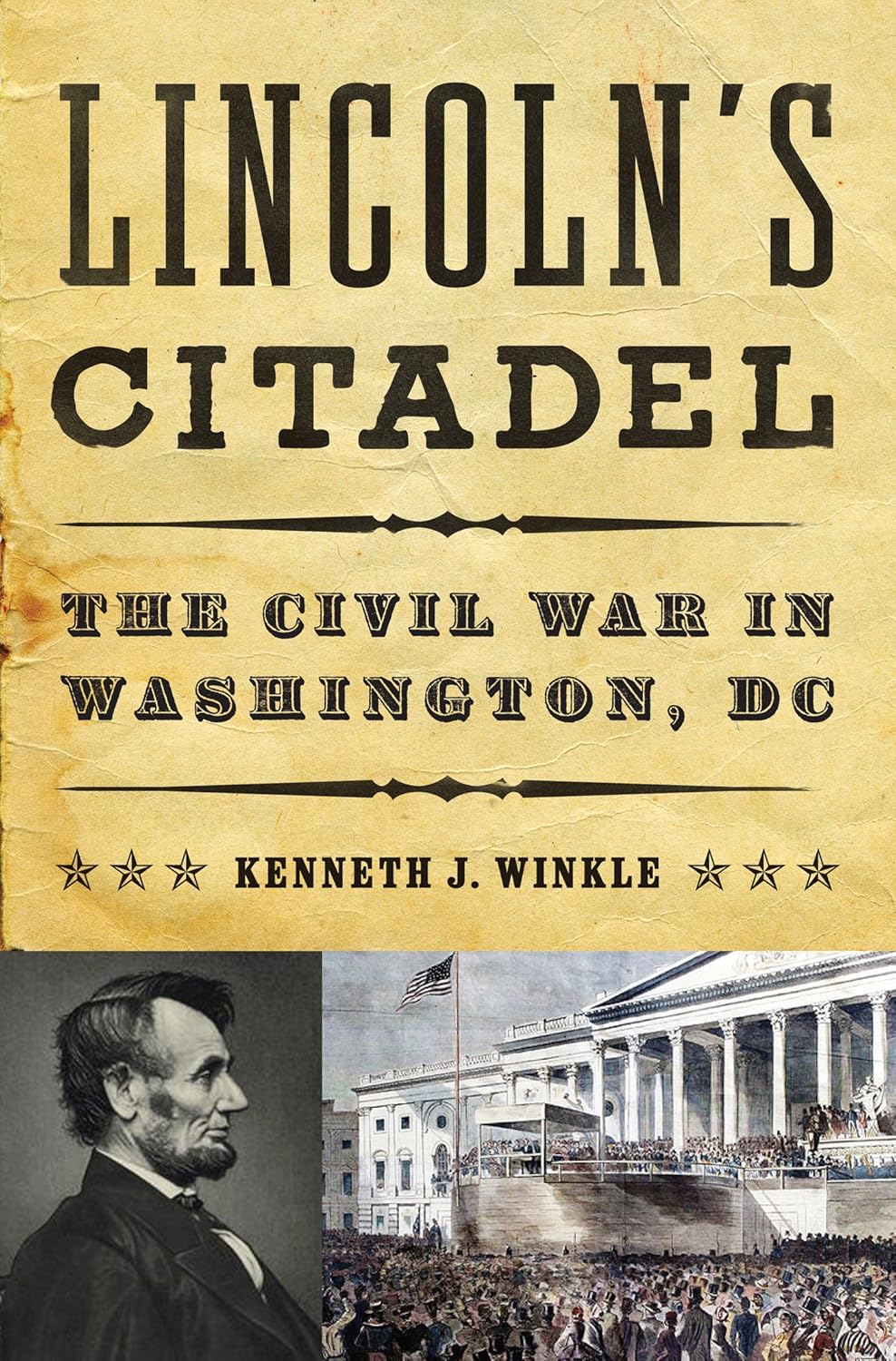
Readers this week can find a review of Lincoln’s Citadel: The Civil War in Washington, D.C. (Norton) by Kenneth J. Winkle in the Washington Post. "A prize-winning Lincoln biographer (“The Young Eagle”), Winkle is also a scholar of quantitative history — call it a “big data” approach to the past — who clearly delights in raw numbers and their telling effect. “Lincoln’s Citadel” is a treasure trove of empirical specificity."


The New York Times reviews The Great Escape: Health, Wealth, and the Origins of Inequality (Princeton University Press) by Angus Deaton. 

The NYT also takes a look at a few books--including Robert M. Fogelson's The Great Rent Wars: New York, 1917-1929 (Yale University Press)--in a piece titled, "Landlord vs. Tenant: When It All Began."

The LA Review of Books has a thoughtful essay about Karen E. Fields and Barbara J. Fields's Racecraft: The Soul of Inequality in American Life (Verso).

"Serrano, a staff writer in the Los Angeles Times' Washington, D.C., bureau, starts with two main characters: former Union soldier Albert Woolson and onetime rebel soldier Walter Washington Williams. Each man forms a compelling story of becoming caught up in the nation's bloodiest war and its aftermath. By the late 1950s, as the United States neared the centennial of the start of the war, each was feted as the oldest living veteran of his respective army. 
But one was a fraud, a scam that would have gone undetected had he not outlived all of his fellow Confederate veterans. 
There's not a lot of suspense here. It becomes clear pretty quickly which was the real deal and which a fraud. But suspense isn't the point. Serrano uses the men as a window into the long-playing reverberations of the Civil War, from the reunions to the reenactments to the wounds covered with, in retrospect, tissue paper."
And H-Net adds reviews of three edited volumes of interest, including Knowledge and Power: Essays on Politics, Culture, and War (Society for the Promotion of Science and Scholarship) edited by Bruce A. Thompson, Carolyn Halladay, and Donald Abenheim (here);  Joel Isaac and Duncan Bell's Uncertain Empire: American History and the Idea of the Cold War (Oxford University Press) (here); as well as Willibald Steinmetz, Ingrid Gilcher-Holtey, and Heinz-Gerhard Haupt's Writing Political History Today (Campus Verlag) (here).

Routel, "Minnesota Bounties on Dakota Men During the US-Dakota War"

Colette Routel (William Mitchell College of Law) has posted "Minnesota Bounties on Dakota Men During the US-Dakota War." Here's the abstract:
The U.S.-Dakota War was one of the formative events in Minnesota history, and despite the passage of time, it still stirs up powerful emotions among descendants of the Dakota and white settlers who experienced this tragedy. Hundreds of people lost their lives in just over a month of fighting in 1862. By the time the year was over, thirty-eight Dakota men had been hanged in the largest mass execution in United States history. Not long afterwards, the United States abrogated its treaties with the Dakota, confiscated their reservations along the Minnesota River, and forced most of the Dakota to remove westward.

While dozens of books and articles have been written about these events, scholars have largely ignored an important legal development that occurred in Minnesota during the following summer. The Minnesota Adjutant General, at the direction of Minnesota Governors Alexander Ramsey and Henry Swift, issued a series of orders offering rewards for the killing of Dakota men found within the State. The first order authorized the creation of a corps of volunteer scouts that would scour the "Big Woods" in search of Dakota men. They were to be paid not only a daily wage, but an additional $25 for each scalp they were able to provide the Adjutant General's Office. Subsequent orders permitted individual citizens who were not part of the volunteer corps to claim up to $200 for proof that they had killed a Dakota. These bounty orders remained in effect until at least 1868, when their constitutionality was finally questioned by the Minnesota Supreme Court in State v. Gut.

Minnesota was not the only state that placed a bounty on their Indian inhabitants. Around the same time, a bounty system was enacted by the Territory of Arizona, and one was also implemented by private citizens and local governments within the State of California. Like the bounty system in Minnesota, these programs were creatures of state and territorial law, but they were implicitly and explicitly approved by the federal government. In fact, they could be viewed as part of a much broader extermination program that was at the heart of federal Indian policy during this time period.

This article uses primary historical sources to describe the events leading up to the enactment of a bounty system in Minnesota, its creation, and subsequent on-the-ground implementation. In an attempt to avoid the pitfalls of "presentism," the legality of this bounty system is analyzed according to the laws in effect in 1863, when it was created. This article concludes that the Minnesota bounty system was illegal from its inception, as it was contrary not only the international law of war, but also the Lieber Code, which was issued by the U.S. Secretary of War in April 1863, and used to govern the conduct of Union soldiers during the ongoing Civil War.
The full article is available here.

Hat tip: Turtle Talk

Edwards to Lecture on “Women, Law, and Culture: Rethinking Legal Change in the Civil War Era"

[Our friends at Oregon Law send us the following announcement.]

The Law, Culture, and Humanities Initiative presents “Women, Law, and Culture: Rethinking Legal Change in the Civil War Era,” with Laura Edwards, Thursday, October 3, 2013, 12:30 – 2:00 p.m., Lewis Lounge, Knight Law Center, University of Oregon.

Laura F. Edwards received her Ph.D. from the University of North Carolina, Chapel Hill and is now Professor of History at Duke University. Her interests focus on race, gender, labor, and law, especially in the nineteenth-century U.S. South. She just completed a legal history of the Civil War and Reconstruction titled A Nation of Rights. Most recently, she is the author of The People and Their Peace: Legal Culture and the Transformation of Inequality in the Post-Revolutionary South (University of North Carolina Press, 2009), which was awarded the American Historical Association’s 2009 Littleton-Griswold prize for the best book in law and society and the Southern Historical Association’s Charles Sydnor prize for the best book in southern history. In addition, she is author of Scarlett Doesn’t Live Here Anymore: Southern Women in the Civil War Era (University of Illinois Press, 2000); and Gendered Strife and Confusion: The Political Culture of Reconstruction (University of Illinois Press, 1997). She has received fellowships from the Newberry Library, the National Humanities Center, the NEH, and the Guggenheim Foundation. She also has been honored with the Howard D. Johnson award for distinguished undergraduate teaching, given by the College Arts and Sciences at Duke University and the Dean’s Award for Excellent Mentoring, given by the Graduate School at Duke University.

RSVP to Sabrina Leathers: leathers@uoregon.edu [ASAP].

Cosponsored by Oregon Humanities Center, Center for the Study of Women in Society, Office of the Vice Provost for Equity and Inclusion, Department of Political Science, School of Law Lectures and Awards, Department of History, and Office of Academic Affairs.

The Law, Culture, and Humanities Initiative was created to facilitate, support, and encourage symposia, lectures, scholarship, and faculty discussion on the relationship between law and other humanistic disciplines. It provides opportunities for faculty to integrate humanistic-based studies with the study of law, and to explore the increasingly diverse and rich scholarships in areas that include (but are not limited to) legal history, law and literature, law and anthropology, and law and philosophy.

Sunday Book Roundup

In the Chronicle of Higher Education there is a review of The Allure of the Archives (Lewis Walpole Series) in which "the historian Arlette Farge conveys how much life can burst from brittle old pages."

H-Net also has several reviews of interest, including a review of Andreas Wimmer's Waves of War: Nationalism, State Formation, and Ethnic Exclusion in the Modern World (Cambridge University Press) as well as a review of Jo Becker's Campaigning for Justice: Human Rights Advocacy in Practice (Stanford University Press). Andrew E. Busch's Truman's Triumphs: The 1948 Election and the Making of Postwar America (University Press of Kansas) has also been reviewed on H-Net.
"Busch’s purpose in Truman’s Triumphs is straightforward. His goal is to analyze the 1948 election, paying heightened attention to the nomination process, the congressional elections, and public opinion. Joining other scholars, Busch argues that the 1948 election was a validation of the domestic policy of the New Deal, of the foreign policy of containment, and of the federal policy advocating civil rights. Busch contributes the unique interpretation that the 1948 election demonstrated both the “resilience” and “vulnerability” of the New Deal coalition (p. 210). He points out that although Truman trailed in the polls and came from behind, he also had significant advantages such as the New Deal coalition. In addition, Busch proves that although the Democrats suffered from obvious schisms, the Republicans were less noticeably but no less critically divided."

Adrian Brettle takes a look at "The Past, Present, and Future of Confederate Nationalism" in a review of two books: Paul Quigley's Shifting Grounds: Nationalism and the American South, 1848-1865 (Oxford University Press), and Coleman Hutchison's Apples and Ashes: Literature, Nationalism, and the Confederate States of America, (University of Georgia Press).
"Although Hutchison and Quigley tackle the larger topic of Southern nationalism from the antebellum era to Reconstruction, they focus on the experience of the Civil War and Confederate nationalism and argue that such nationalism preceded the formation of the Confederacy. Quigley shows the emergence of Southern nationalism “as a variant” and “fringe” of American nationalism. But, by evolving into a mainstream belief, he notes, it was transformed into Confederate nationalism as it struggled to reconcile its two inherent contradictions: first, a slavery based creed needing to appeal to non-slaveholders; and second, a “nationalism that derived its legitimacy from the ostensibly anti-national principle of State rights” (p. 13). Hutchison, by way of using the Confederacy as a case study, seeks to contribute to a wider investigation of the role of various genres of literature in the emerging of political communities. At the same time, Hutchison also wishes to prove his case that literary nationalists helped produce the Confederacy and created a “literary nationalism that was not only internationally minded, but also more durable than its state apparatus” (p. 4)."
And, here's one we missed a few months back, a review of Rick Baldoz's The Third Asiatic Invasion: Empire and Migration in Filipino America, 1898-1946  (New York University Press), "an important work for historians seeking to bridge the fields of immigration and imperial studies."

The LA Review of Books reviews The Inconvenient Indian: A Curious Account of Native People in North America (University of Minnesota) by Thomas King.
"King’s tone is breezy and light, full of funny stories and self-deprecating jokes, but just below that geniality lies a deep reservoir of bitterness over the treatment of Indians in Canada and the United States that continues on to this day. White North Americans, he argues, prefer their Indians noble, primitive, and safely extinct, and actual, live Indians who stubbornly insist on their rights as an independent people they regard as at best a troublesome nuisance.

Salon again this week publishes an excerpt from a law and history related book, Keeping It Civil: The Case of the Pre-nup and the Porsche & Other True Accounts from the Files of a Family Lawyer by Margaret Klaw (Algonquin Books).

There are a few reviews this week of Year Zero: A History of 1945 (Penguin) by Ian Buruma, here in the New York Times and here in the New York Review of Books.

There's also two reviews of The Collaboration: Hollywood’s Pact with Hitler (Belknap Press) by Ben Urwand, one in the Washington Post, and a second in the Wall Street Journal.

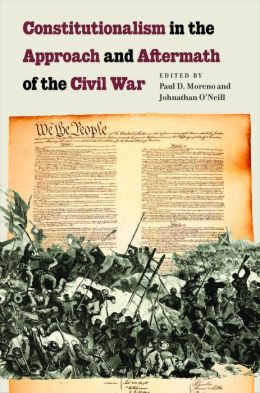
New Release: "Constitutionalism in the Approach and Aftermath of the Civil War"

New from Fordham University Press: Constitutionalism in the Approach and Aftermath of the Civil War, edited by Paul D. Moreno (Hillsdale College) and Johnathan O'Neill (Georgia Southern University). The Press describes the book as follows:
The irreducibly constitutional nature of the Civil War’s prelude and legacy is the focus of this absorbing collection of nine essays by a diversity of political theorists and historians. The contributors examine key constitutional developments leading up to the war, the crucial role of Abraham Lincoln’s statesmanship, and how the constitutional aspects of the war and Reconstruction endured in the late nineteenth and early twentieth centuries. This thoughtful, informative volume covers a wide range of topics: from George Washington’s conception of the Union and his fears for its future to Martin Van Buren’s state-centered, anti-secessionist federalism; from Lincoln’s approach to citizenship for African Americans to Woodrow Wilson’s attempt to appropriate Lincoln for the goals of Progressivism. Each essay zeroes in on the constitutional causes or consequences of the war and emphasizes how constitutional principles shape political activity. Accordingly, important figures, disputes, and judicial decisions are placed within the broader context of the constitutional system to explain how ideas and institutions, independently and in dialogue with the courts, have oriented political action and shaped events over time.
More information is available here.

New Release: Smith, "Freedom's Frontier: California and the Struggle over Unfree Labor, Emancipation, and Reconstruction""

New from the University of North Carolina Press: Freedom's Frontier: California and the Struggle over Unfree Labor, Emancipation, and Reconstruction, by Stacey L. Smith (Oregon State University). A description from the Press: 
Most histories of the Civil War era portray the struggle over slavery as a conflict that exclusively pitted North against South, free labor against slave labor, and black against white. In Freedom's Frontier, Stacey L. Smith examines the battle over slavery as it unfolded on the multiracial Pacific Coast. Despite its antislavery constitution, California was home to a dizzying array of bound and semibound labor systems: African American slavery, American Indian indenture, Latino and Chinese contract labor, and a brutal sex traffic in bound Indian and Chinese women. Using untapped legislative and court records, Smith reconstructs the lives of California's unfree workers and documents the political and legal struggles over their destiny as the nation moved through the Civil War, emancipation, and Reconstruction.
Smith reveals that the state's anti-Chinese movement, forged in its struggle over unfree labor, reached eastward to transform federal Reconstruction policy and national race relations for decades to come. Throughout, she illuminates the startling ways in which the contest over slavery's fate included a western struggle that encompassed diverse labor systems and workers not easily classified as free or slave, black or white.
A few blurbs:
"A real winner: ambitious, thoughtful, and splendidly rendered. Smith peels back history to rework the labor landscapes of nineteenth-century California and reintroduce the state into dynamic, Reconstruction-era political and social debates."--William Deverell

"A brilliant and long overdue examination of late-nineteenth-century California's complicated race and labor history. By comparing the stories of bound Native American, African American, Chinese, Latino, and Hawaiian workers, Smith reveals the complexities of California's racial and labor histories and goes even further to demonstrate the larger implications for the California experience for understanding national stories of abolition, emancipation, Reconstruction, and immigration."--Michael Magliari
More information is available here.

Essays on the History and Interpretation of Interposition, Nullification, and Secession

Just out from the University of Akron Press’s is Union and States' Rights: A History and Interpretation of Interposition, Nullification, and Secession 150 Years After Sumter, edited by Neil H. Cogan.  It is the third book in the Press’s “&Law” series.  The Press explains:
The edited work is a collection of papers that tackles the issue of the power states have to object to and cancel Federal law. For eighty-one years, from the ratification of the Constitution to the end of the Civil War, state power was the central issue of governance. Currently, the issue is gaining more traction due in part of the Tea Party movement to limit Federal intervention in areas like education, health care, voting legislation, etc.
Contents after the jump.
Read more »

Sunday Book Roundup


The Washington Post this week has a review of The Road to War: Presidential Commitments Honored and Betrayed (Brookings Institution Press) by Marvin Kalb. "In his timely book, “The Road to War,” veteran journalist and diplomatic correspondent Marvin Kalb explores the tangled history of the foreign policy commitments that modern presidents have made and the knots these leaders have turned themselves into trying to rationalize or escape their words."

The Post also notes the presence of Harvard Law's Kenneth Mack and others at the National Book Festival's History & Biography Pavilion this week.

Salon has published an excerpt from Karen Dunak's new book As Long as We Both Shall Love: The White Wedding in Postwar America (NYU Press) about "The secret history of gay marriage" and the "same-sex weddings [that] were happening in this country for decades before the Supreme Court permitted it."

"On October 10, 1987, nearly 7,000 people witnessed a wedding on the National Mall in Washington, DC. Men and women cheered and threw rice and confetti as family, friends, and community members took part in the largest mass wedding in American history. After the celebrants exchanged rings and were pronounced newlywed, guests released hundreds of balloons into the air. Brides and grooms, dressed in formal wedding attire, cried and embraced after an “emotional and festive” ceremony. Like so many brides and grooms, participants identified the wedding day as one of the happiest, most meaningful days of their lives. 
But this was no ordinary wedding. And these were not typical brides and grooms. This wedding held special significance for its participants. Beyond the “mass” nature of the celebration, something else was unique. The newlyweds that fall Saturday paired off as brides and brides, grooms and grooms. “The Wedding,” as it came to be known, marked the symbolic beginning of nearly 2,000 same-sex marriages."

This week H-Net has several new reviews in law and history: Keith Altavilla finds a "Printer, Democrat, and Soldier" in Robert Grandchamp' Colonel Edward E. Cross, New Hampshire Fighting Fifth: A Civil War Biography (McFarland & Company, Inc.), and Rachel T. Van reviews Emily Clark's The Strange History of the American Quadroon: Free Women of Color in the Revolutionary Atlantic World (University of North Carolina Press). 

David Siemers also reviews for H-Net The Forgotten Presidents: Their Untold Constitutional Legacy (Oxford University Press) by Michael J. Gerhardt.
"Quick. What do William Howard Taft, Calvin Coolidge, and Jimmy Carter have in common? The answer, or one answer at least, is that they are the twentieth-century presidents placed alongside many of their nineteenth-century counterparts in Michael J. Gerhardt’s The Forgotten Presidency: Their Untold Constitutional Legacy. In this book, Gerhardt underscores that even the presidents we know least well had a major impact on governance and on the shape of their office. In this he is largely successful, with interesting tales told along the way. Scholars of the presidency will find that the book does not break substantial new ground, but lay readers interested in the presidency and wanting a broad tour of presidential history will profit from the book." 
More reviews after the jump...
Read more »

The Third Biennial UnCivil Wars Conference

Here is the schedule for the Third Biennial UnCivil Wars Conference, entitled “From Property to Personhood: The Intents and Unintended Consequences of the Reconstruction Amendments.”  It will take place on October 24-26, 2013, at the T.R.R. Cobb House, 157 Hill Street, Athens, GA.

Read more »

Green, "Loyal Denominatorism and the Fourteenth Amendment: Reconstruction History."

Christopher R. Green (University of Mississippi - School of Law) has posted "Loyal Denominatorism and the Fourteenth Amendment: Reconstruction History." Here's the abstract:
The exclusion of Southern representatives from Congress from December 1865 to the summer of 1868 raises two problems for the Fourteenth Amendment’s legitimacy: Congress (a) proposed the Amendment while excluding Southern representatives in 1866, and (b) required Southern states to ratify as a condition for readmission in 1867. Scholars like Bruce Ackerman, John Harrison, Akhil Amar, and most recently Thomas Colby have proposed a wide variety of conflicting ways to handle these problems. Ackerman explains the Amendment’s legitimacy on the basis of President Johnson’s 1868 capitulation to a non-Article-V process, confirmed by the Supreme Court in 1873. Harrison relies instead on the unreviewable finality of congressional membership decisions and pressured state ratifications, Amar on congressional power to republicanize Southern states with black suffrage, and Colby on the normative desirability of an intergenerationally-authored Fourteenth Amendment including cases like Brown and Roe.
Read more »

Sunday Book Roundup

This week, the 50th anniversary of the March on Washington brought with it several book reviews on race in America.

NPR has put together a list of "books that bring the civil rights movement to life" here, including two of my favorites - Anne Moody's Coming of Age in Mississippi (Random House, 1992) and the edited volume of personal accounts, Hands on the Freedom Plow: Personal Accounts by Women in SNCC (University of Illinois Press, 2012).

The Washington Post's Jonathan Yardley reviews William P. Jones's The March on Washington: Jobs, Freedom, and the Forgotten History of Civil Rights (Norton). Yardley writes,
"This is the central theme of “The March on Washington”: The powerful economic impulses of the march have been lost to view as historians emphasize the eloquence of King’s speech and its effect on the political climate as the country moved to address the questions of basic civil rights and opportunities that he articulated. Initially the march’s organizers demanded “federal jobs creation, raising the minimum wage, a Fair Employment Practice law, and support for [President John F.] Kennedy’s civil rights bill,” demands that “expanded as new groups joined.”"

This week there are also several reviews of For Discrimination: Race, Affirmative Action, and the Law (Pantheon) by Harvard Law Professor Randall Kennedy, including a lengthy L.A. Times review, a Washington Post review, and a Wall Street Journal review for subscribers.

H-Net has a review of Emily West's Family or Freedom: People of Color in the Antebellum South (University Press of Kentucky), which makes use of enslavement petitions to examine antebellum race and status relationships in the South.

Lewie Reece has tackled two books in a H-Net review titled, "The Lincoln Theme in the Twenty-First Century." The reviewed books are Michael Burlingame's Lincoln and the Civil War (Southern Illinois University Press) and Mark E. Neely's Lincoln and the Triumph of the Nation: Constitutional Conflict in the American Civil War (University of North Carolina Press).  Reece writes:

These two books serve as a reminder that the Lincoln theme, far from being exhausted, continues to be explored in new ways by historians. Pure biography remains a subject of lively interest, but so do efforts to connect Lincoln to issues related to antislavery and the Civil War. Additionally, several works are but marginally connected to history, and instead examine the ongoing impact Lincoln had, and continues to have, on American culture. Moreover, as these two volumes suggest, academic historians continue to widen the parameters of our understanding of Lincoln. 
Mark Neely and Michael Burlingame have written widely not only about Lincoln, but Civil War America as well. Their approach in these volumes is different, yet similar. Neely presents a constitutional and legal history of the Civil War which, despite the title, is only partly about Lincoln. Burlingame has written a compressed history of Lincoln’s presidency and its influence on the Civil War. Both works reveal these historians’ impressive scholarship and wide reading in manuscript sources; both provide insight into the subject. It takes courage to try and do something different and provocative, and both men are to be commended for seeking new approaches.
 n+1 reviews Walter Johnson's River of Dark Dreams: Slavery and Empire in the Cotton Kingdom (Harvard University Press).

Other reviews of interest include Washington Post's review of Higher Education in America (Princeton University Press) by Derek Bok.

HistoryToday asks "How could the first nation to cleave church from state remain so pious?"as it reviews The Creation of the American Soul: Roger Williams, Church and State, and the Birth of Liberty (Duckworth) by John Barry.

The New York Times reviews A Wild Justice: The Death and Resurrection of Capital Punishment in America (Norton) by Evan J. Mandery. (Previously mentioned in the Aug. 18 Book Roundup.)

And Salon has published an excerpt from Estelle B. Freedman's Redefining Rape: Sexual Violence in the Era of Suffrage and Segregation (Harvard University Press).

Weekend Roundup

  • The most recent issue of Perspectives on History (the newsmagazine of the American Historical Association) includes roundtables on the Supreme Court's decisions in Windsor and Fisher. Participants include Laura Edwards (Duke University) and Nancy Cott (Harvard University).
  • More news from the AHA: if you're in the D.C. area for research or otherwise, join fellow friends of the Association on July 9th for the third annual Summer Reception. More info is available here.
  • From the Huffington Post: "What's in a Naim?" Melissa Murray (UC Berkeley) offers "[t]he history of Naim and Loving" as "a useful frame for understanding the Court's decision in Perry." 
  • In honor of the 150th anniversary of the Battle of Gettysburg, the editors of the History News Network have compiled the best resources on the topic. Check them out here
  • Just in time for someone's vacation is this post on the Lake George Trespass Case.
  • "The Humanities, Declining? Not According to the Numbers," according to Michael Bérubé (Pennsylvania State University). Read on here, at the Chronicle of Higher Education.
Weekend Roundup is a weekly feature compiled by all the Legal History bloggers.

Stealey's "West Virginia Civil War Era Constitution"

John E. Stealey, III, distinguished professor emeritus of history at Shepherd University, has published  West Virginia’s Civil War Era Constitution: Loyal Revolution, Confederate Counter-Revolution, and the Convention of 1872 with the Kent State University Press:
When western Virginians separated from the Commonwealth of Virginia to form West Virginia, the distinctive action reflected five decades of deep dissatisfaction with the Commonwealth’s regressive constitution and the governmental procedures that protected slavery. The westerners’ creation of a new state was revolutionary in the context of U. S. statecraft. New constitutional approaches and laws addressed past wrongs and the realities of war. Grave external and internal forces, sometimes armed, opposed West Virginia’s creation and establishment of civil order and state institutions.

The state-makers resorted to statutory and constitutional measures, often arbitrarily applied, to preserve the state, their legislation, and their political position. Some enactments removed state citizenship and the franchise from the disloyal; enabled the seizure of rebel property; required oaths of past loyalty for voting, suing in courts, and for the practice of professions such as teaching, law, and other pursuits; and established a stringent registration system administered by the loyal to prospective voters. Returning Confederates, along with stay-at-home sympathizers, and opponents of national policies organized a political and legal assault that succeeded.

Rejecting the hackneyed and inaccurate concept of “Reconstruction” as it reflects rebel assertions, author John Stealey reinterprets West Virginia’s post–Civil War constitutional and political development within the counter-revolutionary framework. The Democratic/Conservative opponents of the Republican state-makers rode to power after seven years on the issues of race and the existence of wartime and postwar statutory and constitutional enactments that assured temporary state security and political dominance of the loyal. The torturous and complicated path to counter-revolutionary success and change occurred within the context of national events.

A primary counter-revolutionary goal was drafting a new constitution to replace the state-makers’ original of 1861–1863. The Constitutional Convention of 1872 was the culmination of the quest for power. Stealey presents for the first time a comprehensive account of the debates and acts of the constitutional convention that reflected the Virginia and wartime experiences of delegates as well as the counter-revolutionary aims of the overwhelming Democratic/Conservative majority. This framework still serves as the Mountain State’s fundamental law.
A review in the Charleston Gazette is here; an interview with Professor Stealey on West Virginia Public Broadcasting is here.

McAward on McCulloch and the Thirteenth Amendment

Jennifer Mason McAward, Notre Dame Law School, has posted McCulloch and the Thirteenth Amendment, which appeared in the Columbia Law Review 112 (2012).  Here is the abstract:
Section 2 of the Thirteenth Amendment gives Congress the “power to enforce” the ban on slavery and involuntary servitude “by appropriate legislation.” The conventional view of Section 2 regards this language as an allusion to McCulloch v. Maryland’s explication of Congress’s executory powers, and holds that Congress has substantial, and largely unreviewable, power to determine both the ends and the means of Section 2 legislation.

This Essay argues that the conventional view departs from the original meaning of Section 2. It demonstrates that McCulloch preserved a role for judicial review with respect to both the ends and means of federal legislation. This role was clearly part of the understanding and anticipated application of McCulloch by the time the Thirteenth Amendment was ratified and the Civil Rights Act of 1866 enacted. This Essay concludes that Section 2 preserves a role for meaningful judicial review and grants Congress power to regulate conduct that threatens the reinvigoration of slavery or involuntary servitude, but not near-plenary power over all civil or human rights.

White on the "Strangely Insignificant Role" of the Supreme Court in the Civil War

At least since the publication of Peter Irons’s The New Deal Lawyers (1982), constitutional historians of the twentieth-century United States have understood the role Franklin D. Roosevelt’s lawyers played in shaping the legislation and litigation that produced the constitutional landmarks of the 1930s.  Now, in a (gated) article in the Journal of the Civil War Era 3 (June 2013): 211-38, Jonathan W. White, an Assistant Professor of American Studies at Christopher Newport University, has investigated the role legal strategy played in producing “The Strangely Insignificant Role of the U.S. Supreme Court in the Civil War.”  Professor White identifies three main factors:

Roger B. Taney (credit)
"First, the Lincoln administration worked strategically to reduce the amount of litigation involving federal war measures. For example, the Union military often released or moved political prisoners before they could petition for writs of habeas corpus. Similarly, Lincoln carefully crafted the Emancipation Proclamation to make it difficult for slave owners to sue in the federal courts. Second, the Lincoln administration ignored lower court decisions that struck down federal war measures rather than appeal them to the U.S. Supreme Court. Third, and most importantly, the Judiciary Act of 1789–the law that first created and organized the federal judicial system–gave the government a distinct advantage in litigation involving controversial war measures because it limited the route of appeal to the nation’s highest tribunal."

Lind's "Lincoln's Suspension of Habeas Corpus"

Douglas Lind, the Law Library Director and Professor of Law at the SIU School of Law,has published Lincoln's Suspension of Habeas Corpus: The Pamphlet Literature and Congressional Debate
The public debate held via pamphlet literature as a result of Lincoln’s suspension of habeas corpus and the subsequent Merryman case is often cited in analysis of the modern balance of executive powers in wartime as pertaining to civil rights. The congressional debate produced several failed attempts to authorize a continued wartime suspension of the writ and indemnify the President. This sourcebook contains the text of most of the pamphlets and other fugitive items, arranged chronologically and with an introduction discussing the author’s main points. The work also includes an annotated chronology of all procedural measures associated with the various pieces of legislation from the 37th Congress, with the complete texts of speeches and debates to allow researchers to analyze the competing arguments.
The work was recently awarded the Joseph L. Andrews Bibliographic Award by the American Association of Law Libraries.  The table of contents is here.

Carwardine to Lecture on Lincoln and Emancipation

The Washington History Seminar announces the session "Lincoln and Emancipation: Presidential Intent at Home and Abroad,” by Richard Carwardine, to be held on Monday May 13, 2013, at 4:00 p.m. in the Woodrow Wilson Center, 4th Floor Conference Room, Ronald Reagan Building.

The Seminar explains:
During the American Civil War Abraham Lincoln stated that his paramount object was to save the Union, leading many since to question his reputation as "The Great Emancipator." Emancipation and the nation's unity were indivisible in Lincoln's mind, and it was for the fusion and pursuit of these two ideas that British and other foreign progressives of the time esteemed him so highly. What were the international repercussions of Lincoln's actions? Even more basically, what were his actual motivations?
Richard Carwardine, previously the Rhodes Professor of American History at Oxford University, and now President of Corpus Christi College, Oxford, has a particular interest in the politics and religion of the Civil War era. His political biography, Lincoln: A Life of Purpose and Power, won the Lincoln Prize in 2004. An essay collection, The Global Lincoln, co-edited with Jay Sexton, appeared in 2011.
Reservations requested because of limited seating: HAPP@wilsoncenter.org or 202-691-4166.  Photo ID required for admittance to the building.  The seminar is sponsored jointly by the National History Center of the American Historical Association and the Wilson Center. 

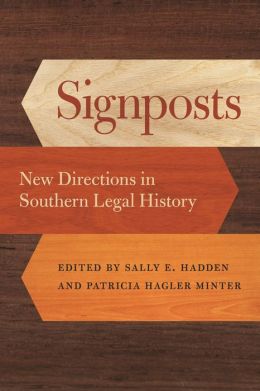
New Release: Hadden & Minter, eds., "Signposts: New Directions in Southern Legal History"

This past weekend at OAH I had the pleasure of commenting on the panel "Race and Law: New Directions in Southern Legal History," chaired by David Lieberman (UC Berkeley) and featuring papers by Sally Hadden (Western Michigan University), Charles Zelden (Nova Southeastern University), and Patricia Minter (Western Kentucky University). The scholarship presented was terrific, but the real star of the show was Hadden and Minter's new edited collection, Signposts. According to the Acknowledgements, the "volume originated in a conversation many years ago, in the early morning hours before a long day at the Organization of American Historians annual meeting." It was fun to see the two editors, many conversations and conferences later, celebrating the product of their collaboration.

Here is a description of the book, from the University of Georgia Press website:
In Signposts, Sally E. Hadden and Patricia Hagler Minter have assembled seventeen essays, by both established and rising scholars, that showcase new directions in southern legal history across a wide range of topics, time periods, and locales. The essays will inspire today's scholars to dig even more deeply into the southern legal heritage, in much the same way that David Bodenhamer and James Ely's seminal 1984 work, Ambivalent Legacy, inspired an earlier generation to take up the study of southern legal history.
Contributors to Signposts explore a wide range of subjects related to southern constitutional and legal thought, including real and personal property, civil rights, higher education, gender, secession, reapportionment, prohibition, lynching, legal institutions such as the grand jury, and conflicts between bench and bar. A number of the essayists are concerned with transatlantic connections to southern law and with marginalized groups such as women and native peoples. Taken together, the essays in Signposts show us that understanding how law changes over time is essential to understanding the history of the South.
A few blurbs:
"Constitutional and legal history converge comfortably in this welcome rethinking of the southern legal heritage. Signposts is a milestone in the emergence of a more encompassing vision of the legal and constitutional history of the South."
—William M. Wiecek, author of The Birth of the Modern Constitution: The United States Supreme Court, 1941-1953 
"This collection is truly first rate, offering essays that plow new ground or offer fresh perspectives on more familiar topics. While the individual essays are more than worth the price of admission, together they offer rich insights into the ways law shaped and was shaped by southern society. Hadden and Minter have done an enormous service to the field of legal history by bringing this outstanding group of authors together in a volume that underscores the vitality of southern legal history and sets an ambitious agenda for future scholarship.—Donald G. Nieman, coeditor of Local Matters: Race, Crime, and Justice in the Nineteenth-Century South
After the jump -- a table of contents. (I got a sneak peak through my OAH commenting gig):
Read more »

Finkelman on the Proslavery Constitution and the Civil War

Paul Finkelman, Albany Law School, has posted How the Proslavery Constitution Led to the Civil War, forthcoming in the Rutgers Law Journal 43 (2013):405.  Here is the abstract:    
This article explores the proslavery nature of the US Constitution and the ways in which that Constitution set the country on the road to the Civil War. The article points out that under the Constitution it was impossible to end slavery. Even to this day, in 2013, it would be impossible to amend the Constitution if all 15 of the slave states (or now former slave states) opposed the amendment. This article was first presented a symposium on the Constitution and the Civil War at Rutgers Camden Law School.

Armitage to Deliver 2013 Fulton Lecture in Legal History

David Armitage, the Lloyd C. Blankfein Professor of History and Chair of the Department of History at Harvard University, will deliver this year’s Fulton Lecture in Legal History at the University of Chicago Law School on May 9.  It is entitled Civil War: A Genealogy:
Civil war is like pornography--we think know it when we see it. Yet ideas of civil war have a long and contested history with multiple meanings and contested applications. This lecture offers a critical history of conceptions of civil war, with special attention to its legal definition since the nineteenth century. The application of the term “civil war” can depend on whether you are a ruler or a rebel, the victor or the vanquished, an established government or an interested third party. It can also determine whether outside powers intervene, which provisions of international humanitarian laws, and what international aid bodies like the World Bank are willing to invest in war-torn countries. Conflict over its meaning, as well as the meaning of conflict, demand historical reconstruction to illuminate contemporary confusions about civil war.

Blog Archive