Sunday Book Roundup


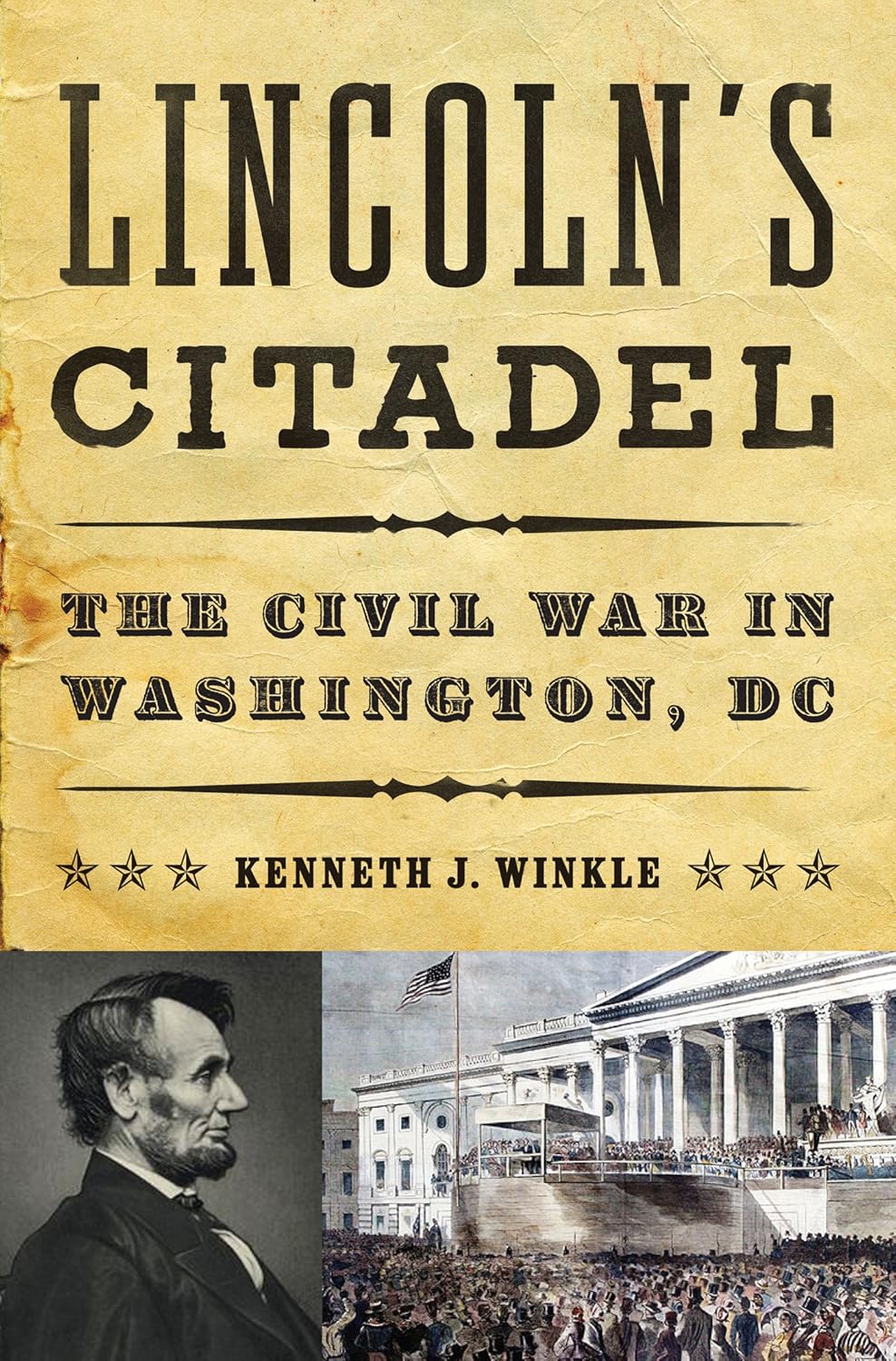
Readers this week can find a review of Lincoln’s Citadel: The Civil War in Washington, D.C. (Norton) by Kenneth J. Winkle in the Washington Post. "A prize-winning Lincoln biographer (“The Young Eagle”), Winkle is also a scholar of quantitative history — call it a “big data” approach to the past — who clearly delights in raw numbers and their telling effect. “Lincoln’s Citadel” is a treasure trove of empirical specificity."


The New York Times reviews The Great Escape: Health, Wealth, and the Origins of Inequality (Princeton University Press) by Angus Deaton. 

The NYT also takes a look at a few books--including Robert M. Fogelson's The Great Rent Wars: New York, 1917-1929 (Yale University Press)--in a piece titled, "Landlord vs. Tenant: When It All Began."

The LA Review of Books has a thoughtful essay about Karen E. Fields and Barbara J. Fields's Racecraft: The Soul of Inequality in American Life (Verso).

"Serrano, a staff writer in the Los Angeles Times' Washington, D.C., bureau, starts with two main characters: former Union soldier Albert Woolson and onetime rebel soldier Walter Washington Williams. Each man forms a compelling story of becoming caught up in the nation's bloodiest war and its aftermath. By the late 1950s, as the United States neared the centennial of the start of the war, each was feted as the oldest living veteran of his respective army. 
But one was a fraud, a scam that would have gone undetected had he not outlived all of his fellow Confederate veterans. 
There's not a lot of suspense here. It becomes clear pretty quickly which was the real deal and which a fraud. But suspense isn't the point. Serrano uses the men as a window into the long-playing reverberations of the Civil War, from the reunions to the reenactments to the wounds covered with, in retrospect, tissue paper."
And H-Net adds reviews of three edited volumes of interest, including Knowledge and Power: Essays on Politics, Culture, and War (Society for the Promotion of Science and Scholarship) edited by Bruce A. Thompson, Carolyn Halladay, and Donald Abenheim (here);  Joel Isaac and Duncan Bell's Uncertain Empire: American History and the Idea of the Cold War (Oxford University Press) (here); as well as Willibald Steinmetz, Ingrid Gilcher-Holtey, and Heinz-Gerhard Haupt's Writing Political History Today (Campus Verlag) (here).

Sunday Book Roundup


The Nation reviews Without Copyrights: Piracy, Publishing and the Public Domain (Oxford Univ. Press) by Robert Spoo.
"Sometimes, in the absence of copyright, publishers have paid authors and have abstained from reprinting the books of authors they haven’t paid. Ulysses, by James Joyce, considered by some the greatest novel of the twentieth century, lost its copyright protection in America on a technicality soon after it was published. But from the 1930s to the ’90s, Joyce and his estate were paid royalties from its publication in America anyway, thanks to exactly this kind of happy anarchy. In his new scholarly book Without Copyrights, the legal and literary historian Robert Spoo tells the remarkable tale, which Spoo doesn’t necessarily deem a pretty one. Spoo rather sympathizes, in fact, with the character many observers would consider the villain."
Salon publishes an excerpt of Thomas Jefferson's Qur'an: Islam and the Founders (Knopf) by Denise A Spellberg, and NPR reviews Jill Lepore's book about a Founding Father's sister, Book of Ages: The Life and Opinions of Jane Franklin (Knopf).

H-Net adds several works this week, including one of Wolfgang Knobl and Hans Joas's War in Social Thought: Hobbes to the Present (Princeton University Press), another of Robert Cassanello's To Render Invisible: Jim Crow and Public Life in New South Jacksonville (University Press of Florida) (audio interview in last week's post), a third of Nancy Kollmann's Crime and Punishment in Early Modern Russia (Cambridge), and a fourth of Judy Tzu-Chun Wu's Radicals on the Road: Internationalism, Orientalism, and Feminism during the Vietnam Era (Cornell University Press).
"As its title suggests, Radicals on the Road uses the transpacific journeys of anti-Vietnam War activists as a window into radical American and Vietnamese politics and culture in the 1960s. Its principal claim is as multipronged as its intended audience and intervention: in the 1960s American and Vietnamese antiwar activists created a transnational political community, beyond the confines of any nation-state or locality, based on a sustained critique of U.S. policy in Asia."

Read more »

Sunday Book Review Roundup


This week on H-Net, John Sbardellati's J. Edgar Hoover Goes to the Movies: The FBI and the Origins of Hollywood's Cold War (Cornell University Press) is reviewed.
"In J. Edgar Hoover Goes to the Movies, Sbardellati analyzes the FBI’s scrutiny of the film industry from the days of the first Red Scare after World War I through the second Red Scare of the late 1940s. In Sbardellati’s estimation, Hoover’s “sincerely held, if ill-founded” belief that Communist agents had infiltrated the industry and used the screen to spread pro-Communist propaganda to gullible, unsuspecting audiences motivated the investigations (p. 3)."
History Today takes a look at Soldier, Sailor, Beggarman, Thief: Crime and the British Armed Services Since 1914 (Oxford University Press) by Clive Emsley (here) and Your Country Needs You: The Secret History of the Propaganda Poster (Scaraband) by James Taylor (here).

LHB readers can also listen to a recent interview with author Robert Cassanello about his book, To Render Invisible: Jim Crow and Public Life in New South Jacksonville (University Press of Florida) in the New Books in History Podcast.

For those who read John Paul Stevens's review of Gary May's Bending Toward Justice (Basic Books) included in a July Book Roundup post, Professor Kevin Hoover of Duke replies to Stevens's use of "slave bonus" here in the New York Review of Books. Hoover argues
"John Paul Stevens [“The Court & the Right to Vote: A Dissent,” NYR, August 15] is confused about the history, the arithmetic, and, surprisingly, the constitutional status of the provision counting slaves as three fifths of a person for purposes of the apportionment of the House of Representatives."
The Washington Post reviews America's Obsessives: The Compulsive Energy that Built a Nation (Grand Central) by Joshua Kendall. Reviewer Megan McDonough writes,
"Control freak. Neurotic listmaker. Successful American icon. Which one of these is not like the others?
None — they all go together, according to Joshua Kendall. In his new book, “America’s Obsessives,” he profiles seven American super-achievers: political visionary Thomas Jefferson, renowned librarian Melvil Dewey, condiment titan Henry Heinz, prominent sexologist Alfred Kinsey, celebrated aviator Charles Lindbergh, cosmetic giant Estée Lauder and baseball legend Ted Williams. Kendall attributes their success to an unexpectedly powerful force: obsessive-compulsive personality disorder."
Also on the Post is a review of The Blood Telegram: Nixon, Kissinger, and a Forgotten Genocide (Knopf) by Gary J. Bass, as well as a review of America 1933: The Great Depression, Lorena Hickok, Eleanor Roosevelt, and the Shaping of the New Deal (Free Press) by Michael Golay.

Salon has published an excerpt from E. Fuller Torrey's American Psychosis: How the Federal Government Destroyed the Mental Illness Treatment System (Oxford University Press).

And finally, a review accessible to subscribers of the Wall Street Journal: American Founding Son: John Bingham and the Invention of the Fourteenth Amendment (NYU Press) by Gerard N. Magliocca.

Lebovic on "The World War II Origins of the Fulbright Program and the Foundations of American Cultural Globalism, 1945–1950"

credit
The latest issue of Diplomatic History includes an article by Sam Lebovic, an assistant professor at George Mason University and last year's winner of the ASLH's Paul Murphy Prize. The article is titled "From War Junk to Educational Exchange: The World War II Origins of the Fulbright Program and the Foundations of American Cultural Globalism, 1945–1950." Journal content is normally available only to subscribers, but for a limited time the publisher is providing open access to this piece. Here's the first paragraph:
This article uses a close history of the early years of the Fulbright program to explore the emergence of the global cultural program of the postwar U.S. state. While the Fulbright program has commonly been seen as either an exceptional example of U.S. global benevolence, or as part and parcel of the Cold War cultural offensive, I argue that the program emerged from a unique moment of cultural globalism in the liminal period between the end of World War II and the onset of the Cold War. Tracing the history of the exchange program to its curious origins in the foreign disposal of military surplus material, I show how both the practice and ideology of liberal educational exchange emerged from the global conflict with fascism, and reveal the nationalist assumptions and power-politics that underpinned the first U.S. state attempt to create a global flow of culture.
Lebovic has also blogged about this topic here, at the Oxford University Press blog.

CFP: NYU/Tamiment Cold War History Seminar

 [We have, via H-Law, the following call for papers.]

New York University’s Center for the United States and the Cold War invites New York metropolitan area based scholars to submit proposals to present at the Center’s seminar series. The Cold War seminar is a venue for work in progress. The seminar is interdisciplinary and international in scope. All papers are pre-circulated.

We are interested in projects that explore the ways in which the ideological and geopolitical conflict between the Soviet Union and the United States affected politics, culture, and society throughout the world.  Proposals that focus on the impact of the Cold War on political economy, the national security state, civil rights, civil liberties, labor relations, and gender relations are welcomed, as are projects that that see the central issue as U.S., Soviet, and European response to revolutionary nationalism and decolonization.

The Center is a joint project of Faculty of Arts and Science and the Tamiment Library, a special collection at NYU documenting the history of Labor and the Left.

The Center will reimburse presenters’ travel expenses. However, due to budget cutbacks we cannot offer hotel accommodations. We can offer a modest honorarium.

Please submit a one-page abstract and current CV by June 15th to Zuzanna Kobrzynski at zk3@nyu.edu

Heins, "Priests of Our Democracy"

New from New York University Press: Priests of Our Democracy: The Supreme Court, Academic Freedom, and the Anti-Communist Purge, by civil liberties lawyer Marjorie Heins. Here's a description from the Press:
In the early 1950s, New York City’s teachers and professors became the targets of massive investigations into their political beliefs and associations. Those who refused to cooperate in the questioning were fired. Some had undoubtedly been communists, and the Communist Party-USA certainly made its share of mistakes, but there was never evidence that the accused teachers had abused their trust. Some were among the most brilliant, popular, and dedicated educators in the city.

Priests of Our Democracy tells of the teachers and professors who resisted the witch hunt, those who collaborated, and those whose battles led to landmark Supreme Court decisions. It traces the political fortunes of academic freedom beginning in the late 19th century, both on campus and in the courts. Combining political and legal history with wrenching personal stories, the book details how the anti-communist excesses of the 1950s inspired the Supreme Court to recognize the vital role of teachers and professors in American democracy. The crushing of dissent in the 1950s impoverished political discourse in ways that are still being felt, and First Amendment academic freedom, a product of that period, is in peril today. In compelling terms, this book shows why the issue should matter to every American.
A few blurbs:
"In this insightful and illuminating history of academic freedom and the Constitution, Marjorie Heins brings to life the characters, controversies, and cases that have framed the evolution of this critical and contentious realm of American liberty." -- Geoffrey R. Stone, Edward H. Levi Distinguished Service Professor of Law, University of Chicago

"Marjorie Heins has given a human face to leading American controversies and cases about academic freedom, creatively integrating personal interviews and archival sources into her account of the developing law." -- David Rabban, University Distinguished Teaching Professor, University of Texas School of Law
The Introduction and Table of Contents are available here.

Lebovic to Lecture on Information and Cold War Politics

The Center for the United State and the Cold War announces the seminar, “The National Secrecy State: The Politics of Information in America’s Cold War,” by Sam Lebovic, a fellow at NYU’s Frederic Ewen Academic Freedom Center, on May 9, 2013, from 5:00 pm to 7:00 pm.  The seminar will take place at the Tamiment Library, located at on the 10th Floor of NYU’s Bobst Library, 70 Washington Square South.  (Last November, Dr. Lebovic received a Paul Murphy Award from the American Society for Legal History for his research.  For a copy of the paper, email Zuzanna Kobrzynski at zk3@nyu.edu.

Hat tip: H-Law

Blog Archive