New from Quid Pro Books: Northup and Story

Our friends at Quid Pro Books have drawn our attention to the reprinting of two quite notable books.  The first is Solomon Northup’s Twelve Years a Slave, in a very readable font and with such images “as the manifest of slaves from the ship Orleans that carried Northup to New Orleans, and the plantation house Northup built.”  Writes the press of the book:
The classic and compelling narrative of the kidnapping, slavery, and freedom of a free man of color wrested to rural Louisiana. Lured to the nation’s capital by the prospect of work, Solomon Northup, a free man born in New York, is kidnapped and sold into slavery. He spends the next twelve years in bondage, primarily on a plantation in Louisiana, along the Red River. Solomon was a witness to the inhumanity of the institution of slavery, the abuses suffered at the hands of cruel masters, and working conditions and the daily lives of his fellow slaves.

Throughout his enslavement, Solomon never reveals his true identity as a free man, kept secret for fear of brutal physical consequences and the possibility of being traded to a plantation further away from society. Eventually enlisting the aid of a white man from Canada employed on the plantation, Solomon strives to realize his dream of returning to Saratoga, New York, to his wife and now-grown children.

First published in 1853, Twelve Years a Slave is a stark description of that “peculiar institution” that drove the southern economy and bitterly divided Americans. Solomon Northup’s narrative is perhaps one of the most important–and compelling–first-hand accounts of slavery that exists. The new edition features additional interesting and rare images relating to Solomon Northup, such as the actual “manifest of slaves” from the ship that brought him in chains to New Orleans. The paperback uses clearer, more legible formatting and font than do typical reproductions of this book, and the eBooks include the additional images and active Contents, linked notes, and proper digital presentation–also rare among the usual eBook editions of this work.
The second book is a one-volume abridgment of Joseph Story’s Commentaries on the Constitution of the United States (1833), with an introduction by Penn Law’s Kermit Roosevelt III:
Justice Joseph Story’s famous and influential review of the origins, influences, and early interpretations of the Constitution is now presented in the author’s own 1833 Abridged Edition—considered the most useful and readable version of this important work, written by the Supreme Court’s youngest member. No other ebook version offers the accessible abridged form, and in proper digital format no less. The new hardcover and paperback use modern, legible font. Plus in print or digital, this edition adds an extensive 2013 introduction by Kermit Roosevelt III.

One of the United States’ most influential legal scholars and jurists wrote his landmark treatise before the Civil War, describing federalism, states’ history, freedoms, and constitutional structure. He abridged it into this usable book. Adding a new and informative Foreword by constitutional scholar Kermit Roosevelt III of the University of Pennsylvania Law School, the quality Quid Pro edition features active Contents, proper formatting, and embedded pagination from the original, for continuity of referencing and citation. Professor Roosevelt catalogs many instances in which the current Court has relied on this book to decide issues of gun rights, federalism, and privacy. In addition, he provides a fascinating biographical summary of Story and describes the origins of this monumental work, as well as the sway it has had on legal history since 1833.

Sunday Book Roundup


The Nation reviews Without Copyrights: Piracy, Publishing and the Public Domain (Oxford Univ. Press) by Robert Spoo.
"Sometimes, in the absence of copyright, publishers have paid authors and have abstained from reprinting the books of authors they haven’t paid. Ulysses, by James Joyce, considered by some the greatest novel of the twentieth century, lost its copyright protection in America on a technicality soon after it was published. But from the 1930s to the ’90s, Joyce and his estate were paid royalties from its publication in America anyway, thanks to exactly this kind of happy anarchy. In his new scholarly book Without Copyrights, the legal and literary historian Robert Spoo tells the remarkable tale, which Spoo doesn’t necessarily deem a pretty one. Spoo rather sympathizes, in fact, with the character many observers would consider the villain."
Salon publishes an excerpt of Thomas Jefferson's Qur'an: Islam and the Founders (Knopf) by Denise A Spellberg, and NPR reviews Jill Lepore's book about a Founding Father's sister, Book of Ages: The Life and Opinions of Jane Franklin (Knopf).

H-Net adds several works this week, including one of Wolfgang Knobl and Hans Joas's War in Social Thought: Hobbes to the Present (Princeton University Press), another of Robert Cassanello's To Render Invisible: Jim Crow and Public Life in New South Jacksonville (University Press of Florida) (audio interview in last week's post), a third of Nancy Kollmann's Crime and Punishment in Early Modern Russia (Cambridge), and a fourth of Judy Tzu-Chun Wu's Radicals on the Road: Internationalism, Orientalism, and Feminism during the Vietnam Era (Cornell University Press).
"As its title suggests, Radicals on the Road uses the transpacific journeys of anti-Vietnam War activists as a window into radical American and Vietnamese politics and culture in the 1960s. Its principal claim is as multipronged as its intended audience and intervention: in the 1960s American and Vietnamese antiwar activists created a transnational political community, beyond the confines of any nation-state or locality, based on a sustained critique of U.S. policy in Asia."

Read more »

Jones on "Narrating Slavery, Freedom, and the Haitian Revolution in Baltimore City"

Martha S. Jones (University of Michigan) has posted "The Case of Jean Baptiste, un Créole De Saint-Domingue: Narrating Slavery, Freedom, and the Haitian Revolution in Baltimore City," which was published in The American South and the Atlantic World (University Press of Florida, May 2013), edited by Brian Ward, Martin Bone, and William A. Link. Here's the abstract:

The story of the widow Volunbrun and her slaves might be told through differing analytic frames: empire, constitution making, anti-slavery constitution making, antislavery movements, political economy, high court pronouncements pronouncements, and biography.8 In this essay the answers lie in the intimate dynamics of a household and the lived experience of the enslaved people in it. Can we understand what the problem of slavery and freedom looked like for those enslaved people whose life itineraries were shaped by the meta-forces of commercial, political, and military conflict and exchange? Being enslaved in 1796 Port-au-Prince differed from being enslaved in 1801 New York City or 1818 Baltimore. Along this Atlantic itinerary, the Volunbrun slaves confronted new rules, rituals, and structures of power. Straining to adopt their perspective, we see the lived dimensions of slavery and law. We learn how enslaved people quietly navigated a complex matrix of courts, attorneys, and reformers. We will also see how the claims of Saint-Domingue's slaves in Maryland, making their lives at the intersection of the Haitian Revolution and an emerging domestic slave trade, shaped the parameters of Southern southern legal culture.
The full chapter is available here.

Dennis on "Blacks Informing during Slavery"

Andrea Dennis, University of Georgia Law School, has posted A Snitch in Time: An Historical Sketch of Black Informing During Slavery, which is forthcoming in the Marquette Law Review,  97 (2014).  Here is the abstract:    
This article sketches the socio-legal creation, use, and regulation of informants in the Black community during slavery and the Black community’s response at that time. Despite potentially creating benefits such as crime control and sentence reduction, some Blacks today are convinced that cooperation with government investigations and prosecutions should be avoided. One factor contributing to this perspective is America’s reliance on Black informants to police and socially control Blacks during slavery, the Civil Rights Movement, and the Wars on Drugs, Crime and Gangs. Notwithstanding this historical justification for non-cooperation, only a few informant law and policy scholars have examined closely the Black community’s relationship with informing. Furthermore, even among this small group of works, noticeably absent are historical explorations of Black America’s experience with informing during slavery. Drawn using a variety of primary and secondary historical and legal sources, this article develops a snapshot of the past revealing many similarities between the Black experience with informing both while enslaved and in contemporary times. Consideration of these resemblances during present debate on the topic may help to facilitate nuanced conversation as to whether and how the modern Black community and government should approach using informants in current times.

Sunday Book Roundup

Jotwell has posted a review of Eliga H. Gould's Among the Powers of the Earth: The American Revolution and the Making of a New World Empire (Harvard Univ. Press). In it Christina Duffy Ponsa writes "the book makes you feel like you’re looking at history through a 360-degree lens. A legal, diplomatic, and intellectual history spanning from the mid-18th century to the declaration of the Monroe Doctrine in 1823, the book situates the Revolution in the context of the evolving law of nations in a strikingly rich and detailed account. Everything, it seems, is in there."

The September issue of The Federal Lawyer is out and has reviewed several books of note: The Law of Armed Conflict: An Operational Approach (Wolters Kluwer Law & Business) by Geoffrey Corn, Victor Hansen, Chris Jenks, Richard Hackson, Eric Talbot Jenson, and Hames Schoettler Jr; Rebels at the Bar: The Fascinating, Forgotten Stories of America's First Women Lawyers (NYU Press) by Jill Norgren; Out of Order: Stores from the History of the Supreme Court (Random House) by Sandra Day O'Connor; as well as David O. Stewart's The Lincoln Deception (Kensington). Of the last book, reviewer JoAnn Baca provides an intriguing introduction:
"Lawyer and award-winning author David O. Stewart has written three nonfiction books—on Aaron Burr, Andrew Johnson’s impeachment, and the men who drafted the Constitution. But what happens when a historian comes across a story that cannot be proven by any fact he can uncover, yet it sparks his imagination? For Stewart, the answer is to leave his comfort zone and write a novel, allowing him to theorize and extrapolate, far from established facts, about a part of our history that fascinates many as much today as it did in 1865: the assassination of Abraham Lincoln. The Lincoln Deception is the result of Stewart’s need to explore to his own satisfaction a vague suggestion of duplicity as yet undiscovered in the assassination of the President."
H-Net has added many reviews of interest to this week's roundup readers including several books that extend beyond the American context, such as David Lemmings's Crime, Courtrooms, and the Public Sphere in Britain, 1700-1850 (Ashgate) here; and a review of two books including Adam Roberts and Timothy Garton Ash's Civil Resistance and Power Politics: The Experience of Non-violent Action from Gandhi to the Present (Oxford University Press) and Sean Scalmer's Gandhi in the West: The Mahatma and the Rise of Radical Protest (Cambridge University Press). Elizabeth F. Thompson's Justice Interrupted: The Struggle for Constitutional Government in the Middle East (Harvard University Press) is also reviewed. Seth Offenbach writes of Thompson's work:
"In the nearly three years since the Arab uprisings began, the expertise of Middle East historians has been in demand like almost never before, as observers attempt to understand the historical roots underlying the seemingly sudden popular challenges to long-standing authoritarian regimes. The result has been a surge in publications that are broad in their scope and appeal but limited in the depth of their analysis and historical insight. A strong exception to this trend is the recent work of historian Elizabeth F. Thompson, whose study on the rise of constitutionalism in the Middle East swiftly dispenses with the facile explanations of the Arab uprisings, instead offering readers a comprehensive yet nuanced look at the lasting impact of efforts to enshrine and institutionalize the language of justice across the region during the last two centuries. While the study is bookended by a discussion of the implications that these developments hold for the contemporary calls for universal rights, its substantive chapters provide a perceptive and deeply contextualized look at the common thread underlying a struggle that dates back to the premodern era."
For the Washington Post Johnathan Yardley reviews Ebony and Ivy: Race, Slavery, and the Troubled History of America’s Universities by Craig Steven Wilder. Also in the Post is a review of Gerald R. Ford: An Honorable Life (University of Michigan) by James Cannon.

The Guardian reviews Churchill's Bomb: How the United States Overtook Britain in the First Nuclear Arms Race (Faber & Faber) by Graham Farmelo.

Maya Jasanoff reviews River of Dark Dreams: Slavery and Empire in the Cotton Kingdom (Harvard University Press) by Walter Johnson in the New York Review of Books. She finds:
"The artistry of River of Dark Dreams lies in the close-up—in Johnson’s mesmerizing attention to the “material” in historical-geographical materialism. In the pointillist style so dexterously displayed in his reconstruction of the New Orleans slave market, Soul by Soul, Johnson zooms in on the “nested set of abstractions” that made the Cotton Kingdom run: money, markets, maps, labor. “If you looked more closely,” he observes, “you would see that each abstraction stood at odds with the physical properties of the object it sought to represent.”River of Dark Dreams delivers spectacularly on the long-standing mission to write “history from the bottom up”: from the soil tangy and pungent with manure, and the Petit Gulf cotton plants rooted into it, and the calloused fingers plucking its blooming, sharp-edged bolls. This is a history of how wilderness became plantations that became states, nations, and empires—of how an overseer’s lashes sliced into a slave’s back turned “into labor into bales into dollars” into visions of America’s future in the world."
This week readers can also listen to the New Books in History Podcast for a discussion with Tevi Troy, author of What Jefferson Read, Ike Watched, and Obama Tweeted: 200 Years of Popular Culture in the White House (Regnery History).

On HNN, reviewer Bernard von Bothmer finds that American Umpire (Harvard University Press) by Elizabeth Cobbs Hoffman "offers a sweeping, wide-ranging, and remarkably in-depth overview of the history of American foreign relations." HNN also reviews Thurston Clarke's JFK's Last Hundred Days (Penguin).

Salon has published an excerpt from Front Porch Politics: The Forgotten Heyday of American Activism in the 1970s and 1980s (Hill and Wang) by Michael Stewart Foley.

New Release: Smith, "Freedom's Frontier: California and the Struggle over Unfree Labor, Emancipation, and Reconstruction""

New from the University of North Carolina Press: Freedom's Frontier: California and the Struggle over Unfree Labor, Emancipation, and Reconstruction, by Stacey L. Smith (Oregon State University). A description from the Press: 
Most histories of the Civil War era portray the struggle over slavery as a conflict that exclusively pitted North against South, free labor against slave labor, and black against white. In Freedom's Frontier, Stacey L. Smith examines the battle over slavery as it unfolded on the multiracial Pacific Coast. Despite its antislavery constitution, California was home to a dizzying array of bound and semibound labor systems: African American slavery, American Indian indenture, Latino and Chinese contract labor, and a brutal sex traffic in bound Indian and Chinese women. Using untapped legislative and court records, Smith reconstructs the lives of California's unfree workers and documents the political and legal struggles over their destiny as the nation moved through the Civil War, emancipation, and Reconstruction.
Smith reveals that the state's anti-Chinese movement, forged in its struggle over unfree labor, reached eastward to transform federal Reconstruction policy and national race relations for decades to come. Throughout, she illuminates the startling ways in which the contest over slavery's fate included a western struggle that encompassed diverse labor systems and workers not easily classified as free or slave, black or white.
A few blurbs:
"A real winner: ambitious, thoughtful, and splendidly rendered. Smith peels back history to rework the labor landscapes of nineteenth-century California and reintroduce the state into dynamic, Reconstruction-era political and social debates."--William Deverell

"A brilliant and long overdue examination of late-nineteenth-century California's complicated race and labor history. By comparing the stories of bound Native American, African American, Chinese, Latino, and Hawaiian workers, Smith reveals the complexities of California's racial and labor histories and goes even further to demonstrate the larger implications for the California experience for understanding national stories of abolition, emancipation, Reconstruction, and immigration."--Michael Magliari
More information is available here.

Sunday Book Roundup

This week, the 50th anniversary of the March on Washington brought with it several book reviews on race in America.

NPR has put together a list of "books that bring the civil rights movement to life" here, including two of my favorites - Anne Moody's Coming of Age in Mississippi (Random House, 1992) and the edited volume of personal accounts, Hands on the Freedom Plow: Personal Accounts by Women in SNCC (University of Illinois Press, 2012).

The Washington Post's Jonathan Yardley reviews William P. Jones's The March on Washington: Jobs, Freedom, and the Forgotten History of Civil Rights (Norton). Yardley writes,
"This is the central theme of “The March on Washington”: The powerful economic impulses of the march have been lost to view as historians emphasize the eloquence of King’s speech and its effect on the political climate as the country moved to address the questions of basic civil rights and opportunities that he articulated. Initially the march’s organizers demanded “federal jobs creation, raising the minimum wage, a Fair Employment Practice law, and support for [President John F.] Kennedy’s civil rights bill,” demands that “expanded as new groups joined.”"

This week there are also several reviews of For Discrimination: Race, Affirmative Action, and the Law (Pantheon) by Harvard Law Professor Randall Kennedy, including a lengthy L.A. Times review, a Washington Post review, and a Wall Street Journal review for subscribers.

H-Net has a review of Emily West's Family or Freedom: People of Color in the Antebellum South (University Press of Kentucky), which makes use of enslavement petitions to examine antebellum race and status relationships in the South.

Lewie Reece has tackled two books in a H-Net review titled, "The Lincoln Theme in the Twenty-First Century." The reviewed books are Michael Burlingame's Lincoln and the Civil War (Southern Illinois University Press) and Mark E. Neely's Lincoln and the Triumph of the Nation: Constitutional Conflict in the American Civil War (University of North Carolina Press).  Reece writes:

These two books serve as a reminder that the Lincoln theme, far from being exhausted, continues to be explored in new ways by historians. Pure biography remains a subject of lively interest, but so do efforts to connect Lincoln to issues related to antislavery and the Civil War. Additionally, several works are but marginally connected to history, and instead examine the ongoing impact Lincoln had, and continues to have, on American culture. Moreover, as these two volumes suggest, academic historians continue to widen the parameters of our understanding of Lincoln. 
Mark Neely and Michael Burlingame have written widely not only about Lincoln, but Civil War America as well. Their approach in these volumes is different, yet similar. Neely presents a constitutional and legal history of the Civil War which, despite the title, is only partly about Lincoln. Burlingame has written a compressed history of Lincoln’s presidency and its influence on the Civil War. Both works reveal these historians’ impressive scholarship and wide reading in manuscript sources; both provide insight into the subject. It takes courage to try and do something different and provocative, and both men are to be commended for seeking new approaches.
 n+1 reviews Walter Johnson's River of Dark Dreams: Slavery and Empire in the Cotton Kingdom (Harvard University Press).

Other reviews of interest include Washington Post's review of Higher Education in America (Princeton University Press) by Derek Bok.

HistoryToday asks "How could the first nation to cleave church from state remain so pious?"as it reviews The Creation of the American Soul: Roger Williams, Church and State, and the Birth of Liberty (Duckworth) by John Barry.

The New York Times reviews A Wild Justice: The Death and Resurrection of Capital Punishment in America (Norton) by Evan J. Mandery. (Previously mentioned in the Aug. 18 Book Roundup.)

And Salon has published an excerpt from Estelle B. Freedman's Redefining Rape: Sexual Violence in the Era of Suffrage and Segregation (Harvard University Press).

Sunday Book Roundup

This weekend, you can find a review of Charles Moore's new biography, Margaret Thatcher: From Grantham to the Falklands (Knopf) in New Republic. Reviewer John Gray writes,
"Covering the time from Thatcher's birth up to her role in the Falklands war in 1982, Margaret Thatcher: From Grantham to the Falklands is one of two projected volumes; but this is already a major study of a pivotal leader—indeed, it is already one of the greatest biographies in the English language."
HistoryToday reviews City Water & City Life:Water and the Infrastructure of Ideas in Urbanizing Philadelphia, Boston and Chicago (University of Chicago Press), by Carl Smith here.

H-Net has added two reviews of interest: editors Keith M. Brown and Alastair J. Mann's The History of the Scottish Parliament, Volume 3, Parliament in Context, 1235-1707 (Edinburgh University Press) here; and a second review of both John Ashworth's The Republic in Crisis, 1848-1861 (Cambridge University Press) and the edited volume A Political Nation: New Directions in Mid-Nineteenth-Century American Political History (Gary W. Gallagher, Rachel A. Shelden, eds.) (University of Virginia Press).

The Washington Post reviews Mac Griswold's The Manor, a cultural landscape history of a slave plantation here. (Another review of the book was included in a prior book roundup post here.) The reviewer describes the book:
"“The Manor” traces the history of the house and its inhabitants, quickly leaving the garden behind to explore archaeology and research that range from West Africa to Barbados and back to Shelter Island. When Griswold stumbled upon the place, it was inhabited by Andrew and Alice Fiske, descendants of the original owners, Nathaniel and Grizzell Sylvester. Called Sylvester Manor, the house had been in the family in an unbroken line since the 1650s, providing an extraordinary lens with which to view a complex American story about (among other things) race, religion and the history of slavery in the North — largely documented."
The Washington Post also reviews Mistrial: An Inside Look at How the Criminal Justice System Works . . . and Sometimes Doesn’t (Gotham) by Mark Geragos and Pat Harris.

Salon has published excerpts from In Spies We Trust: The Story of Western Intelligence (Oxford), by Rhodri Jeffreys-Jones.

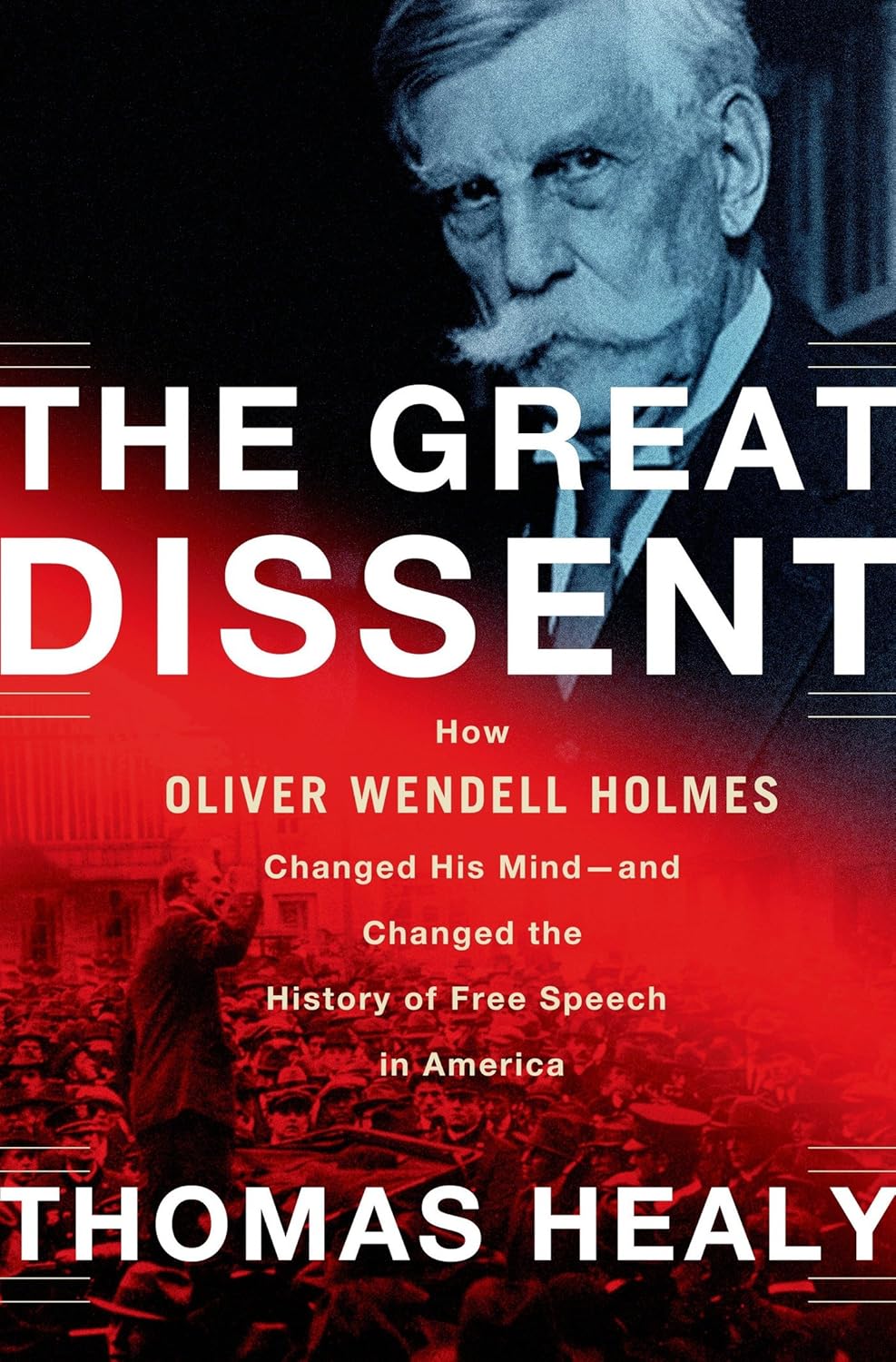
For Wall Street Journal subscribers, there is a review of Thomas Healy's The Great Dissent (Metropolitan), as well as a review of Lawrence J. Vale's Purging the Poorest: Public Housing and the Design Politics of Twice-Cleared Communities (Chicago). Of Vale's work, the reviewer writes,
"The beauty of Mr. Vale's book is that as a scrupulous scholar he lays out his two case studies with all the careful detail you as a reader need to judge his conclusions. But in the end, the reformist approach exemplified by Ms. Glover is probably correct. "Poverty does not have to be a permanent condition covering multiple generations," she has said. "And we should not establish housing programs on the assumption that it is.""

Robert D. Sloane has posted a review of James Q. Whitnman, The Verdict of Battle: The Law of Victory and the Making of Modern War (Harvard University Press) on SSRN (forthcoming in American Journal of International Law).

For those heading back to the classroom this month, the New York Times reviews Why Teach? In Defense of a Real Education (Bloomsbury), by Mark Edmundson, an English professor at the University of Virginia.

And for those of you who'd like to check out a few reviews of the summer reads that our guest blogger, Sally Gordon, recommended earlier this week, try these:
  • An October 2012 New York Times review, and an August 2012 Slate review by Eric Posner, of John Fabian Witt's Lincoln's Code.
  • A 1998 H-Net review of James C. Scott's Seeing Like a State, as well as an April 1998 review (with a link to the first chapter) in the New York Times.  
  • A 2012 review of Sarah Osborn's World: The Rise of Evangelical Christianity in Early America by Catherine A. Brekus, from Books and Culture, and a second review here from Christianity Today.
  • Last but not least, Beyond the Blurb reviewed Martin Walker's Bruno, Chief of Police in 2011.

Schmitt on Slavery and Extraterritorial State Power

Jeffrey M. Schmitt, Florida Coastal School of Law, has posted Constitutional Limitations on Extraterritorial State Power: State Regulation, Choice of Law, and Slavery, which is forthcoming in the Mississippi Law Journal.  Here is the abstract:    
Modern legal scholarship has been highly critical of the Supreme Court’s precedent governing when a state may apply its law to conduct that occurs beyond its borders. Under this precedent, while a state court has broad discretion to apply forum law through its choice of law analysis, a state legislature may not pass legislation which regulates wholly extraterritorial conduct. Courts and scholars have long argued that the prohibition on extraterritorial legislation should be abandoned and that, under principles of federalism, stricter constitutional limitations should be placed on a state’s choice of law. Moreover, scholars have argued that these doctrines are inconsistent because there is no meaningful distinction between action by a state’s courts and its legislature.

This Article responds to such criticism by arguing that the Court’s doctrines are fully consistent with the treatment of extraterritorial state power under the antebellum Constitution. In the decades leading up to the Civil War, the most important legal, political, and social issue of the day — the subject of slavery — provoked one of the country’s first and most contentious disputes over the extraterritorial application of state law. When arguing for the rejection of southern law, northerners asserted that any forced application of the law of slavery would infringe on fundamental aspects of the sovereignty of the northern states. In response, southerners contended that, under implicit principles of federalism which commanded that southern law to be treated on equal terms, northern states were constitutionally required to apply southern law when ordinary choice of law rules so dictated. Facing this conflict between principles of state sovereignty and state equality, northern courts followed traditional legal doctrine by holding that state sovereignty must prevail.

An appreciation of the importance of state sovereignty to the antebellum constitution helps to make sense of the Court’s modern extraterritoriality doctrines. If state sovereignty is viewed as a fundamental tenant of federalism, any limitations on a state’s ability to apply its own law should come only from the Due Process concerns of individual litigants. A robust view of state sovereignty also fully supports the Court’s prohibition on extraterritorial legislation, despite recent judicial criticism of the doctrine. Finally, because forcing a state court to apply and enforce the law of another sovereign has very different implications for state sovereignty than a rule prohibiting a state legislature from regulating conduct in another state, state sovereignty provides a potential way to reconcile the modern Court’s differing treatment of state courts and state legislatures.

Barker on "Fugitive Slaves and the American Revolution"

Out from McFarland recently is Fugitive Slaves and the Unfinished American Revolution: Eight Cases, 1848-1856, by Gordon S. Barker, an associate professor of history at Bishop’s University in Sherbrooke, Quebec, Canada:
This book posits that the American Revolution-- waged to form a "more perfect union"--still raged long after the guns went silent. Eight major fugitive slave stories of the antebellum era are described and interpreted to demonstrate how fugitive slaves and their abolitionist allies embraced Patrick Henry’s motto "Give me Liberty or Give me Death" and the principles enshrined in the Declaration of Independence. African Americans and white abolitionists seized upon these dramatic events to exhort citizens to complete the Revolution by extending liberty to all Americans. Casting fugitive slaves and their slave revolt leaders as heroic American Revolutionaries seeking freedom for themselves and their enslaved brethren, this book provides a broader interpretation of the American Revolution.
Robert A. Gross, author of The Minutemen and Their World blurbs:

"No one acted on the promises of the American Revolution with greater commitment and courage than the little-known African Americans at the heart of Gordon S. Barker’s stirring new book. Caught up in the dramatic fight over the Fugitive Slave Law of 1850, these brave souls, along with their abolitionist allies, demanded ’liberty or death’ and thereby summoned Americans to renew the ’spirit of 1776.’ They were, in Barker’s apt phrase, the ’minutemen’ of their own day, on the front lines of freedom for a nation that has not yet paid them their due. Barker’s insightful and inspiring account rightly recognizes these unsung heroes of American democracy."

Sunday Book Round-up

NPR looks at "when fashion and law collide" in an author interview with Ruthann Robson. Her new book is Dressing Constitutionally: Hierarchy, Sexuality, and Democracy from Our Hairstyles to Our Shoes (Cambridge University Press). Here's an excerpt:
"On local laws that ban 'cross-dressing' 'It often acts as a cipher for other sorts of problems, right. So that if people dress decently, then there won't be gambling, then there won't be theft, then there won't be muggings — as if those two things go together. And of course, people's notions of what's 'decent' really varies across class, varies across time, and varies across age. And one way to look at some of these is really about older people policing the sexuality of younger people."
The new August issue of The Federal Lawyer has a couple of book reviews of interest this week. Michael Ariens reviews Joanna Grossman and Lawrence Friedman's Inside the Castle: Law & the Family in 20th Century America (Princeton University Press, 2011). Louis Fisher reviews Robert Bork's Saving Justice: Watergate, the Saturday Night Massacre, and Other Adventures of a Solicitor General (Encounter Books).

Over at The New Republic Andrew Delbanco has written a review essay of several works on Lincoln and slavery in "Lincoln's Long Game: The morally painful road to slavery's end."

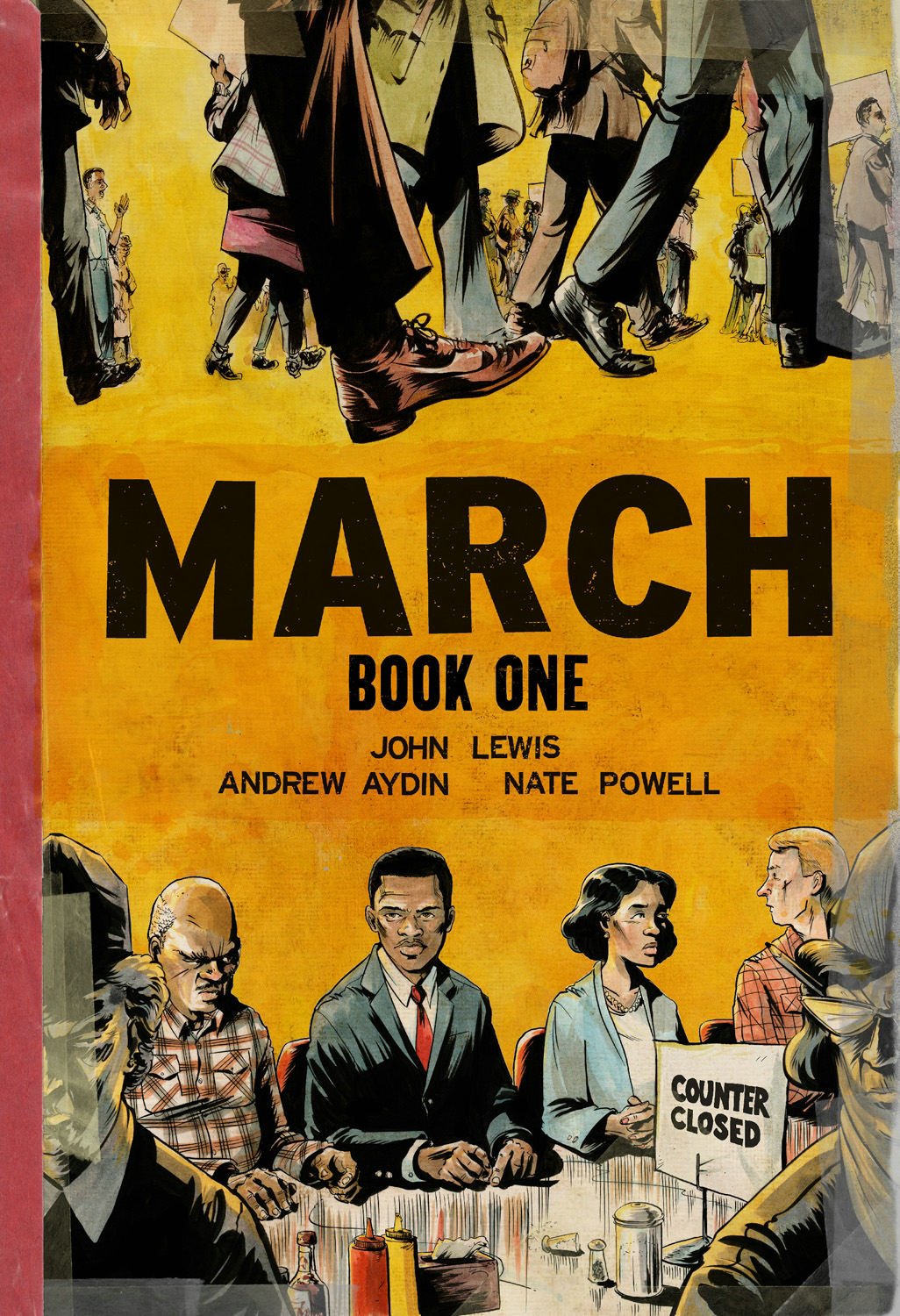
NPR reviews March (Top Shelf) which has been co-written by civil rights activist and member of the U.S. House of Representatives John Lewis, his staffer Andrew Aydin, and graphic novelist Nate Powell. Reviewer Jody Arlington writes:
"And yet March is a fresh and sometimes shocking work, even for those familiar with Lewis' life. Not just for its violence and its graphic re-creation of a dark time, but for its inside look at the leaders of the civil rights movement. In one disturbing scene, they shout insults at each other and enact other indignities as a way to prepare for the resistance and abuse they'll face in public."

The New York Times's David Garrow also takes up the topic of civil rights in his review of William Jones's The March on Washington (Norton)

Jeannette Cockroft has reviewed Keira V. Williams's Gendered Politics in the Modern South: The Susan Smith case and the Rise of a New Sexism (Louisiana State University Press) for H-Net here.

Excerpts from Evan Mandery's book on death penalty lawyers in the 1960s and 1970s, A Wild Justice (Norton), can be found on Salon here. Salon has also published adapted excerpts from an e-book essay about the history of forced sterilization, For the Public Good (New New South).

This week the Guardian has reviewed another book about American death penalty policy, Injustice: Life and Death in the Courtrooms of America by Clive Stafford Smith.

Finally, John Yoo reviews A Principled Stand: The Story of Hirabayashi v. United States (University of Washington Press) by Gordon K. Hirabayashi in the Wall Street Journal.

Fede on Mississippi Supreme Court Judge Joshua G. Clarke

Andrew Fede has published "Judging Against the Grain? Reading Mississippi Supreme Court Judge Joshua G. Clarke's Views on Slavery Law in Context" in the May 2013 issue of the FHC Annals, the Journal of the Florida Conference of Historians.  That issue also includes an article by J. Calvitt Clarke, III, a descendent of Judge Clarke and a history professor emeritus at Jacksonville University.  Here is an abstract of Fede's article:
This article reviews Mississippi Supreme Court Judge Joshua G. Clarke's one signed slavery law opinion, State v. Jones (1821)(affirming defendant's conviction for murdering a slave), and the Court's unsigned opinion in Harry v. Decker and Hopkins (1818)(affirming freedom judgment in favor of enslaved petitioners), which the author contends that Clarke wrote.  According to the article, these opinions stand out because they were not typical of the dominant trend in the antebellum Southern common law of slavery.

The article summarizes Clarke's biography, about which little evidence is available.  Clarke moved from Pennsylvania to the Mississippi territory.  By 1804 he was practicing law in the territory.  He served in the territorial legislature and in the state's first constitutional convention before the legislature elected him in 1818 to serve on the first Mississippi Supreme Court.

The Jones and Harry opinions echo, without citation, Lord Mansfield's words in Somerset v. Stewart, suggesting that slavery was contrary to the common law and that it thus required statutory support.  In Jones, Clarke extended this view to assert that enslaved people retained all of their common law rights that statutes did not explicitly deny to them.  Clarke died in 1828.  Fede contends that there is not enough evidence to establish whether he would have consistently extended this jurisprudence to other slavery law issues and cases. 

Nevertheless, the article concludes that the Jones and Harry opinions express views that were contrary to the principles that emerge from the antebellum Southern cases denying to slaves the common law's equal protection, even when the legislatures had not done so, and denying to slaves freedom judgments, even when there was clear evidence that their owners intended to free them.

Brophy on the Nat Turner Trials

Alfred L. Brophy, University of North Carolina at Chapel Hill School of Law, has posted The Nat Turner Trials, which appears in North Carolina Law Review 91 (2013).  Here is the abstract:    
credit
“The Nat Turner Trials” locates the trials of slaves in the wake of the Nat Turner rebellion in the context of common, and statutory, law and extra-legal responses to slavery in Virginia and North Carolina during the early 1830s. The Article shows how trials were part of the whole system of slavery, held together by norms of white supremacy promulgated in the press, the pulpit, and on plantations. Decisions from local courts to appellate courts gave broad power to slave owners to control enslaved people. There was little done in defense of slaves, though in some ways the states’ criminal procedure statutes and the actions of some slave owners and defense lawyers may have helped to limit the number of convictions.

The article is framed by two cases in North Carolina — one in 1830 of a white man who attacked a slave in his custody and was freed from punishment and another in 1834 of a slave who killed his overseer and was found guilty of manslaughter rather than premeditated murder. Sandwiched between those two cases was the Nat Turner rebellion in neighboring Virginia during August of 1831. The trials of those accused of rebellion and conspiracy, along with the vigilante violence that accompanied the rebellion, further illustrate the ways the legal system functioned to support slavery and order.

The article highlights how trials of slaves in the wake of the Nat Turner rebellion worked to re-establish order and to mete out punishment. It also reveals how lawyers for the slaves labored — largely unsuccessfully — to free those most obviously not guilty. Those lawyers were committed to the re-establishment of order; all of the key lawyers had participated in the militia response to the rebellion. Yet the defense lawyers still tried to limit convictions, and they succeeded to some extent.

The trials worked in conjunction with — and sometimes in opposition to — the extra-legal violence that accompanied the repression of the rebellion. The trials reveal, as did the two Supreme Court of North Carolina cases that bookend this Article, the conflicts within the community, as some emphasized the power of slave owners to treat slaves as they wished, while others emphasized the subjection of everyone, including owners of slaves, to the rule of law. The court struggled in part with trying to keep the community from taking vigilante action. It also acted to punish the rebels and stopping further rebellion.

The trials tell compact, linear stories about why someone is being punished (or not). The trials are obscure, but collectively they tell a powerful story about the role of law in American history as a vehicle for establishing order.

The American Presidency and the Crises of the Nineteenth Century

[We have the following announcement.  More here.]

The Miller Center is pleased to announce the 2013–2014 "Historical Presidency" series, “The American Presidency and the Crises of the Nineteenth Century.” Organized by Gary W. Gallagher, renowned U.Va. history professor and Miller Center senior faculty associate, the inaugural season will examine executive leadership during a particularly calamitous period in our nation’s history.

Featuring the most distinguished scholars in their fields, the Miller Center’s “Historical Presidency” series will reach back into the American past in order to gain perspective on the way that presidential leadership has evolved over time, from the founding of the country to the present.

“Lincoln and Davis: War Presidents”
A Conversation with James McPherson and Gary Gallagher
September 18, 5:00 p.m., Nau Hall 101  
GARY W. GALLAGHER is the John L. Nau III Professor in the History of the American Civil War at the University of Virginia. JAMES M. MCPHERSON is the George Henry Davis '86 Professor of History Emeritus at Princeton University.

“James Knox Polk and the War with Mexico”
October 16, 3:30 p.m.
DANIEL WALKER HOWE is Rhodes Professor of American History Emeritus at Oxford University and Professor of History Emeritus at UCLA. 

“Andrew Jackson and the Troubled Birth of Democracy”
November 8, 3:30 p.m.
HENRY WILLIAM BRANDS is the Dickson Allen Anderson Centennial Professor of History at the University of Texas at Austin.

“Sink Hole: How Kansas Crises Undid the Presidencies of Franklin Pierce and James Buchanan”
February 26, 3:30 p.m.
MICHAEL F. HOLT is Langbourne M. Williams Professor of American History Emeritus at the University of Virginia.

“U.S. Grant and the Crisis of Reconstruction”
March 19, 3:30 p.m.
JOAN WAUGH is professor in the UCLA History Department.

“James Madison and the Brink of National Ruin”
April 16, 3:30 p.m.
ALAN TAYLOR is the Thomas Jefferson Memorial Foundation Professor at the University of Virginia. 

Two Reviews on Race, Family & Law in U.S. History

The new Interim issue of Common-place includes two reviews of interest.

In Legally Free, Unable to Live Freely, Rebecca Anne Goetz (New York University) reviews Eva Sheppard Wolf, Almost Free: A Story about Family and Race in Antebellum Virginia (University of Georgia Press, 2012). Here's a taste:
Wolf skillfully weaves together a narrative of [nineteenth-century Virginian Samuel] Johnson's life, tracing his triumphs and defeats as he sought both freedom and a meaningful place in his community of Warrenton, Virginia. The man who emerges from Wolf's patient search through the archives, had, she writes, a "keen attentiveness to the law and to doing things in a proper, socially accepted way." Johnson also "yearned for legitimacy—a socially and legally secure place for his family and himself in his homeland of Virginia" (53).
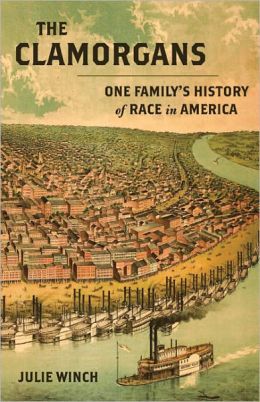
In The Law Could Make You Rich, Jared Hardesty (Ph.D. candidate, Boston College) reviews Julie Winch, The Clamorgans: One Family's History of Race in America (Hill & Wang, 2011). Hardesty begins the review as follows:
Governor Riggins, a leader of Boston's nineteenth-century black community, once publicly admonished a fellow person of color, William Patterson, and took the opportunity to offer a lesson to the community at large. Patterson had purchased unlicensed liquor for some fellow African Americans, and the authorities in Boston caught him red-handed. In the midst of dressing Patterson down, Riggins expressed the hope that the "law will make you smart." His proclamation to his fellow Afro-Bostonians—the law could be a source of empowerment for African Americans—may have been lost on Patterson, but it was a message that blacks across the United States heard loud and clear. Half a continent away in St. Louis, Missouri, the mixed-race grandsons of Jacques Clamorgan geared up to file suit and lay claim to their grandfather's extensive lands. For them, Riggins's message carried special resonance and an additional caveat. For the Clamorgan men, the law not only made them smart, but could also make them rich.
Did the Clamorgans have a legitimate chance to win their legal battles? In her wonderful The Clamorgans: One Family's History of Race in America, Julie Winch answers this question by offering readers a thorough examination of the family's past, especially their relationship with the law. . . .
The full issue is available here.

June 2013 Journal of American History

The June 2013 issue of the Journal of American History is out. Here's a preview of the content (full text is limited to subscribers):

The House on Bayou Road: Atlantic Creole Networks in the Eighteenth and Nineteenth Centuries

Faubourg Tremé in New Orleans has been described as the oldest black neighborhood in America. In his article, Pierre Force uses as his starting point a dispute in 1813 over the payments for a house between a white man and a free man of color that took place in Tremé. Attempting to find out more about both parties to the case (won by the free man of color), Force reconstructs each man's family history and follows the archival track on a journey to Cuba, Haiti, France, Spain, and Senegal. What might have seemed at first sight like a random encounter between representatives of two different racial groups emerges as a story of shared ancestries and cultural references, as well as shifting allegiances and identities.

Status across Borders: Roger Taney, Black British Subjects, and a Diplomatic Antecedent to the Dred Scott Decision

Michael A. Schoeppner offers a fresh interpretation of the origins of then–attorney general Roger B. Taney’s 1832 opinion on the Negro Seamen Acts. Historians and legal scholars, many of them looking backward from the Supreme Court’s 1857 Dred Scott decision, have cited that opinion as Taney's first official examination of the racial limits of American citizenship. As a rule, however, they have not examined the history of the opinion itself. Inspired by recent work in transnational history, Schoeppner lays out that history and suggests that Taney’s primary purpose in writing the opinion had very little to do with African Americans. Rather, he argues, Taney was more concerned with limiting the international legal force of British imperial racial policies, and his use of history as a way of limiting the meaning of citizenship and subjecthood was a tactical response to British racial progressivism.

“Punishment of Mere Political Advocacy”: The FBI, Teamsters Local 544, and the Origins of the 1941 Smith Act Case

Donna T. Haverty-Stacke explores how the Federal Bureau of Investigation’s fear of fifth column infiltration and sabotage of the nation’s wartime preparedness program, along with the efforts of a grassroots working-class anticommunist movement in Minneapolis, led to the 1941 prosecution of twenty-nine Trotskyist antiwar activists and union leaders for advocating the overthrow of the U.S. government. Her article probes the World War II–era compromise certain Americans were willing to make between First Amendment rights and national security, and considers the consequences for organized labor, political dissent, and free speech. In so doing, this study provides a historical perspective on similar bargains struck today as America finds itself in a state of perpetual war on terror.
This issue also includes a "State of the Field" forum on American Environmental History:
Since the Journal of American History last published a round table on the subject in 1990, American environmental history has seen explosive growth. Paul S. Sutter takes us on a selective tour of this expansive field, paying particular attention to questions of environmental causation and the ways environmental historians have replaced the once-firm categories of nature and culture with various approaches to environmental hybridity. That hybrid turn, Sutter suggests, has been analytically essential, yet it has also left the field at a moral crossroads. Following Sutter’s essay David Igler, Christof Mauch, Gregg Mitman, Linda Nash, Helen M. Rozwadowski, and Bron Taylor offer critical responses.
For more of the TOC, including exhibition and book reviews, follow the link.

McAward on McCulloch and the Thirteenth Amendment

Jennifer Mason McAward, Notre Dame Law School, has posted McCulloch and the Thirteenth Amendment, which appeared in the Columbia Law Review 112 (2012).  Here is the abstract:
Section 2 of the Thirteenth Amendment gives Congress the “power to enforce” the ban on slavery and involuntary servitude “by appropriate legislation.” The conventional view of Section 2 regards this language as an allusion to McCulloch v. Maryland’s explication of Congress’s executory powers, and holds that Congress has substantial, and largely unreviewable, power to determine both the ends and the means of Section 2 legislation.

This Essay argues that the conventional view departs from the original meaning of Section 2. It demonstrates that McCulloch preserved a role for judicial review with respect to both the ends and means of federal legislation. This role was clearly part of the understanding and anticipated application of McCulloch by the time the Thirteenth Amendment was ratified and the Civil Rights Act of 1866 enacted. This Essay concludes that Section 2 preserves a role for meaningful judicial review and grants Congress power to regulate conduct that threatens the reinvigoration of slavery or involuntary servitude, but not near-plenary power over all civil or human rights.

LSA John Hope Franklin Prize to Ferrer

Credit
Ada Ferrer (New York University) is the recipient of the 2013 John Hope Franklin Prize (in recognition of "exceptional scholarship in the field of Race, Racism and the Law") from the Law & Society Association for her article "Haiti, Free Soil, and Antislavery in the Revolutionary Atlantic." It appeared in Volume 117 of the American Historical Review (2012). Here's the citation:
In her article Haiti, Free Soil, and Antislavery in the Revolutionary Atlantic, Ada Ferrer provides an excellent example of how Haitian legal institutions and principles influenced the Atlantic world, including discussions of human rights and emancipation. Specifically, Ferrer presents a case study in the application of the Haitian Republic’s Constitution of 1816 to create a safe-haven territory to which slaves and even free blacks could escape or migrate with the expectation of living as free people, and she traces the effect of this law, and more generally the Haitian Revolution, on the slave societies that surrounded Haiti in the Caribbean and Atlantic, and even the effect of these factors in Europe, the United States and South America.

Magness and Page on Guelzo on Lincoln and Colonization

Phillip W. Magness, George Mason University School of Public Policy, and Sebastian N. Page, Rothermere American Institute, University of Oxford, have posted Lincoln, Colonization, and Evidentiary Standards: A Response to Allen C. Guelzo.  Here is the abstract:
This article is offered in response to historian Allen C. Guelzo, who recently called into question the authenticity of a body of evidence utilized by the authors to trace and interpret the policies of black colonization enacted during the administration of Abraham Lincoln.

For the better part of his presidency, Lincoln pursued the voluntary colonization or resettlement of freed slaves in multiple tropical locales under the authority of a series of statutes adopted in 1862. Subsequent assessments of this policy; including the criticism to which we respond; have called into question the sincerity of Lincoln's actions; despite a body of evidence to support Lincoln's attachment to the colonization idea in matters of statute, international relations, and personal philosophy.

In answering Guelzo, we conclusively demonstrate the provenance of the historical documents he has called into question, and offer a series of further research challenges to the conventional assessments found in the colonization and emancipation literature of the past 50 years.

AJLH 53:2

The April 2013 issue of the American Journal of Legal History is out.  Here are the two articles:

Slavery, Executive Power and International Law:
The Haitian Revolution and American Constitutionalism . . . Robert J. Reinstein

The Marketing of Legal Services in the United States, 1855-1912:
A Case Study of Guggenheimer, Untermyer & Marshall
of New York City and the Predecessor Partnerships . . . . .  Richard A. Hawkins

Blog Archive