Weekend Roundup

  • Attention all potential book reviewers! H-Law is seeking to update its list: "If you are interested in possibly reviewing a book for H-Law please send your name and contact information (as well as the time periods, geography and/or areas of expertise) to hlawbookreview@gmail.com. Reviewers at all levels of experience (grad student through senior scholar) and position (historians, law professors, independent scholars) are encouraged to reply."
  • With a campaign finance case, McCutcheon v. FEC, coming on for argument, Ronald Collins has a post over at Concurring Opinions on the Supreme Court’s conference notes in Buckley v. Valeo and FEC v. National Conservative Political Action Committee.
Weekend Roundup is a weekly feature compiled by all the Legal History bloggers.

Sunday Book Roundup

This week, the 50th anniversary of the March on Washington brought with it several book reviews on race in America.

NPR has put together a list of "books that bring the civil rights movement to life" here, including two of my favorites - Anne Moody's Coming of Age in Mississippi (Random House, 1992) and the edited volume of personal accounts, Hands on the Freedom Plow: Personal Accounts by Women in SNCC (University of Illinois Press, 2012).

The Washington Post's Jonathan Yardley reviews William P. Jones's The March on Washington: Jobs, Freedom, and the Forgotten History of Civil Rights (Norton). Yardley writes,
"This is the central theme of “The March on Washington”: The powerful economic impulses of the march have been lost to view as historians emphasize the eloquence of King’s speech and its effect on the political climate as the country moved to address the questions of basic civil rights and opportunities that he articulated. Initially the march’s organizers demanded “federal jobs creation, raising the minimum wage, a Fair Employment Practice law, and support for [President John F.] Kennedy’s civil rights bill,” demands that “expanded as new groups joined.”"

This week there are also several reviews of For Discrimination: Race, Affirmative Action, and the Law (Pantheon) by Harvard Law Professor Randall Kennedy, including a lengthy L.A. Times review, a Washington Post review, and a Wall Street Journal review for subscribers.

H-Net has a review of Emily West's Family or Freedom: People of Color in the Antebellum South (University Press of Kentucky), which makes use of enslavement petitions to examine antebellum race and status relationships in the South.

Lewie Reece has tackled two books in a H-Net review titled, "The Lincoln Theme in the Twenty-First Century." The reviewed books are Michael Burlingame's Lincoln and the Civil War (Southern Illinois University Press) and Mark E. Neely's Lincoln and the Triumph of the Nation: Constitutional Conflict in the American Civil War (University of North Carolina Press).  Reece writes:

These two books serve as a reminder that the Lincoln theme, far from being exhausted, continues to be explored in new ways by historians. Pure biography remains a subject of lively interest, but so do efforts to connect Lincoln to issues related to antislavery and the Civil War. Additionally, several works are but marginally connected to history, and instead examine the ongoing impact Lincoln had, and continues to have, on American culture. Moreover, as these two volumes suggest, academic historians continue to widen the parameters of our understanding of Lincoln. 
Mark Neely and Michael Burlingame have written widely not only about Lincoln, but Civil War America as well. Their approach in these volumes is different, yet similar. Neely presents a constitutional and legal history of the Civil War which, despite the title, is only partly about Lincoln. Burlingame has written a compressed history of Lincoln’s presidency and its influence on the Civil War. Both works reveal these historians’ impressive scholarship and wide reading in manuscript sources; both provide insight into the subject. It takes courage to try and do something different and provocative, and both men are to be commended for seeking new approaches.
 n+1 reviews Walter Johnson's River of Dark Dreams: Slavery and Empire in the Cotton Kingdom (Harvard University Press).

Other reviews of interest include Washington Post's review of Higher Education in America (Princeton University Press) by Derek Bok.

HistoryToday asks "How could the first nation to cleave church from state remain so pious?"as it reviews The Creation of the American Soul: Roger Williams, Church and State, and the Birth of Liberty (Duckworth) by John Barry.

The New York Times reviews A Wild Justice: The Death and Resurrection of Capital Punishment in America (Norton) by Evan J. Mandery. (Previously mentioned in the Aug. 18 Book Roundup.)

And Salon has published an excerpt from Estelle B. Freedman's Redefining Rape: Sexual Violence in the Era of Suffrage and Segregation (Harvard University Press).

Entering the Field of Legal History


This is the time of year when all thoughts turn back to …. school.  Legal historians generally do a LOT of school.  When others talk of “finishing,” this crowd talks of the long haul.  As Bruce Mann once said, this kind of training is not for the faint of heart.

So what draws people – otherwise talented and accomplished people – into legal history?  I asked a group of people who are either just about to start graduate school or at an early stage of graduate work (a total of six: three joint degree students, two more doing a history PhD first and then law school, and a third who has completed a JD and is now in the second year of history graduate work).  What, I queried, drew you to the field?

Most often, the answers had to do with research.  Sometimes it was on the job – going to the NAACP archives to research a case, and finding that the most exciting questions were debated in past generations.  Or finding that research in a state archive far from home was more challenging and rewarding than a summer internship in law, even a highly competitive public interest internship.

The joys of research, said this group, made the prospect of all that school less daunting.  They knew, in other words, that eventually they would be released back into the world of archive rats, and there they could flourish.

Read more »

Weekend Roundup

  • The Times Colonist recently published the story Royal B.C. Museum Protects Court Documents Full of History and Great Stories.  These include “60 boxes of bound volumes and other items . . . largely from the B.C. Court of Appeal, which first sat in 1910, but some are from its predecessor, the Supreme Court of B.C. — then also known as the Full Court.”  These include “a number of ‘cause’ books included in the material, heavy volumes that contain summaries of cases and were once toted from place to place by judges.” 
    • David Beito (credit)
      From the National Review: The New Deal Witch Hunt. "Federal targeting and intimidation of conservatives is nothing new," writes David T. Beito (University of Alabama).
      Weekend Roundup is a weekly feature compiled by all the Legal History bloggers.

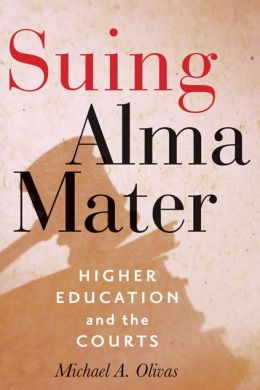
      New Release: Olivas, "Suing Alma Mater"

      New from the Johns Hopkins University Press: Suing Alma Mater: Higher Education and the Courts, by Michael A. Olivas (University of Houston Law Center). Here's a description from the Press:
      Although much has been written about U.S. Supreme Court decisions involving higher education, little has been said about the foundational case law and litigation patterns emerging from the lower courts. As universities become increasingly legislated, regulated, and litigious, campuses have become testing grounds for a host of constitutional challenges. From faculty and student free speech to race- or religion-based admissions policies, Suing Alma Mater describes the key issues at play in higher education law.

      Eminent legal scholar Michael A. Olivas considers higher education litigation in the latter half of the twentieth century and the rise of "purposive organizations," like the American Civil Liberties Union and the Alliance Defense Fund (now known as the Alliance Defending Freedom), that exist to advance litigation. He reviews more than 120 college cases brought before the Supreme Court in the past fifty years and then discusses six key cases in depth. Suing Alma Mater provides a clear-eyed perspective on the legal issues facing higher education today.
      A Q&A with the author is available here, at Inside Higher Ed.

      April 2013 issue of Perspectives on History: The Tuning Project at 12 months

      The April 2013 issue of Perspectives on History (the newsmagazine of the American Historical Association) is available online (some articles are currently open to members only, but the ones linked below are open access). Much of the issue focuses on the AHA's "Tuning" project, a "nationwide, faculty-led project to articulate the disciplinary core of historical study and to define what a student should understand and be able to do at the completion of a history degree program."

      Here's an excerpt from Executive Director James Grossman's column:
      Most readers of Perspectives on History have probably by now encountered conversations about whether history and other humanities majors are “useful.” Generally we might infer that this question refers to the student, and specifically to the student’s employment potential. But when state governors propose that a humanities major pay higher tuition, they are pointing to the larger frame. They want the public subsidies to go towards the education of “useful” residents: young men and women trained in STEM (science, technology, engineering, and mathematics) and business-related disciplines and prepared to sally forth into a career of technological innovation and business acumen.

      In this issue, several historians wrestle with—among other things—whether we ought to be engaging this discourse, and if so, how. The AHA has initiated projects at the undergraduate and graduate level oriented towards helping our students articulate the value of their degree in terms that we sometimes find uncomfortable. At the graduate level, we are exploring what sorts of jobs our PhD students can pursue beyond the professoriate. Public history work is familiar, comfortable. But we are also thinking more broadly, about work that might not be explicitly historical—whether in government, nonprofits/NGOs, higher education administration, or the private sector. This project, “The Malleable PhD,” will form the focus of a future set of articles in Perspectives, as our colleagues continue to debate whether such employment will always be idiosyncratic rather than susceptible to any sort of planning process, and how we think about such issues as the relationship between investment of fellowship resources and possible employment outcomes.
      Read on here.

      Also of interest: In the "Viewpoints" column, Nicholas Evan Sarantakes (whom we know best for his blog In the Service of Clio) offers "Some Proposals to Help Solve the Job Crisis."

      Rise In Immigrants Contributes to Increase in Educational Achievement


      The number of college and high school graduates continues to rise. Pew Research Center reports that about 90% of 25-29 year olds graduated from high school and more than one-third of Americans between 25-29 acquired a bachelor's degree or higher. The educational attainment gap between men and women also continues to increase. Approximately 37% of women compared to 30% of men between the ages of 25-29 have completed college. This growth in college graduates is due, in part, to an increase in the number of immigrants. In the past, natives were usually more educated than their immigrant counterparts. However, over the past decade, greater numbers of recent immigrants have at least a bachelor's degree. According to Pew, the plurality of newly arrived immigrants are from Asia. This increase in immigrants from Asia contributes to the rising educational levels among immigrants, since Asians rank among the highest educated ethnic group. This is reflected in the figure on the right, which shows that 60% of Asian immigrants have a bachelor's degree, followed by 40% of Whites, 23% of Blacks, and 15% of Hispanics.

      Blog Archive