Routel, "Minnesota Bounties on Dakota Men During the US-Dakota War"

Colette Routel (William Mitchell College of Law) has posted "Minnesota Bounties on Dakota Men During the US-Dakota War." Here's the abstract:
The U.S.-Dakota War was one of the formative events in Minnesota history, and despite the passage of time, it still stirs up powerful emotions among descendants of the Dakota and white settlers who experienced this tragedy. Hundreds of people lost their lives in just over a month of fighting in 1862. By the time the year was over, thirty-eight Dakota men had been hanged in the largest mass execution in United States history. Not long afterwards, the United States abrogated its treaties with the Dakota, confiscated their reservations along the Minnesota River, and forced most of the Dakota to remove westward.

While dozens of books and articles have been written about these events, scholars have largely ignored an important legal development that occurred in Minnesota during the following summer. The Minnesota Adjutant General, at the direction of Minnesota Governors Alexander Ramsey and Henry Swift, issued a series of orders offering rewards for the killing of Dakota men found within the State. The first order authorized the creation of a corps of volunteer scouts that would scour the "Big Woods" in search of Dakota men. They were to be paid not only a daily wage, but an additional $25 for each scalp they were able to provide the Adjutant General's Office. Subsequent orders permitted individual citizens who were not part of the volunteer corps to claim up to $200 for proof that they had killed a Dakota. These bounty orders remained in effect until at least 1868, when their constitutionality was finally questioned by the Minnesota Supreme Court in State v. Gut.

Minnesota was not the only state that placed a bounty on their Indian inhabitants. Around the same time, a bounty system was enacted by the Territory of Arizona, and one was also implemented by private citizens and local governments within the State of California. Like the bounty system in Minnesota, these programs were creatures of state and territorial law, but they were implicitly and explicitly approved by the federal government. In fact, they could be viewed as part of a much broader extermination program that was at the heart of federal Indian policy during this time period.

This article uses primary historical sources to describe the events leading up to the enactment of a bounty system in Minnesota, its creation, and subsequent on-the-ground implementation. In an attempt to avoid the pitfalls of "presentism," the legality of this bounty system is analyzed according to the laws in effect in 1863, when it was created. This article concludes that the Minnesota bounty system was illegal from its inception, as it was contrary not only the international law of war, but also the Lieber Code, which was issued by the U.S. Secretary of War in April 1863, and used to govern the conduct of Union soldiers during the ongoing Civil War.
The full article is available here.

Hat tip: Turtle Talk

Recognizing Native American Tribes: A Sourcebook

Out from the University of North Carolina Press is Recognition, Sovereignty Struggles, and Indigenous Rights in the United States: A Sourcebook, edited by Amy E. Den Ouden and Jean M. O'Brien:
This engaging collection surveys and clarifies the complex issue of federal and state recognition for Native American tribal nations in the United States. Den Ouden and O'Brien gather focused and teachable essays on key topics, debates, and case studies. Written by leading scholars in the field, including historians, anthropologists, legal scholars, and political scientists, the essays cover the history of recognition, focus on recent legal and cultural processes, and examine contemporary recognition struggles nationwide.
Contributors are Joanne Barker (Lenape), Kathleen A. Brown-Perez (Brothertown), Rosemary Cambra (Muwekma Ohlone), Amy E. Den Ouden, Timothy Q. Evans (Haliwa-Saponi), Les W. Field, Angela A. Gonzales (Hopi), Rae Gould (Nipmuc), J. Kehaulani Kauanui (Kanaka Maoli), K. Alexa Koenig, Alan Leventhal, Malinda Maynor Lowery (Lumbee), Jean M. O'Brien (White Earth Ojibwe), John Robinson, Jonathan Stein, Ruth Garby Torres (Schaghticoke), and David E. Wilkins (Lumbee).

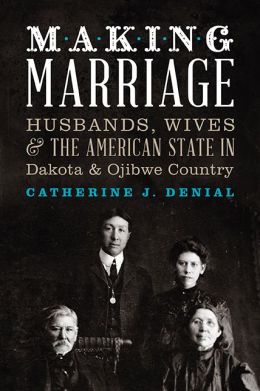
New Release: Denial, "Making Marriage: Husbands, Wives, and the American State in Dakota and Ojibwe Country"

The Minnesota Historical Society Press has released Making Marriage: Husbands, Wives, and the American State in Dakota and Ojibwe Country by Catherine J. Denial (Knox College). Here's a description:
The debate over the meaning of marriage in the United States and specifically in Minnesota is not a recent development. From 1820 to 1845, when the first significant numbers of Americans arrived in the region now called Minnesota, they carried the belief that good government and an orderly household went hand in hand. The territorial, state, and federal governments of the United States were built upon a particular vision of civic responsibility: that men, as heads of households, enter civic life on behalf of their dependents—wives, children, servants, and slaves. These dependents were deemed unfit to make personal decisions or to involve themselves in business and government—and they owed labor and obedience to their husbands, fathers, and masters.

These ideas clashed forcibly with the conceptions of kinship and social order that existed among the Upper Midwest's long-established Dakota, Ojibwe, and mixed-heritage communities. In resisting the new gender and familial roles advocated by military personnel, Indian agents, and missionaries, the region’s inhabitants frustrated American attempts to transform Indian country into a state. Indeed, many Americans were forced to compromise their own beliefs so that they could put down roots.

Through the stories of married—and divorcing—men and women in the region, Catherine J. Denial traces the uneven fortunes of American expansion in the early nineteenth century and the nation-shaping power of marital acts.

Grogan reviews Watson, "Buying America from the Indians"

The Law & Politics Book Review has posted a review of Blake A. Watson, Buying American from the Indians: Johnson v. McIntosh and the History of Native Land Rights (University of Oklahoma Press, 2012). The book "succeeds in giving a new spin to the 1823 Supreme Court case," writes reviewer Susan E. Grogan (St. Mary’s College of Maryland). Here's a bit more:
Scholars of indigenous peoples, even those well beyond the North American continent, are alert to Johnson v. McIntosh as clearly one of the “10 Worst Indian Law Cases Ever Decided,” to use Walter EchoHawk’s (2010) damning characterization. From this perspective, Chief Justice John Marshall’s opinion in Johnson is infamous for at least three reasons. First, it denies to native people legal title to their land, leaving them only a right of occupancy. Second, it vests the legal title to the lands in North America in the European crowns and their successor American governments, elevating the Doctrine of Discovery (that the lands of non-Christian peoples, “discovered” by a European adventurer, belong to his monarch and the successor governments) from a generally, but not universally, accepted understanding in international law to positive domestic law sanctioned by the High Court. Third, in justifying the Doctrine of Discovery, Marshall’s opinion permanently inscribes into the U.S. Reports a disparaging view of the native peoples of North America. They were, Marshall wrote, “fierce savages, whose occupation is war” (21 U.S, 543, 590).

By the end of the book, Watson makes it clear that he subscribes to the “Worst Indian Law Case” assessment and directly calls for Johnson’s repudiation (pp.351-58). How he gets there is what makes this book interesting. . . .
The full review is available here.

Cavanagh on History and Aboriginal Title

Edward Cavanagh, University of Ottawa and University of the Witwatersrand, has posted Land Rights that Come with Cut-Off Dates: A Comparative Reflection on Restitution, Aboriginal Title, and Historical Injustice.  Here is the abstract:
The doctrine of aboriginal title allows for a distinct form of redress, empowering communities to use the judiciary to take action against the state for foundational acts of historical dispossession. It has not taken root in South Africa, yet in other former settler colonies of the British Empire, it remains important to this day. This article interrogates history and law to explain why this is the case. Such an approach allows for a critical reflection on the system of land restitution that developed in South Africa instead of aboriginal title. by exploring the past and present realities of ‘dispossession’ in South Africa, this article discredits the inclusion of cut-off dates in the Restitution of Land Rights Act. These dates have discriminated between claimant communities irrationally and insensitively – even racially. History should not be mobilised in statute law to obstruct the pathway to redress. It should, instead, be used positively to restore the rights of those formerly dispossessed, and to preserve the rights of those facing dispossessions pending, in South Africa.

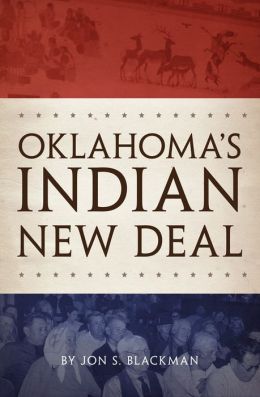
Blackman, "Oklahoma's Indian New Deal"

These past few years I've developed more than a passing interest in Native American history. A section of a dissertation chapter turned into a book chapter (and soon, I hope, an article) about Native American efforts to claim state welfare benefits in the Southwest in the 1940s and 1950s. Because of this project, I deeply appreciate the great work being done at the intersection of Native American history and legal history, and I hunger for even more, especially on twentieth-century topics.

One avenue that scholars continue to explore is the impact of the "Indian New Deal" on particular people and places. Jon S. Blackman's new book, Oklahoma's Indian New Deal (University of Oklahoma Press), is in this vein. Cribbing now from the book's Amazon site:
Among the New Deal programs that transformed American life in the 1930s was legislation known as the Indian New Deal, whose centerpiece was the Indian Reorganization Act (IRA) of 1934. Oddly, much of that law did not apply to Native residents of Oklahoma, even though a large percentage of the country’s Native American population resided there in the 1930s and no other state was home to so many different tribes. The Oklahoma Indian Welfare Act (OIWA), passed by Congress in 1936, brought Oklahoma Indians under all of the IRA’s provisions, but included other measures that applied only to Oklahoma’s tribal population. This first book-length history of the OIWA explains the law’s origins, enactment, implementation, and impact, and shows how the act played a unique role in the Indian New Deal.
In the early decades of the twentieth century, white farmers, entrepreneurs, and lawyers used allotment policies and other legal means to gain control of thousands of acres of Indian land in Oklahoma. To counter the accumulated effects of this history, the OIWA specified how tribes could strengthen government by adopting new constitutions, and it enabled both tribes and individual Indians to obtain financial credit and land. Virulent opposition to the bill came from oil, timber, mining, farming, and ranching interests. Jon S. Blackman’s narrative of the legislative battle reveals the roles of bureaucrats, politicians, and tribal members in drafting and enacting the law.
Although the OIWA encouraged tribes to organize for political and economic purposes, it yielded mixed results. It did not produce a significant increase in Indian land ownership in Oklahoma, and only a small percentage of Indian households applied for OIWA loans. Yet the act increased member participation in tribal affairs, enhanced Indian relations with non-Indian businesses and government, promoted greater Indian influence in government programs—and, as Blackman shows, became a springboard to the self-determination movements of the 1950s and 1960s.
More information is available here.

New Release: Calloway, "Pen and Ink Witchcraft"

New from Oxford University Press: Pen and Ink Witchcraft: Treaties and Treaty Making in American Indian History, by Colin G. Calloway (Dartmouth College). Here's a description from the Press:
Indian peoples made some four hundred treaties with the United States between the American Revolution and 1871, when Congress prohibited them. They signed nine treaties with the Confederacy, as well as countless others over the centuries with Spain, France, Britain, Mexico, the Republic of Texas, Canada, and even Russia, not to mention individual colonies and states. In retrospect, the treaties seem like well-ordered steps on the path of dispossession and empire. The reality was far more complicated.

In Pen and Ink Witchcraft, eminent Native American historian Colin G. Calloway narrates the history of diplomacy between North American Indians and their imperial adversaries, particularly the United States. Treaties were cultural encounters and human dramas, each with its cast of characters and conflicting agendas. Many treaties, he notes, involved not land, but trade, friendship, and the resolution of disputes. Far from all being one-sided, they were negotiated on the Indians' cultural and geographical terrain. When the Mohawks welcomed Dutch traders in the early 1600s, they sealed a treaty of friendship with a wampum belt with parallel rows of purple beads, representing the parties traveling side-by-side, as equals, on the same river. But the American republic increasingly turned treaty-making into a tool of encroachment on Indian territory. Calloway traces this process by focusing on the treaties of Fort Stanwix (1768), New Echota (1835), and Medicine Lodge (1867), in addition to such events as the Peace of Montreal in 1701 and the treaties of Fort Laramie (1851 and 1868). His analysis demonstrates that native leaders were hardly dupes. The records of negotiations, he writes, show that "Indians frequently matched their colonizing counterparts in diplomatic savvy and tried, literally, to hold their ground."

Each treaty has its own story, Calloway writes, but together they tell a rich and complicated tale of moments in American history when civilizations collided.
A few blurbs:
"Indian treaties were major historical events, and today they are still important sources of legal rights. Pen and Ink Witchcraft is a masterful overview of the complex processes by which these treaties were created." --Stuart Banner, author of How the Indians Lost Their Land: Law and Power on the Frontier
"This extraordinary analysis of Indian treaties and treaty-making reveals the complexity and objectives of the United States government in negotiating nearly 400 ratified agreements. In a book wide in scope--addressing political ceremony, kinship alliances, council meetings, native law, oratorical power, gift-giving diplomacy, and sovereignty--Colin Calloway has produced a masterpiece for Indian treaties to be understood by everyone. This leading scholar of Indian history explains the historical development of Native American legal rights today." --Donald L. Fixico, editor of Treaties with American Indians: An Encyclopedia of Rights, Conflicts, and Sovereignty
For more information, including the TOC, follow the link.

Schwier on Native-European Relations in Indiana

Ryan T. Schwier, Indiana University-Purdue University Indianapolis Law, has posted According to the Custom of the Country”: Indian Marriage, Property Rights, and Legal Testimony in the Jurisdictional Formation of Indiana Settler Society, 1717-1897.  Here is the abstract:   
This study examines the history of Indian-settler legal relations in Indiana, from the state’s pre-territorial period to the late-nineteenth century. Through a variety of interdisciplinary sources and methods, the author constructs a broad narrative on the evolution and co-existence of Native and non-Native customary legal systems in the region, focusing on matters related to marriage, property rights, and testimony. The primary thesis - which emphasizes reciprocally formative relations, rather than persistent conflict - suggests that Indiana’s pre-modern legal past involved an ad hoc yet highly effective process of cultural brokerage, reciprocity and inter-personal accommodation. That the American Indians lost much of their self-governing status following the period of contact is clear; however, a closer look at the ways in which nations historically defined, exercised, asserted, and shared jurisdiction, reveals a more intricate story of influence, authority, and concession. During the French and British colonial and American territorial periods, settler society adjusted to and often accommodated Native concepts of law and justice. Through a complex order of social obligations and community-based enforcement mechanisms, a shared set of rules and jurisdictional practices merged, forming a hybrid system of Indian-settler norms that bound these individuals across the cultural divide.

When Indiana entered the Union in 1816, legal pluralism defined jurisdictional practice. However, with the nineteenth-century rise of legal positivism - the idea of law as the sole command of the nation-state, a sovereign entity vested with exclusive authority - territorial jurisdiction and legal uniformity became guiding principles. Many jurists viewed the informal, pre-existing custom-based regulatory structures with contempt. With the shift to a state-centered legal order, lawmakers established strict standards for recognizing the law of the “other,” ultimately rejecting the status of the tribes as equal sovereigns and forcing them to concede jurisdiction to the settler polity.

Finkelman on Lincoln and the Dakota Pardons

Paul Finkelman, Albany Law School, has posted Lincoln the Lawyer, Humanitarian Concerns, and the Dakota Pardons, which is forthcoming in the William Mitchell Law Review 39 (2013)
Here is the abstract:    
H.A. Schwabe, The Siege of New Ulm. (Credit)
In 1862 there was a short war in Minnesota initiated by some members of the Dakota (Sioux) Nation. The Dakota fought against settlers in central Minnesota, and ultimately against the Minnesota militia and U.S. Army elements. After the War was over the Army tried nearly 400 Dakota soldiers by military commissions, and sentence 303 to death. President Lincoln, acting under the militia act of 1862, refused to sign the warrants of execution for 87 percent of those sentenced to die. In the end Lincoln reprieved 265 of the condemned men. The remain 38 were eventually hanged. This even was both the largest mass hanging in American history and also the largest mass pardon of my people sentenced to death. This article – the lead article in a symposium on the U.S.-Dakota War of 1862 – explores the route Lincoln took to pardoning the vast majority of those convicted. It also explores the fairness –actually the utter unfairness – of these sham “trials” before the military commissions that often lasted no more than ten minutes.

Blog Archive