New Release: "Between Court and Confessional: The Politics of Spanish Inquisitors"

New from Cambridge University Press: Between Court and Confessional: The Politics of Spanish Inquisitors, by Kimberly Lynn. A description from the Press:
Between Court and Confessional explores the lives of Spanish inquisitors, closely examining the careers and writings of five sixteenth- and seventeenth-century inquisitors. Kimberly Lynn considers what shaped particular inquisitors, what kinds of official experience each accumulated, and to what ends each directed his acquired knowledge and experience. The case studies examine the complex interplay of careerism and ideological commitments evident in inquisitorial activities. Whereas many studies of the Spanish Inquisition tend to depict inquisitors as faceless and interchangeable, Lynn probes the lives of individual inquisitors to show how inquisitors' operations in their social, political, religious, and intellectual worlds set the Inquisition in motion. By focusing on specific individuals, this study explains how the theory and regulations of the Inquisition were rooted in local conditions, particular disputes, and individual experiences.
A few blurbs:
"The Inquisitor is a figure engulfed in myth, yet about whom very little is actually known. Kimberly Lynn sets the record straight in this thoroughly researched and well-written book. Showcasing individual portraits of five inquisitors from different parts of the early modern Hispanic empire, she offers a lively and convincing composite biography of a unique - and uniquely complex - figure poised between medieval theocracy and modern bureaucracy." -- James S. Amelang, Universidad Autónoma, Madrid

"This outstanding piece of scholarship demonstrates how little the Spanish inquisitors fit the conventional view of them as insular men in single-minded pursuit of heresy. In a series of exacting and illuminating portraits, Kimberly Lynn reveals them in the full range of their activities, engaged in turf battles, jostling for position at court, moving from post to post, suffering career setbacks and disappointments, and seeking patronage and bestowing patronage - that is, negotiating the complex power structures of early modern Spain like other members of the power elite." -- Miriam Bodian, the University of Texas at Austin 

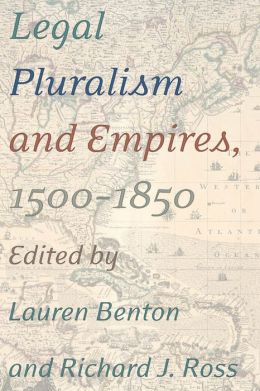
New Release: Benton & Ross, eds., "Legal Pluralism and Empires, 1500-1850"

New from New York University Press: Legal Pluralism and Empires, 1500-1850, edited by Lauren Benton (New York University) and Richard J. Ross (University of Illinois). Here's a description from the Press:
This wide-ranging volume advances our understanding of law and empire in the early modern world. Distinguished contributors expose new dimensions of legal pluralism in the British, French, Spanish, Portuguese, and Ottoman empires. In-depth analyses probe such topics as the shifting legal privileges of corporations, the intertwining of religious and legal thought, and the effects of clashing legal authorities on sovereignty and subjecthood. Case studies show how a variety of individuals engage with the law and shape the contours of imperial rule.

The volume reaches from Peru to New Zealand to Europe to capture the varieties and continuities of legal pluralism and to probe the analytic power of the concept of legal pluralism in the comparative study of empires. For legal scholars, social scientists, and historians, Legal Pluralism and Empires, 1500-1850 maps new approaches to the study of empires and the global history of law.
The blurbs:
"This volume collects thoughtful and provocative essays on the legal complexities of empire, a subject that has been at the forefront of legal history in recent years. Whether one is interested in close studies of individual places or more wide-ranging explorations of the nature of legal pluralism in imperial contexts, this is the state of the art." -- Stuart Banner, Norman Abrams Professor of Law, UCLA

"Legal pluralism has rapidly become one of the most fertile concepts among early modern historians. The richly documented and subtly argued essays in this collection amply exhibit its power to illuminate and complexify understandings of a variety of empires: Ottoman, British, French, and Spanish. As both a compendium of cutting-edge work and a blueprint for future research, the volume should inspire historians of other empires and other periods to add legal pluralism to their analytical armory." -- David Armitage, Harvard University

"Historians of law and historians of empire alike will derive new insights from this impressive collection of discerning synthetic essays and rich case studies of the diversity of legal systems as European empires (including the Ottomans) claimed sovereignty over territories and peoples around the world. These scholars offer methodological and conceptual models that will push the field forward in new directions." -- Sarah Chambers, University of Minnesota
The Introduction and Table of Contents are available here.  

Hulsebosch on "The Origin and Nature of Colonial Grievances"

No version is available on the web, but be on the lookout for The American Revolution (II): The Origin and Nature of Colonial Grievances, an essay by Daniel J. Hulsebosch, NYU School of Law, forthcoming this year in The Oxford History of the British Empire: The American Colonies in the British Empire, 1607-1776, ed. Stephen Foster.  Here is the abstract:    
Colonial grievances were not new in July 1776 but rather were as old as the British Empire and a constant feature of imperial governance. The continuous stream of grievances was not, however, evidence that “the spirit of the colonies demanded freedom from the beginning.” Paradoxically, grievances helped make the Empire work. They facilitated imperial development for two reasons. First, people lodging grievances could rely on a communication network for processing them, a system that helped integrate the many different subjects and places in the empire. Second, from the colonial perspective, the imperial grievance system had a safety valve: war. When the empire was at war, metropolitan policy-makers and local governors were more willing to compromise with provincial interests and acceded to claims that had been or threatened to become the source of grievances. The two together – the imperial grievance system and the leverage enjoyed by colonists during war – generated the sense throughout North America that the imperial constitution was a flexible set of institutions responsive to provincial claims and yet also efficient enough to facilitate common projects, like carrying out transatlantic commerce and waging war. The imperial constitution, with the grievance system at its core, provided the possibility for change that is essential to any workable constitution.

By the middle of the 1770s, however, the grievance network no longer performed effectively. A system that for over a century helped bind the North American colonies to the empire suddenly, after an unusually long and stable period of peace, fragmented and became an instrument of rebellion. Only then, in the Declaration of Independence, were the many and sometimes inconsistent colonial grievances compiled into a “history of repeated injuries and usurpations, all having in direct object the establishment of an absolute Tyranny over these States.” These grievances were irremediable and flowed outside the imperial constitution. The genre to which they now belonged was the international declaration of war.

New Release: Calloway, "Pen and Ink Witchcraft"

New from Oxford University Press: Pen and Ink Witchcraft: Treaties and Treaty Making in American Indian History, by Colin G. Calloway (Dartmouth College). Here's a description from the Press:
Indian peoples made some four hundred treaties with the United States between the American Revolution and 1871, when Congress prohibited them. They signed nine treaties with the Confederacy, as well as countless others over the centuries with Spain, France, Britain, Mexico, the Republic of Texas, Canada, and even Russia, not to mention individual colonies and states. In retrospect, the treaties seem like well-ordered steps on the path of dispossession and empire. The reality was far more complicated.

In Pen and Ink Witchcraft, eminent Native American historian Colin G. Calloway narrates the history of diplomacy between North American Indians and their imperial adversaries, particularly the United States. Treaties were cultural encounters and human dramas, each with its cast of characters and conflicting agendas. Many treaties, he notes, involved not land, but trade, friendship, and the resolution of disputes. Far from all being one-sided, they were negotiated on the Indians' cultural and geographical terrain. When the Mohawks welcomed Dutch traders in the early 1600s, they sealed a treaty of friendship with a wampum belt with parallel rows of purple beads, representing the parties traveling side-by-side, as equals, on the same river. But the American republic increasingly turned treaty-making into a tool of encroachment on Indian territory. Calloway traces this process by focusing on the treaties of Fort Stanwix (1768), New Echota (1835), and Medicine Lodge (1867), in addition to such events as the Peace of Montreal in 1701 and the treaties of Fort Laramie (1851 and 1868). His analysis demonstrates that native leaders were hardly dupes. The records of negotiations, he writes, show that "Indians frequently matched their colonizing counterparts in diplomatic savvy and tried, literally, to hold their ground."

Each treaty has its own story, Calloway writes, but together they tell a rich and complicated tale of moments in American history when civilizations collided.
A few blurbs:
"Indian treaties were major historical events, and today they are still important sources of legal rights. Pen and Ink Witchcraft is a masterful overview of the complex processes by which these treaties were created." --Stuart Banner, author of How the Indians Lost Their Land: Law and Power on the Frontier
"This extraordinary analysis of Indian treaties and treaty-making reveals the complexity and objectives of the United States government in negotiating nearly 400 ratified agreements. In a book wide in scope--addressing political ceremony, kinship alliances, council meetings, native law, oratorical power, gift-giving diplomacy, and sovereignty--Colin Calloway has produced a masterpiece for Indian treaties to be understood by everyone. This leading scholar of Indian history explains the historical development of Native American legal rights today." --Donald L. Fixico, editor of Treaties with American Indians: An Encyclopedia of Rights, Conflicts, and Sovereignty
For more information, including the TOC, follow the link.

Ruskola on "The Invention of American Imperial Sovereignty"

Teemu Ruskola, Emory University School of Law, has posted Canton is Not Boston: The Invention of American Imperial Sovereignty, which originally appeared in the American Quarterly: 57 (September 2005): 859-84.  Here is the abstract:
Although the United States began its international legal career in 1776 as an outlaw, a rebel against the European legal order, it soon established itself as a juridical equal among the so-called Family of Nations, consisting of “civilized” European states. Yet it is a remarkable historical fact that when the British launched the Opium War in 1839 to coerce China to participate in free trade (freedom of trade not including the right not to buy opium), most Americans sided with the Chinese, against the British. With confiscated British opium being flushed into the Canton harbor, the events echoed the still not-so-distant Boston Tea Party — two heroic acts of struggle against British imperial interventions in trade, in China and America, respectively. However, after China was indeed successfully opened for “free trade” at the end of the Opium War, in 1844 President Tyler sent the first American minister to China to negotiate a trade treaty that would create a framework for American participation in the that trade as well as the basis of the United States’ political and legal relations with China until 1943. Tyler’s plenipotentiary Caleb Cushing — a New England lawyer as well as future U.S. Attorney General — ended up exceeding his instructions and (with the backing of gunboats), negotiating an extraordinary Treaty of Peace, Trade, and Amity which ultimately placed China in a semi-colonial relationship vis-à-vis the United States. Most notably, the Treaty of Wanghia of 1844 gave Americans the privilege of extraterritoriality: even while on sovereign Chinese territory, American citizens would not be subject to “despotic” Chinese law, until such time that the Chinese had created a “civilized” (i.e., modern liberal) legal regime. This article tells the little-known story of the beginnings of Sino-American legal relations and of the foundation it laid for the emergence of an extraterritorial empire of U.S. law in the Asia Pacific, ultimately ranging from China to Japan, Korea to Siam, Borneo to Tonga, and beyond. Long before the United States came to practice European-style territorial imperialism at the conclusion of the Spanish-American War 1898, the United States became a global leader in the institutionalization of a kind of legal imperialism in the Orient. In addition to analyzing the history of U.S. extraterritorial jurisdiction in Asia, this article outlines the changing global claims to sovereignty among Europe, the United States, and China over the course of the nineteenth century.

L&HR 31:2 (May 2013)

Law and History Review’s 31:2 issue (May 2013) is up on the Cambridge Journals website.  Here are the articles

Protective Labor Legislation in the Courts: Substantive Due Process and Fairness in the Progressive Era, by Claudio J. Katz

Constitutional Principle, Partisan Calculation, and the Beveridge Child Labor Bill, by Logan Everett Sawyer

“Equals of the White Man”: Prosecution of Settlers for Violence Against Aboriginal Subjects of the Crown, Colonial Western Australia, by Amanda Nettelbeck

Jews or Germans? Nationality Legislation and the Restoration of Liberal Democracy in Western Europe after the Holocaust, by David Fraser and Frank Caestecker

“Our Militancy is in Our Openness”: Gay Employment Rights Activism in California and the Question of Sexual Orientation in Sex Equality Law, by Katherine Turk

Book reviews after the jump.
Read more »

Cavanagh's "Settler Colonialism and Land Rights in South Africa"

Edward Cavanagh, a scholar-in-residence at the University of Ottawa, has published Settler Colonialism and Land Rights in South Africa: Possession and Dispossession on the Orange River with Palgrave Macmillan.  The press explains:
Layers of dispossession and disruption are definitive of South African history. Bouncing from Griqua Philippolis (1824-1862) to Afrikaner Orania (1990-2013), this book shows how land rights are prioritised in pre-apartheid and post-apartheid contexts. The result is a new way of looking at the country's history - different to the version of history that guided transformation and inspired an idiosyncratic system of land restitution.
We learn from Professor Cavanaugh that a launch for the book will occur in Ottawa on Thursday, June 6.  (Check this post later for details.)  He explains that “although the book is principally concerned with South African land rights, it develops a framework compatible with Canadian circumstances.”  He has been developing this comparative approach in his current research project.

Here is a blurb:

"This book constitutes a significant contribution to the burgeoning field of settler colonial studies. It does so in a very original and persuasive way: applying this paradigm to the analysis of past and present circumstances and to the investigation of developments affecting very different sociopolitical collectives in very different historical circumstances. Settler Colonialism and Land Rights in South Africa convincingly reintroduces settler colonialism to South African history."
 - Lorenzo Veracini, Swinburne Institute for Social Research

More blurbs after the jump.

Read more »

Burger & Frymer, "Property Law and American Empire"

Michael Burger (Roger Williams University School of Law) and Paul Frymer (Princeton University) have posted "Property Law and American Empire." It is forthcoming in Volume 34 of the University of Hawaii Law Review (2013). Here's the abstract:
Current scholarship by legal commentators and political scientists recognizes that the weapons of American empire have involved non-militaristic activities as much as militaristic ones. Such non-militaristic activities include the hegemonic influence of trade agreements, the imposition of legal and procedural norms, and the dissemination of ideological and cultural predispositions through corporations and diverse medias. In this paper, we examine an under-explored area on the “soft” belly of the American leviathan, focusing specifically on how property and intellectual property law have operated on physical and ideological frontiers to comprehend, participate in, and legitimate the expansion of American empire. We offer new accounts of two historical instances of empire-building: the acquisition and seizure of property from Native Americans in the early- and mid-19th century, and the expropriation of intellectual property rights to plant genetic resources from indigenous communities in the global South in the late 20th century. These two stories, taken together, offer unique insights into both the process and the substance of law’s operation on the frontier of empire. They illuminate how the authority of law has fused with private power and legal legitimacy to enable the nation to expand swiftly, energetically, and powerfully. These insights, in turn, lead toward the more general conclusion that the rhetoric of property has functioned to subjugate peoples and places, cultures and natures, to an imperial regime.
The full article is available here, at SSRN.

Hat tip: bookforum

States and Jurisdiction: Three Essays

During April, Comparative Studies in Society and History is providing access to three essays, each of which treat how states make jurisdictions and how people manage or fail to work around them.

Frontier as Resource: Law, Crime, and Sovereignty on the Margins of Empire by Eric Lewis Beverly
Nineteenth-century European colonialism produced a textured and uneven legal terrain rather than homogeneous imperial units. The fragmentation of sovereignty between empires and subordinated states created frontier zones that unsettled the workings of governance. This article views the developing landscape of power in high colonial South Asia from the loosely controlled frontier zone between Hyderabad, a Princely State ruled by sovereign Muslim dynasts titled Nizams, and the Bombay Presidency, part of Britain's Indian Empire, or Raj. I argue that the heterogeneous legal terrain along the border was a useful resource for administrators and subjects. State officials of both Hyderabad and Bombay justified various projects there; subjects of the two states shopped forums in a legal pluralist environment; and populations on either side of the border whose livelihoods and political agendas ran afoul of social pressures or the economic and cultural imperatives of state projects fled there from adversity. I examine cases of alleged cattle rustlers, bandits, and prostitutes and their engagements with police and courts to explore the political challenges and possibilities the frontier offered different groups. Colonial attempts to extend racialized policing practices across the frontier were frequently met by machinations of marginal people trying to avoid imprisonment or extricate themselves from oppressive social structures. Such figures could use the ambiguity of frontier legal authority to their advantage. The picture that emerges is one of a brute and often-arbitrary colonial power offset by alternative malleable sovereignties that resourceful subjects could play against one another.
Jurisdictional Borderlands: Extraterritoriality and "Legal Chameleons" in Precolonial Alexandria, 1840-1870 by Ziad Fahmy
This essay highlights the role of thousands of nineteenth-century Alexandrian residents with multiple extraterritorial legal identities. The manner with which extraterritoriality was practiced in Egypt effectively gave Western consulates legal jurisdiction not only over their citizens but also over all those able, through whatever means, to acquire protégé status. Many Alexandrians acquired legal protection from multiple consulates, shifting their legal identities in order to maximize their immediate social and economic interests. These legal realities present historians with the dilemma of how to account for and “classify” this highly flexible and syncretic society. I strive to answer this question through the use of a borderland lens. Realizing that the heart of Egypt's borderland society was legal has led me to consider the concept of “jurisdictional borderland” as a productive method for examining the complexity of Egypt's nineteenth-century heterogeneous population. I define a jurisdictional borderland as a significant contact zone where there are multiple, often competing legal authorities and where some level of jurisdictional ambiguity exists. Jurisdictional borderlanders have their own unique and independent agenda that often conflicts with many of the competing “national” or imperial positions. Without an allegiance to any single government—be it Egyptian, Ottoman, or Western—and living in a peripheral environment with multiple, separate, and often competing “national” institutions, these borderlanders thrived in the jurisdictional spaces created in between multiple authorities. I conclude by suggesting how a jurisdictional borderland lens is useful for globally investigating other colonial and precolonial cities, many of which had similar extraterritorial legal systems.
Turk and Jew in Berlin: The First Turkish Migration to Germany and the Shoah by Marc David Baer
 In this paper I critically examine the conflation of Turk with Muslim, explore the Turkish experience of Nazism, and examine Turkey's relation to the darkest era of German history. Whereas many assume that Turks in Germany cannot share in the Jewish past, and that for them the genocide of the Jews is merely a borrowed memory, I show how intertwined the history of Turkey and Germany, Turkish and German anti-Semitism, and Turks and Jews are. Bringing together the histories of individual Turkish citizens who were Jewish or Dönme (descendants of Jews) in Nazi Berlin with the history of Jews in Turkey, I argue the categories “Turkish” and “Jewish” were converging identities in the Third Reich. Untangling them was a matter of life and death. I compare the fates of three neighbors in Berlin: Isaak Behar, a Turkish Jew stripped of his citizenship by his own government and condemned to Auschwitz; Fazli Taylan, a Turkish citizen and Dönme, whom the Turkish government exerted great efforts to save; and Eric Auerbach, a German Jew granted refuge in Turkey. I ask what is at stake for Germany and Turkey in remembering the narrative of the very few German Jews saved by Turkey, but in forgetting the fates of the far more numerous Turkish Jews in Nazi-era Berlin. I conclude with a discussion of the political effects today of occluding Turkish Jewishness by failing to remember the relationship between the first Turkish migration to Germany and the Shoah.

Blog Archive