[We have the following CFP.]
We seek panelists for the 2014 Law and Society Association meeting in Minneapolis (May 29-June 1) for a panel entitled Colonial Law around the Indian Ocean. We are looking for scholars interested in colonial law around the Indian Ocean littoral, including East Africa, Persian Gulf, South Asia, and Southeast Asia. We are particularly interested in papers that probe legal classifications, different understandings of imperial and/or indigenous legal knowledge, and related topics. Our panel currently comprises one paper that would explore legal classification of Arabs in the Netherlands Indies and another that would focus on colonial versus metropolitan classifications of legal knowledge and legal conceptions of publicity in the French Indian Ocean colonies.
If you're interested in joining our panel, please contact both Laurie Wood at lmwood2@wisc.edu and Fadzilah Yahaya at nyahaya@wustl.edu before October 7.

"Signposts," "Westward Bound," "Inside the Castle" Reviewed in the Law & Politics Book Review
The Law & Politics Book Review is out with a new batch of reviews. Items of interest include:
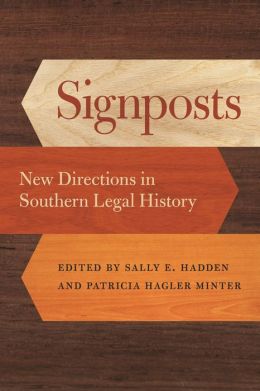 Walter F. Pratt, Jr. (University of South Carolina School of Law) reviews SIGNPOSTS: NEW DIRECTIONS IN SOUTHERN LEGAL HISTORY (University of Georgia Press, 2013), edited by Sally E. Hadden and Patricia Hagler Minter.
Zvi H. Triger (The Haim Striks School of Law, College of Management Academic Studies, Rishon LeZion, Israel) reviews INSIDE THE CASTLE: LAW AND THE FAMILY IN 20TH CENTURY AMERICA (Princeton University Press, 2011), by Joanna L. Grossman and Lawrence M. Friedman.
Michael Boudreau (Department of Criminology & Criminal Justice, St. Thomas University) reviews WESTWARD BOUND: SEX, VIOLENCE, THE LAW, AND THE MAKING OF A SETTLER SOCIETY (UBC Press, 2011), by Lesley Erickson.
Walter F. Pratt, Jr. (University of South Carolina School of Law) reviews SIGNPOSTS: NEW DIRECTIONS IN SOUTHERN LEGAL HISTORY (University of Georgia Press, 2013), edited by Sally E. Hadden and Patricia Hagler Minter. Zvi H. Triger (The Haim Striks School of Law, College of Management Academic Studies, Rishon LeZion, Israel) reviews INSIDE THE CASTLE: LAW AND THE FAMILY IN 20TH CENTURY AMERICA (Princeton University Press, 2011), by Joanna L. Grossman and Lawrence M. Friedman.
Michael Boudreau (Department of Criminology & Criminal Justice, St. Thomas University) reviews WESTWARD BOUND: SEX, VIOLENCE, THE LAW, AND THE MAKING OF A SETTLER SOCIETY (UBC Press, 2011), by Lesley Erickson.
2013 Annual Meeting of the British Group of Early American Historians
Correspondence from Across the Pond
Norwich, UK, September 7, 2013
The 2013 annual meeting of the British Group of Early American Historians (BGEAH) has featured several topics of considerable interest to legal historians. Carla Pestana’s plenary address on Thursday was delivered in the medieval Dragon Hall. Her talk focused on the unsuccessful seventeenth-century attack on Spanish Caribbean islands by Britain. Debates over the validity of plunder under the law of war raged alongside powerful invocations of divine blessing and support on both sides of the fight.
Other papers havetreated the law and practice of surrender, the granting of “peace bonds” by judges in colonial Pennsylvania, and the law of corporations in the early Republic, in addition to presentations on taverns, elite Mohawk culture, silkworms, and more.
BGEAH is a relatively new group. The website records meetings going back to 2000, but others report the first meeting was several years earlier. It is a delightfully collegial, non-hierarchical, and welcoming society (there is no membership fee, for example).
This year's conference includes nine panel sessions, two plenaries, and tonight's conference dinner at the beautiful Sainsbury Centre for the Visual Arts.
Founding member Betty Wood of Cambridge University has worked extensively on slavery and power. She is currently studying relations between servants in the eighteenth-century Chesapeake, and welcomes insight into the law governing conflict between servants, including the practice of “auctioning” off newborn babies born to servant women at town fairs.
Ramnath on the Criminal Jury in Colonial India
Kalyani Ramnath, a graduate student in the Department of History at Princeton University, has published The Colonial Difference between Law and Fact: Notes on the Criminal Jury in India, which appears in the (gated) Indian Economic & Social History Review (July 2013) 50: 341-363. Here is the abstract:
This article tracks the rise and fall of criminal jury in colonial India through official and non-official debates, discussions and interventions. The discussion on criminal juries in the Anglo-American system has typically focused on the division of legal labour between judge and jury. In colonial India, this conventional difference between ‘law’ and ‘fact’ were shaped by notions of belonging to a different race, religion and language. These were frequently articulated as the story of the ‘unreliable’ juror or the ‘religious’ native who feared eternal damnation. From the jurors who were allegedly intoxicated by the publicity over the infamous Nanavati trial to women jurors who claimed to be followed on the way home from court, to the religious Brahmin juror who would not swear an oath, the story of the criminal jury is peopled with anxieties over undesirable forms of influence, that impinge on legal impartiality. Using the criminal jury as a lens, I look at the claims of universal legal reform as particularly lending themselves to contestations over sovereignty.
Burak on "The Second Formation of Islamic Law"
Until August 31, Cambridge Journals Online is providing free access to The Second Formation of Islamic Law: The Post-Mongol Context of the Ottoman Adoption of a School of Law, by Guy Burak, Bobst Library, New York University, in Comparative Studies in Society and History 55 (2013): 579-602. Here is the abstract:
This article proposes a comparative analytical framework to study changes in Islamic law during the post-Mongol period, particularly the rise of the official school of law (or state madhhab). Taking as my case study the Ottoman adoption of a particular branch within the Sunni Hanafi school of law, I suggest that this adoption marks a new chapter in Islamic legal history. In earlier periods, while rulers appointed judges and thus regulated the adjudication procedures, they did not intervene, at least theoretically, in the structure and doctrine of the schools of law, which remained the relatively autonomous realm of the jurists. The Ottoman adoption of the school, by contrast, was not merely an act of state patronage, since the dynasty played an important role in regulating the school's structure and doctrine. To this end, it employed a set of administrative and institutional practices, such as the development of an imperial learned hierarchy with standardized career and training tracks and the appointment of jurisconsults (muftis). Some of these practices were found in other polities across the eastern Islamic lands in the post-Mongol period, but these similarities have not been treated comparatively in modern historiography. They suggest that the Ottoman case was part of a broader legal culture that spanned several polities across the region. This article outlines a framework that will enable historians of Islamic law to treat these similarities in a more coherent manner. The framework raises key issues in the historiography of Islamic law and its nineteenth-century modernization.
Pirates!
Patricia O’Brien, Kislak Fellow at the Library of Congress’s Kluge Center and a Visiting Associate Professor at Georgetown University, will be lecturing on English Colonialism and Piracy from the Atlantic to the Pacific from 12:00 – 1:00 p.m., Room 113, Thomas Jefferson Building, Library of Congress on August 1.
Siddique on the Continuing Influence of Colonialism on Law Reform in Pakistan
Out soon from in Cambridge Studies in Law and Society is Pakistan's Experience with Formal Law: An Alien Justice, by Osama Siddique, an associate professor at Lahore University of Management Sciences. Here is the press’s description:
As Professor Siddique further explains, "[T]he book endeavors to present a new typology and framework for analyzing the literature on India's experience of colonial law and traces post-colonial India and Pakistan's approaches to the formal legal system and law reform while adhering to colonial legal structures and norms."Law Reform in Pakistan attracts such disparate champions as the Chief Justice of Pakistan, the USAID and the Taliban. Common to their equally obsessive pursuit of 'speedy justice' is a remarkable obliviousness to the historical, institutional and sociological factors that alienate Pakistanis from their formal legal system. This pioneering book highlights vital and widely neglected linkages between the 'narratives of colonial displacement' resonant in the literature on South Asia's encounter with colonial law and the region's post-colonial official law reform discourses. Against this backdrop, it presents a typology of Pakistani approaches to law reform and critically evaluates the IFI funded single-minded pursuit of 'efficiency' during the last decade. Employing diverse methodologies it proceeds to provide empirical support for a widening chasm between popular, at times violently expressed, aspirations for justice and democratically deficient reform designed in distant IFI headquarters that is entrusted to the exclusive and unaccountable Pakistani 'reform club.'
Parker reviews Esmeir, "Juridical Humanity"
JOTWELL's Legal History Section has posted new material: Kunal Parker (University of Miami School of Law) reviews Samera Esmeir, Juridical Humanity: A Colonial History (Stanford University Press, 2012) (a book we mentioned not too long ago, here). Here's the first paragraph of the review:
Samera Esmeir’s ambitious book, Juridical Humanity: A Colonial History, explores the legal transformation of British-ruled Egypt between the 1880s and the 1930s. With news from Egypt the subject of daily headlines, the book is timely and important. However, it is Esmeir’s innovative treatment of her subject that truly makes this book deserving of the widest readership. In contradistinction to a powerful tradition of writing about colonialism, Esmeir sees in the legal colonization of Egypt not the occlusion of Egyptians’ intrinsic humanity, but instead the instantiation of “humanity” as the object of colonial law’s solicitude. This is the “juridical humanity” of the book’s title.Read on here.
Weekend Roundup
- CALI does constitutional history! Hat tip: Ross Davies and Roger Skalbeck.
- Over at JOTWELL: William Baude (Stanford Law School) writes a glowing review of Clyde Spillenger's "Risk Regulation, Extraterritoriality, and the Constitutionalization of Choice of Law, 1865-1940."
- If you've never perused the website of the Historical Society of the New York Courts it is worth a look.
- From the New York Review of Books Blog: Spying on Americans: A Very Old Story.
- Over at H-Law, Kenneth J. Hirsh, Cincinnati Law, plugs the Louis Marshall Papers at the Jacob Rader Marcus Center of the American Jewish Archives at the Cincinnati campus of Hebrew Union College.
- Lori Clune, an assistant professor of history at California State University, Fresno, makes the case for sparing the Rosenbergs at HNN.
- Scott Douglas Gerber (Ohio Northern University Law), editorializes in the Providence Journal on Law and the Lively Experiment in Colonial Rhode Island.
- The American Academy in Berlin invites applications for its residential fellowships for 2014-2015, as well as early applications for the academic years 2015-2016 and 2016-2017. The deadline is Monday, September 2, 2013 (12 pm EST or 6 pm CET). More.
- The University of Pennsylvania Law Review is looking for contributors to “its online companion, Heightened Scrutiny. Essays selected for HS go through the full editorial process and are published to the major databases, in addition to being perpetually available on our website. We typically run shorter pieces with an eye towards more timely commentary on current events in the law.”
- It's still June, so there's still hope for our summer writing agenda. If you're feeling the need to be sternly talked to on the subject, try Rachel Toor in the Chronicle of Higher Education: I Don't Write Enough Because ... Hat tip: Linda Przybyszewski.
- From Books & Ideas: on the Commons, Old and New: From Land Use to Information Sharing.
Dutch New York and the Law
Just out from SUNY Press is the collection of essays, Opening Statements: Law, Jurisprudence, and the Legacy of Dutch New York, edited by Albert M. and Julia C. Rosenblatt.
No society can function without laws, that set of established practices and expectations that guide the way people get along with one another and relate to ruling authorities. Although much has been written about the English roots of American law and jurisprudence, little attention has been paid until recently to the legacy left by the Dutch. In Opening Statements, a broad spectrum of eminent scholars examine the legal heritage that New Netherland bequeathed to New York in the seventeenth century. Even after the transfer of the colony to England placed New York under English Common Law rather than Dutch Roman Law, the Dutch system of jurisprudence continued to influence evolving American concepts of governance, liberty, women’s rights, and religious freedom in ways that still resonate in today’s legal culture.
The TOC after the jump.Read more »
New Release: Calloway, "Pen and Ink Witchcraft"
New from Oxford University Press: Pen and Ink Witchcraft: Treaties and Treaty Making in American Indian History, by Colin G. Calloway (Dartmouth College). Here's a description from the Press:
A few blurbs:Indian peoples made some four hundred treaties with the United States between the American Revolution and 1871, when Congress prohibited them. They signed nine treaties with the Confederacy, as well as countless others over the centuries with Spain, France, Britain, Mexico, the Republic of Texas, Canada, and even Russia, not to mention individual colonies and states. In retrospect, the treaties seem like well-ordered steps on the path of dispossession and empire. The reality was far more complicated.
In Pen and Ink Witchcraft, eminent Native American historian Colin G. Calloway narrates the history of diplomacy between North American Indians and their imperial adversaries, particularly the United States. Treaties were cultural encounters and human dramas, each with its cast of characters and conflicting agendas. Many treaties, he notes, involved not land, but trade, friendship, and the resolution of disputes. Far from all being one-sided, they were negotiated on the Indians' cultural and geographical terrain. When the Mohawks welcomed Dutch traders in the early 1600s, they sealed a treaty of friendship with a wampum belt with parallel rows of purple beads, representing the parties traveling side-by-side, as equals, on the same river. But the American republic increasingly turned treaty-making into a tool of encroachment on Indian territory. Calloway traces this process by focusing on the treaties of Fort Stanwix (1768), New Echota (1835), and Medicine Lodge (1867), in addition to such events as the Peace of Montreal in 1701 and the treaties of Fort Laramie (1851 and 1868). His analysis demonstrates that native leaders were hardly dupes. The records of negotiations, he writes, show that "Indians frequently matched their colonizing counterparts in diplomatic savvy and tried, literally, to hold their ground."
Each treaty has its own story, Calloway writes, but together they tell a rich and complicated tale of moments in American history when civilizations collided.
"Indian treaties were major historical events, and today they are still important sources of legal rights. Pen and Ink Witchcraft is a masterful overview of the complex processes by which these treaties were created." --Stuart Banner, author of How the Indians Lost Their Land: Law and Power on the Frontier
"This extraordinary analysis of Indian treaties and treaty-making reveals the complexity and objectives of the United States government in negotiating nearly 400 ratified agreements. In a book wide in scope--addressing political ceremony, kinship alliances, council meetings, native law, oratorical power, gift-giving diplomacy, and sovereignty--Colin Calloway has produced a masterpiece for Indian treaties to be understood by everyone. This leading scholar of Indian history explains the historical development of Native American legal rights today." --Donald L. Fixico, editor of Treaties with American Indians: An Encyclopedia of Rights, Conflicts, and SovereigntyFor more information, including the TOC, follow the link.
DeLombard, "In the Shadow of the Gallows"
We somehow missed this 2012 release from the University of Pennsylvania Press: In the Shadow of the Gallows: Race, Crime, and American Civic Identity, by Jeannine Marie DeLombard (University of Toronto). Here's the Press's description:
From Puritan Execution Day rituals to gangsta rap, the black criminal has been an enduring presence in American culture. To understand why, Jeannine Marie DeLombard insists, we must set aside the lenses of pathology and persecution and instead view the African American felon from the far more revealing perspectives of publicity and personhood. When the Supreme Court declared in Dred Scott that African Americans have "no rights which the white man was bound to respect," it overlooked the right to due process, which ensured that black offenders—even slaves—appeared as persons in the eyes of the law. In the familiar account of African Americans' historical shift "from plantation to prison," we have forgotten how, for a century before the Civil War, state punishment affirmed black political membership in the breach, while a thriving popular crime literature provided early America's best-known models of individual black selfhood. Before there was the slave narrative, there was the criminal confession.

Placing the black condemned at the forefront of the African American canon allows us to see how a later generation of enslaved activists—most notably, Frederick Douglass—could marshal the public presence and civic authority necessary to fashion themselves as eligible citizens. At the same time, in an era when abolitionists were charging Americans with the national crime of "manstealing," a racialized sense of culpability became equally central to white civic identity. What, for African Americans, is the legacy of a citizenship grounded in culpable personhood? For white Americans, must membership in a nation built on race slavery always betoken guilt? In the Shadow of the Gallows reads classics by J. Hector St. John de Crèvecoeur, Edgar Allan Poe, Frederick Douglass, Herman Melville, George Lippard, and Edward Everett Hale alongside execution sermons, criminal confessions, trial transcripts, philosophical treatises, and political polemics to address fundamental questions about race, responsibility, and American civic belonging.A few blurbs:
"In her exquisitely written In the Shadow of the Gallows, Jeannine DeLombard reads early American criminal law in conjunction with the idea of social contract to illustrate the intricacies of political belonging from the early Republic through the antebellum period. Through the double helix of print and legal history, she chronicles the metamorphic role of authorship in African Americans' bids for enfranchisement against the backdrop of a nation entangled in contradictory definitions of personhood and property and of criminality and civility. Exemplary of humanities scholarship at its best, the book establishes the connections between American literature and the African American struggle for civic inclusion."—Priscilla Wald, Duke University
"I have long thought that DeLombard is at the absolute top of the scholars working on law and literature in North America, and In the Shadow of the Gallows confirms her status."—Alfred Brophy, University of North Carolina, Chapel HillFor more information, including the TOC, follow the link.
Tsoukala reviews Kang'ara, "Beyond Bed and Bread"
Over at JOTWELL, Philomila Tsoukala (Georgetown University Law Center) has posted a review that may be of interest. She covers Sylvia Wairimu Kang'ara, "Beyond Bed and Bread: Making the African State through Marriage Law Reform -- Constitutive and Transformative Influences of Anglo-American Legal Thought." The article appeared in Volume 9 of the Hastings Race & Poverty Law Journal (2012) and is available online at Comparative L. Rev. Here's an excerpt from Tsoukala's review:
The Article begins by analyzing the central role that the invalidation of customary marriages in Africa played in colonial administration. During the initial legal encounter between common law and African customary laws, judges invalidated large swaths of prior legal relations. In a (professed) effort to align colonial practices with English morality, colonial administrations superimposed a classical legal scheme of thinking about the family and the market at a moment when most of the African economy depended upon a different household model. Instead of the separate spheres ideology that characterized family law of the classical legal tradition, African customary marriages were based on an economically active household—often composed of polygamous units engaging in economically important exchanges of property through marriage, such as the bride-price. Starting from an assumption that individual free will was the building block for any civilized legal system, colonial judges invalidated customary marriages as repugnant to English colonial morality. They looked hard, but did not seem to find any African subjects capable of becoming “individual holders of exclusive and absolute rights” in the classical legal tradition. Critically, customary marriage’s failure to cultivate subjects that were suitable rightsholders marked the first step toward property expropriation in the name of empire building.
In this way, Kang’ara shows that, far from being an act with merely moral significance, “defining marriage was an important act of conquest and a corner stone of the market oriented state” that emerged via colonialism. . . .Read on here.
Memorial Day Roundup
- Scott Douglas Gerber, Ohio Northern University Law, discusses his plans for his second book, which will take up "British American colonies and Comparative Subnational Constitutionalism," on I-CONnect.
- "Not Dick Whitney!" Thus spake FDR upon learning of the defalcations of the haughty Wall Street financier and fellow Grotonian, news of which which delivered the New York Stock Exchanges into the hands of William O. Douglas's SEC. Whitney now has a biography: Malcom MacKay's Impeccable Connections. To see what the shouting was about, consult, via the website of the SEC Historical Society, newsreels of Whitney riding high and low.
- Earlier we noted the publication of Edward Cavanagh’s Settler Colonialism and Land Rights in South Africa. We now learn that it will have a launch at The Space, 139 Bank Street, Ottawa, on the evening of Thursday, June 6.
- From the Caribbean Journal: “How did English colonial law develop into the legal system of Jamaica today, and what has that meant for Jamaica’s development? A new book by attorney and law professor David P. Rowe attempts to answer these questions, examining the history of Jamaica’s constitutional jurisprudence and its relation to the country’s maturation over the decades. Aspects of Jamaican Constitutional History, co-authored by Rowe and University of Miami School of Law graduates Niyala Harrison and Jason Frederick Emert, takes a look at the history of Jamaica’s political economy through the lens of the constitution."

Cavanagh's "Settler Colonialism and Land Rights in South Africa"
Edward Cavanagh, a scholar-in-residence at the University of Ottawa, has published Settler Colonialism and Land Rights in South Africa: Possession and Dispossession on the Orange River with Palgrave Macmillan. The press explains:
Here is a blurb:
"This book constitutes a significant contribution to the burgeoning field of settler colonial studies. It does so in a very original and persuasive way: applying this paradigm to the analysis of past and present circumstances and to the investigation of developments affecting very different sociopolitical collectives in very different historical circumstances. Settler Colonialism and Land Rights in South Africa convincingly reintroduces settler colonialism to South African history."
- Lorenzo Veracini, Swinburne Institute for Social Research
More blurbs after the jump.
Read more »
We learn from Professor Cavanaugh that a launch for the book will occur in Ottawa on Thursday, June 6. (Check this post later for details.) He explains that “although the book is principally concerned with South African land rights, it develops a framework compatible with Canadian circumstances.” He has been developing this comparative approach in his current research project.Layers of dispossession and disruption are definitive of South African history. Bouncing from Griqua Philippolis (1824-1862) to Afrikaner Orania (1990-2013), this book shows how land rights are prioritised in pre-apartheid and post-apartheid contexts. The result is a new way of looking at the country's history - different to the version of history that guided transformation and inspired an idiosyncratic system of land restitution.
Here is a blurb:
"This book constitutes a significant contribution to the burgeoning field of settler colonial studies. It does so in a very original and persuasive way: applying this paradigm to the analysis of past and present circumstances and to the investigation of developments affecting very different sociopolitical collectives in very different historical circumstances. Settler Colonialism and Land Rights in South Africa convincingly reintroduces settler colonialism to South African history."
- Lorenzo Veracini, Swinburne Institute for Social Research
More blurbs after the jump.
Read more »
CFP: 1619: Making of America conference
Via H-Law, we have the following Call for Papers:
Read more »
The Joseph Jenkins Roberts Center of Norfolk State University (NSU), in partnership with the Hampton History Museum is hosting a two-day conference, 1619: Making of America conference that will be held in Hampton and Norfolk, VA on September 26-27, 2013. This conference will offer scholars and participants from various disciplines a unique platform to engage in dialogue on important issues defining new interpretations of 1619 in American history.After the jump, more on the submission process (deadline: May 15) and the conference themes.
This conference seeks to place the events stemming from 1619 within the context of Atlantic migration, culture, and race, and will emphasize the wide-ranging, familiar, and mobile character of the African Diaspora. The overarching point is that Chesapeake society was part of a hybrid and global culture predicated on intimate and overlapping encounters among Africans, Native Americans, Western Europeans, and other cultures from around the globe.
Featured speakers for the conference include Michael Blakey (Director of the Institute for Historical Biology and the National Endowment for the Humanities Professor, College of William and Mary), Paul Finkelman (President William McKinley Distinguished Professor of Law and Public Policy and Senior Fellow, Government Law Center, Albany Law School), Linda Heywood (Professor of History and African American Studies at Boston University),James Sweet (Vilas Distinguished Achievement Professor of History at the University of Wisconsin), John Thornton (Professor of African and African Diaspora History at Boston University), and Ben Vinson III (Herbert Baxter Adams Professor of Latin American History and Vice Dean of Centers and Interdepartmental Programs, Krieger School of Arts and Sciences, Johns Hopkins University).
The conference is sponsored in part, by the National Endowment for the Humanities.
Consult the conference website at: 1619makingofamerica.com
Read more »
Schwier on Native-European Relations in Indiana
Ryan T. Schwier, Indiana University-Purdue University Indianapolis Law, has posted According to the Custom of the Country”: Indian Marriage, Property Rights, and Legal Testimony in the Jurisdictional Formation of Indiana Settler Society, 1717-1897. Here is the abstract:
This study examines the history of Indian-settler legal relations in Indiana, from the state’s pre-territorial period to the late-nineteenth century. Through a variety of interdisciplinary sources and methods, the author constructs a broad narrative on the evolution and co-existence of Native and non-Native customary legal systems in the region, focusing on matters related to marriage, property rights, and testimony. The primary thesis - which emphasizes reciprocally formative relations, rather than persistent conflict - suggests that Indiana’s pre-modern legal past involved an ad hoc yet highly effective process of cultural brokerage, reciprocity and inter-personal accommodation. That the American Indians lost much of their self-governing status following the period of contact is clear; however, a closer look at the ways in which nations historically defined, exercised, asserted, and shared jurisdiction, reveals a more intricate story of influence, authority, and concession. During the French and British colonial and American territorial periods, settler society adjusted to and often accommodated Native concepts of law and justice. Through a complex order of social obligations and community-based enforcement mechanisms, a shared set of rules and jurisdictional practices merged, forming a hybrid system of Indian-settler norms that bound these individuals across the cultural divide.
When Indiana entered the Union in 1816, legal pluralism defined jurisdictional practice. However, with the nineteenth-century rise of legal positivism - the idea of law as the sole command of the nation-state, a sovereign entity vested with exclusive authority - territorial jurisdiction and legal uniformity became guiding principles. Many jurists viewed the informal, pre-existing custom-based regulatory structures with contempt. With the shift to a state-centered legal order, lawmakers established strict standards for recognizing the law of the “other,” ultimately rejecting the status of the tribes as equal sovereigns and forcing them to concede jurisdiction to the settler polity.
Kim, "The Story of the Tattooed Lady"
The Fall 2012 issue of Law & Social Inquiry includes "The Story of the Tattooed Lady: Scandal and the Colonial State in British Burma," by Diana Kim (Ph.D. candidate, University of Chicago). Here's the abstract:
This article centers on Branded Woman v. Unknown, an unusual 1889 trial that gave birth to the “ordinarily accepted significance” of Burmese tattoos. What began as a snippet of gossip from a colonial village became a scandal involving the highest echelon of Britain's metropolis. I explain why this dynamic of escalation occurred and how colonial officials in Burma utilized a courtroom to transform tenuous fictions of tattooing into a seemingly coherent fact about Burma. My argument that this process—shaped through cues from a fragmented audience of peers (rather than a single audience of subordinates)—represents the production of an elite public transcript highlights how colonial scandals worked as eventful moments for an always precarious state to reconfigure its claim to power by prompting local agents to enact expressions of certainty. It further carries implications for scholarship on symbolic state power and the construction of legal facts and public knowledge.Subscribers to the journal may access the full article here.


