The Cayman Islands are one of the world’s leading offshore financial centers (OFCs). Their development from a barter economy in 1960 to a leading OFC for the location of hedge funds, captive insurance companies, yacht registrations, special purpose vehicles, and international banking today was the result of a collaborative policy making process that involved local leaders, expatriate professionals, and British officials. Over several decades, Cayman created a political system that enabled it to successfully compete in world financial markets for transactions, participate in major international efforts to control financial crimes, and avoid the political, economic, racial, and social problems that plague many of its Caribbean neighbors. Using archival sources, participant interviews, and a wide range of other materials, this Article describes how the collaborative policy making process developed over time and discusses the implications of Cayman’s success for financial reform efforts today.
Freyer and Morris on the Making of Cayman
Tony A. Freyer and Andrew P. Morriss, University of Alabama School of Law, have posted Creating Cayman as an Offshore Financial Center: Structure & Strategy Since 1960, whih is forthcoming in the Arizona State Law Journal. Here is the abstract:

Desan on Money as a Legal Institution
 |
| Washington Inspecting the First Money Coined by the United States |
This essay summarizes the case for considering money as a legal institution. The Western liberal tradition, represented here by John Locke’s iconic account of money, describes money as an item that emerged from barter before the state existed. Considered as an historical practice, money is instead a method of representing and moving resources within a group. It is a way of entailing or fixing material value in a standard that gains currency because of its unique character. As the second half of the essay details, the relationships that make money work are matters of governance carried out in law.
Hovenkamp on Coase
Herbert J. Hovenkamp, Iowa Law, has published Coase, a “brief essay [that] considers the lifetime contributions of Ronald Coase and their influence. Comments are welcome.”
Bush on Unauthorized Practice of Law in U.S. Economic History
Michael Bush, West Virginia University, has posted From the Great Depression to the Great Recession: (Non-)Lawyers Practicing Law, which is to appear in West Virginia Law Review 115 (2013). Here is the abstract
In most American jurisdictions, a practitioner of legal services must have a license to practice law. However, history illustrates that economic recessions increase demand to deregulate the legal profession and allow non-lawyers to provide legal services. This article is a defense of licensing requirements for legal services, because the rule of law is too important to a civilized democracy to let it be undermined by quick judgments in the shadows of bad economies. Ultimately, legal services will be governed- by courts, legislatures, a licensed bar, or the free market. However, due to the critical nature of the rule of law in our society, the licensed bar which is bound by ethical duties and minimum competencies, is in the best position to regulate.
"The Virtues and Vices of Business—A Historical Perspective"
[Via Legal Scholarship Blog, we have the following announcement:]
 The 2014 Business History Conference annual meeting will be held on March 13-15 in Frankfurt, Germany. The Gesellschaft für Unternehmensgeschichte (GUG, Society for Business History) is handling local arrangements for the 2014 meeting. All sessions will take place at Goethe University in Frankfurt, and lodging will be in a number of area hotels.
The theme for the meeting will be "The Virtues and Vices of Business — A Historical Perspective." The organizers invite papers and session proposals that address both the micro and macro levels of the virtues and vices of business in historical perspective. In keeping with longstanding BHC policy, submissions need not be directly related to the conference theme. The 2014 Program Committee consists of: Ed Balleisen, Duke University (chair); Chris McKenna, University of Oxford; Andrea Schneider, Goethe University; Per Hansen, Copenhagen Business School (BHC President), and Jan-Otmar Hesse, University of Bielefeld. GUG members are encouraged to propose papers; the language of the conference will be English.
[From the Call for Papers:]
Is business good or bad, or both? Does business serve private or public interests, or both? A variety of theories from the social sciences furnish different answers to these questions and, by implication, different ideas about the role of the state in creating the good society. The 2014 BHC annual meeting aims to address these issues from a historical and empirical perspective by exploring the virtues and vices of business across societies from the early modern period to the present.
More.
The 2014 Business History Conference annual meeting will be held on March 13-15 in Frankfurt, Germany. The Gesellschaft für Unternehmensgeschichte (GUG, Society for Business History) is handling local arrangements for the 2014 meeting. All sessions will take place at Goethe University in Frankfurt, and lodging will be in a number of area hotels.The theme for the meeting will be "The Virtues and Vices of Business — A Historical Perspective." The organizers invite papers and session proposals that address both the micro and macro levels of the virtues and vices of business in historical perspective. In keeping with longstanding BHC policy, submissions need not be directly related to the conference theme. The 2014 Program Committee consists of: Ed Balleisen, Duke University (chair); Chris McKenna, University of Oxford; Andrea Schneider, Goethe University; Per Hansen, Copenhagen Business School (BHC President), and Jan-Otmar Hesse, University of Bielefeld. GUG members are encouraged to propose papers; the language of the conference will be English.
[From the Call for Papers:]
Is business good or bad, or both? Does business serve private or public interests, or both? A variety of theories from the social sciences furnish different answers to these questions and, by implication, different ideas about the role of the state in creating the good society. The 2014 BHC annual meeting aims to address these issues from a historical and empirical perspective by exploring the virtues and vices of business across societies from the early modern period to the present.
More.
SEC Historical Society 2014 Writing Award
The SEC Historical Society announces a writing award on corporate governance for works that, while not necessarily historical, "incorporate at least one material from the collection of the [Society's] virtual museum and archive." The recipient will receive a $5,000 prize at the Society’s June 2014 Annual Meeting program in Washington, D.C.
The winning essay "will be permanently added to Papers in the virtual museum and archive ... and linked within The Center for Audit Quality Gallery on Corporate Governance." All applicants must complete and sign the writing award release. No submission will be considered without a completed and signed release. In the release, the applicant will attest that the essay is his/her own work, and is single-authored, confirm that the essay has never been published in any print or electronic format, and identify the material(s) in the virtual museum and archive used. The essay must be in English, and must be a maximum of 3,000 words, inclusive of optional footnotes, bibliography or tables.
The competition is open to all who visit the Society’s website: “regulators from federal, state, municipal and international agencies; self-regulators; practitioners from corporations and law, accounting and auditing, and financial services firms; and academics – both professors and students.” The jury will include “practitioners and professors of accounting and auditing, economics and law.” Submission, by December 31, 2013, "is in hard copy by postal mail":
SEC Historical Society 2014 Writing Award
1101 Pennsylvania Avenue NW, Suite 600
Washington, D.C. 20004
The full guidelines and a release are here.
Reid on Scotland's First Banknotes
Kenneth Reid, University of Edinburgh School of Law, has posted Banknotes and Their Vindication in Eighteenth-Century Scotland, which is forthcoming in Money in the Western Legal Tradition, ed. David Fox and Wolfgang Ernst (Oxford University Press, 2014). Here is the abstract:
The first banknotes in Scotland were issued in 1695 following the incorporation of the Bank of Scotland. In a country critically short of coin and vulnerable to changes in its value, they were an almost immediate success. A century later no fewer than 21 banks, mainly private, issued notes, and Scotland was awash with paper money. This proliferation of paper would hardly have been possible without a stable legal framework. In 1749 the case of Crawfurd v The Royal Bank considered, and settled, one of the key legal issues: whether the holder of a banknote took free from infirmities of title which affected those from whom it had been acquired. In the litigation Mr Crawfurd sought to vindicate a £20 Bank of Scotland note which had gone missing in the post and turned up some time later in the hands of the Royal Bank of Scotland. The printed arguments of counsel which have survived provide a fascinating glimpse into a collision between orthodox property law on the one hand and the needs of commerce and the future of the banking system on the other. According to the former, Mr Crawfurd’s victory was assured because no one can acquire title through a thief; according to the latter, the Royal Bank must prevail, for any other result ‘would be to render the Notes absolutely useless, and consequently would in a great Measure deprive the Nation of the Benefit of the Banks, which could hardly subsist without the Circulation of their Notes’. In this battle of doctrine against policy, Roman law was used as a proxy, with both sides calling on Digest texts and on the account of vindication in Voet’s Commentarius ad Pandectas. Victory for the Royal Bank was obtained only by re-characterising a rule of bona fide consumption, by spending, as one of bona fide acquisition; and so with this flimsiest of doctrinal veneers, the free circulation of banknotes was assured.
Memorial Day Roundup
- Scott Douglas Gerber, Ohio Northern University Law, discusses his plans for his second book, which will take up "British American colonies and Comparative Subnational Constitutionalism," on I-CONnect.
- "Not Dick Whitney!" Thus spake FDR upon learning of the defalcations of the haughty Wall Street financier and fellow Grotonian, news of which which delivered the New York Stock Exchanges into the hands of William O. Douglas's SEC. Whitney now has a biography: Malcom MacKay's Impeccable Connections. To see what the shouting was about, consult, via the website of the SEC Historical Society, newsreels of Whitney riding high and low.
- Earlier we noted the publication of Edward Cavanagh’s Settler Colonialism and Land Rights in South Africa. We now learn that it will have a launch at The Space, 139 Bank Street, Ottawa, on the evening of Thursday, June 6.
- From the Caribbean Journal: “How did English colonial law develop into the legal system of Jamaica today, and what has that meant for Jamaica’s development? A new book by attorney and law professor David P. Rowe attempts to answer these questions, examining the history of Jamaica’s constitutional jurisprudence and its relation to the country’s maturation over the decades. Aspects of Jamaican Constitutional History, co-authored by Rowe and University of Miami School of Law graduates Niyala Harrison and Jason Frederick Emert, takes a look at the history of Jamaica’s political economy through the lens of the constitution."

Weekend Roundup
- We've previously noted the publication of Mrs. Shipley's Ghost, by Jeffrey Kahn. A (gated) review in the Chronicle of Higher Education is here.
- From History News Network: "How Did the IRS Get Investigatory Authority, Anyway?" Douglas M. Charles (Penn State) has the answer.
- The European Association for Banking & Financial History presents 1914: Banks at War: Banks Confronted by WWI, a conference to be held on June 14, 2014. Paper proposals are due September 1, 2013. Hat tip: Legal Scholarship Blog
- Via the Poverty Law Blog: "In honor of the 50th Anniversary of the “War on Poverty,” the AALS sections on Poverty Law and Clinical Legal Education will sponsor a joint program at the AALS Annual Meeting, entitled 50 Years After the “War on Poverty": Evaluating Past Enactments and Innovative Approaches for Addressing Poverty in the 21st Century." More info here.
- John Q. Barrett, St. John's Law, introduced Chief Justice John G. Roberts, Jr., at the Robert H. Jackson Center earlier this month. Barrett's remarks touched upon, among other things, "some Jackson-like and Jackson-connected aspects of Chief Justice Roberts’ life and career; including his birth and early boyhood in western New York State, his service as a law clerk to former Jackson law clerk Justice William H. Rehnquist, and his private law practice with former Jackson law clerk E. Barrett Prettyman, Jr."
CFP: “Revisiting Charles Beard's An Economic Interpretation of the Constitution: An Interdisciplinary Symposium”
From the University of Virginia, we have the following Call for Papers:
“Revisiting Charles Beard's An Economic Interpretation of the Constitution: An Interdisciplinary Symposium”
University of Virginia
October 24, 2013
The University of Virginia School of Law, in conjunction with the Miller Center, invites proposals for a day-long symposium to honor the one hundredth anniversary of the publication of Charles Beard’s An Economic Interpretation of the Constitution of the United States. In 1913, Charles Beard famously upended traditional scholarship on the Constitution when he proposed that this founding document should be understood not as a sacred text or one expounding upon important principles, but rather as the product of the economic interests of the men who framed it. In the decades that followed, even as scholars disputed its tenents, Beard’s work remained foundational – even a necessary prerequisite – to modern histories of the Constitution, and, more broadly, to discussions of political and legal behavior.
On October 24, 2013, the University of Virginia School of Law, in cooperation with the Miller Center, will host a day-long symposium celebrating the anniversary of Beard’s seminal work, and reflecting on its relevance and legacy one hundred years after its publication. Papers might address An Economic Interpretation as a historical work, its significance for modern studies of the Constitution and American politics, or the general idea of constitutional veneration. Comparative projects are welcome. Our goal is a vigorous, provocative, and interdisciplinary discussion, in a roundtable atmosphere. In this spirit we encourage submission of papers that are speculative or in an early stage of development, and from various areas of study, including history, law, and political science.
One-page proposals and a short CV should be submitted to Jessica Lowe (jessicaklowe@virginia.edu) and Mark Graber (MGraber@law.umaryland.edu) by July 10, 2013.
Schmidt Reviews Burgin, "The Great Persuasion"

In The Great Persuasion: Reinventing Free Markets since the Great Depression, Angus Burgin, a historian at Johns Hopkins, offers the fascinating story of a trans-Atlantic group of intellectuals who, beginning in the 1930s, came together in an effort to articulate and promote an alternative vision to the then-dominant ideas of Keynesian economics. In this short essay, I describe Burgin’s impressive contribution to the intellectual history of modern conservatism, and then offer some concluding thoughts on neoliberalism as a constitutional value today.Read on here.
Lytton's "Kosher"
Timothy D. Lytton, the Albert and Angela Farone Distinguished Professor of Law at Albany Law School, has published Kosher: Private Regulation in the Age of Industrial Food, with the Harvard University Press.
“Kosher is one terrific book. It’s a wonderfully entertaining account of the squabbles, finger-pointing, and cutthroat competition that turned kosher certification from scandalous corruption to a respectable—and highly profitable—business. Today, if a food is labeled kosher, it is kosher, which is more than can be said of most claims on food labels. You don’t have to be Jewish to appreciate the fun in Timothy Lytton’s presentation of an unusually successful case study in business ethics.”—Marion Nestle, New York University, author of Food Politics
Lytton discusses the subject here. TOC after the jump.
Read more »
A blurb:Generating over $12 billion in annual sales, kosher food is big business. It is also an unheralded story of successful private-sector regulation in an era of growing public concern over the government’s ability to ensure food safety. Kosher uncovers how independent certification agencies rescued American kosher supervision from fraud and corruption and turned it into a model of nongovernmental administration.
Currently, a network of over three hundred private certifiers ensures the kosher status of food for over twelve million Americans, of whom only eight percent are religious Jews. But the system was not always so reliable. At the turn of the twentieth century, kosher meat production in the United States was notorious for scandals involving price-fixing, racketeering, and even murder. Reform finally came with the rise of independent kosher certification agencies which established uniform industry standards, rigorous professional training, and institutional checks and balances to prevent mistakes and misconduct.
In overcoming many of the problems of insufficient resources and weak enforcement that hamper the government, private kosher certification holds important lessons for improving food regulation, Timothy Lytton argues. He views the popularity of kosher food as a response to a more general cultural anxiety about industrialization of the food supply. Like organic and locavore enthusiasts, a growing number of consumers see in rabbinic supervision a way to personalize today’s vastly complex, globalized system of food production.
“Kosher is one terrific book. It’s a wonderfully entertaining account of the squabbles, finger-pointing, and cutthroat competition that turned kosher certification from scandalous corruption to a respectable—and highly profitable—business. Today, if a food is labeled kosher, it is kosher, which is more than can be said of most claims on food labels. You don’t have to be Jewish to appreciate the fun in Timothy Lytton’s presentation of an unusually successful case study in business ethics.”—Marion Nestle, New York University, author of Food Politics
Lytton discusses the subject here. TOC after the jump.
Read more »
Financial Scandals and the Legislation They Inspired
The SEC Historical Society announces the opening of a new gallery in its “virtual museum,” Wrestling with Reform: Financial Scandals and the Legislation They Inspired. Curated by Robert K.D. Colby of History Associates, Inc., it examines five financial scandals and resulting legislation: (1) Burr Brothers, and the Kansas Blue Sky Law of 1911; (2) Constantino Riccardi, and the Arizona Securities Law of 1951; (3) Illegal corporate payments, and the Foreign Corrupt Practices Act of 1977; (4) Ivan Boesky, Dennis Levine, Michael Millken, and the Insider Trading and Securities Fraud Enforcement Act of 1988; and (5) Enron and WorldCom, and the Sarbanes-Oxley Act of 2002.
Bernstein on Merchant Law, the UCC, and the Modern Economy
Lisa Esther Bernstein, University of Chicago Law School, has posted Merchant Law in a Modern Economy. Here is the abstract:
Drawing on empirical evidence from the Middle Ages to the present and theoretical arguments developed by neo-formalist scholars over the past decade, this Essay explores the uneasy fit between the jurisprudence of the Uniform Commercial Code and its Machinery for adjusting to change, and the needs of a modern outsourced economy. It concludes that when the effects of the Code on multi-agent firms dealing with other multi-agent firms are taken into account, it becomes clear that to support trade in the modern economy mere amendments to Article 2 will not suffice; commercial law must be rethought from the ground up.
Desan on the Mythic Origins of Money
Christine A. Desan, Harvard Law School, has posted Creation Stories: Myths About the Origins of Money, "the opening chapter of a longer history about the transformation in England from a monetary system based on commodity money to one based on bank-issued money." Here is the abstract:
A myth about the origins of money has long organized modern approaches to the medium. According to that creation story, money is the natural product of human exchange. It can be analogized to a commodity like silver that comes to hand out of the decentralized activity of trading or a convention like language that arises out of a consensus about the value of an item. Attributing that character to money black-boxes it: whether it is a commodity or a convention, money becomes an opaque instrument that operates to facilitate its more substantive partner, the market. Despite its stature, however, the modern creation story about money bears little resemblance to what we know about money’s invention or, rather, re-invention, in early medieval England. After considering that evidence, the article advances a creation story that explains how money emerges in conditions truly bereft of liquidity. Money is a constitutional project, a political initiative undertaken by a society to mobilize resources. Money comes into circulation when authorities use the unique capacity they have to evaluate the contributions of subjects or citizens and mark them in a common unit of account. People accept money as a token that will extinguish their obligations to the center and can be used in the interim as a medium of exchange and mode of payment. In contrast to the dominating myths about money, this alternative creation story explains how societies install those capacities and how that activity shapes “the market” that is made by money. The essay concludes by suggesting that modern money systems operate on a fiscally constructed base that is supplemented by money sold to individuals for private use.
Corporations in America (and Other OAH Sessions)
Over on HNN, David Austin Walsh has posted the video of a plenary session at last week’s meeting of the Organization of American Historians, Corporations in America. In it, Naomi Lamoreaux, Yale University, discusses her research on the U.S. Supreme Court's Santa Clara decision. The other speakers are Richard White, Stanford University; Bethany Moreton, University of Georgia; Karen Ho, University of Minnesota; and Peter James Hudson Vanderbilt University.
Other OAH sessions that may be watched on HNN's website include Eric Foner's "Reconstruction" at Twenty-Five and Albert Camarillo's presidential address, Navigating Segregated Life in America's Racial Borderlands.
Other OAH sessions that may be watched on HNN's website include Eric Foner's "Reconstruction" at Twenty-Five and Albert Camarillo's presidential address, Navigating Segregated Life in America's Racial Borderlands.
Lubben on the Bankruptcy Clause
Stephen J. Lubben, Seton Hall University School of Law, has posted The Bankruptcy Clause, which is forthcoming in volume 64 of the Case Western Reserve Law Review. Here is the abstract:
In the contest for least studied part of Article I, section 8, the Bankruptcy Clause certainly might win. We have lived with a permanent bankruptcy law since the end of the Nineteenth Century, yet efforts to understand the Clause typically extend little further than an assumption that the Clause is the bankruptcy counterpart to the much better-known Commerce Clause.
To the extent the Bankruptcy Clause is given any thought at all, the modern conception of the Clause is to assume it part of a larger Hamiltonian effort to federalize the economy: the Commerce Clause, the Bankruptcy Clause, and the Contracts Clause, combined perhaps with the Supremacy Clause and the Necessary and Proper Clause, working together to provide that the most important aspects of commerce are federalized, and kept from piecemeal regulation by the states. Indeed, this conception has probably been the most common understanding for almost a century.
That may have been the framers intentions, and it works well in explaining the recent past, particularly since the New Deal, but struggles as an explanation once we remember that Congress only rarely exercised its powers under the Bankruptcy Clause for almost a century after the Nation’s founding.
It also neglects the understanding of the Bankruptcy Clause that developed shortly after ratification: namely, that Congress’ powers with regard to insolvency were simply to impose uniformity, and that the states continued to enjoy full power to enact bankruptcy legislation that would apply to debtors within their realm.
The Supreme Court’s 1819 decision in Sturges v. Crowninshield, striking down a New York bankruptcy law under the Contracts Clause, upended this. But the issue remained contested – and thus the need for a national bankruptcy law debated – until the Gilded Age. By this time, relations between the states and the federal government had been hugely revamped by the Fourteenth Amendment, which made the original “Hamiltonian” project more consistent with the overall conception of the Constitution.
In this article I argue that the only way to really understand the Bankruptcy Clause is to relearn its history. Central to the new understanding of the Clause I suggest is understanding the ways in which American bankruptcy law as enacted by the colonies and the states diverged from that of England. This divergence was well-established by the revolution, and helps to explain why the federal 1800 Bankruptcy Act, which was heavily reflective of English bankruptcy practice, was so ill-received.
Price for Partridges Rise, Turtledoves Constant
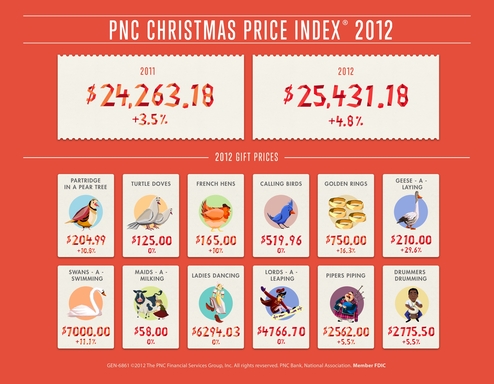
In their yearly display of price change and how it affects holiday prices, PNC has again released their Christmas Price Index. This interactive feature allows users to track the price changes of each subject of the popular Christmas carol, "The Twelve Days of Christmas," beginning with a partridge in a pear tree, with the price of the tree determined by a local Philadelphia nursery and the partridge by the Cincinnati Zoo and Botanical Gardens. Other prices can be found here.
This year the cost of Christmas is $25,431.18, up 4.8% since 2011's score of 24,263.18. This is the cost to purchase each of the 78 items in "The Twelve Days of Christmas," with the least expensive being the eight maids-a-milking, as determined by US minimum wage law, which hasn't changed since 2009. The most expensive item on the list (topping ten lords-a-leaping), are the seven swans-a-swimming at $7,000, up 11.1% from their 2011 price of $6,300.
However, indices like these should be taken with a grain of coal; criticism of PNC's index can be found here. According to the critics, Christmas' price when adjusted for inflation are not as high as perceived. Additionally, what is the price of the cow for the maids-a-milking, how long are the dancers dancing for, and where are you going to find real lords to leap (The index measures the going rate for male ballet dancers)? Ultimately, this lighthearted game of Christmasnomics isn't without its Scrooges, but it shows relative economic change; swans are up, maids unchanged.
Positive Momentum in Economic Confidence
 A recent report released by Gallup Economy indicates that Americans' confidence in the US economy is the highest it has been in four years. The monthly average of economic confidence in November (-13) is significantly improved from confidence levels recorded during the onset of the Great Recession in January 2008 (-32). Throughout the month of November, Economic Confidence was relatively stable, ranging from a high (-10) in the week leading up to the presidential election and dropping slightly toward the end of the month (-15) as the fiscal cliff approaches.
The Gallop Economic Confidence Index determines monthly averages of economic confidence by averaging Americans' interpretation of current economic conditions and their future expectations for the US economy. Although in November more Americans viewed the economy as "poor" (38%) than "excellent" or "good" (17%) and the net score of Americans' opinions of the current US economy was negative (-11), the average rating of the current US economic conditions in November was the highest it had been since March 2008 (-20). Additionally, while more Americans believe that the US economy is getting worse (50%) rather than better (45%) for an economic outlook net score of (-5), the economic outlook score is steadily improving. Therefore, while Americans' assessment of the current economy and their economic outlook is bleak, it is the best it has been nearly five years.
Certain subgroups of the American population are more confident in the US economy. Notably, Democrat (30), Black (30), Hispanic (6), and 18-29 year old (3) Americans reported the highest levels of confidence in the US economy, whereas married (-20), elderly (-23) White (-23) and Republican (-59) Americans expressed the least confidence in the US economy.
VOX's opened a debate: What’s the use of economics?
VOX has opened a new discussion "What’s the use of economics?" moderated by Richard Baldwin.
It would be helpful to have opinions from professionals from the hard sciences. We know about the overall opinion of the economic profession - the role of economics has dramatically increased after the crisis [:)]. We know the opinion of the general public - "failed once again". But only the approach adopted in the hard sciences can reshape economics in a way appropriate for the safe usage by the society. Currently, economics is irrelevant what makes it agressive and dangerous for the ustainability of the economy and society. It is time to put the economic studies in the bounds of quantiative responsibility. Otherwise, it will fail again and again ...
This is the announcement and invitation to participate the discussion
Economics is under fire both from outside and inside the profession for irrelevance, arrogance, and more. This new Vox debate focuses on two questions: What’s the use of economics? How should we be teaching it to the next generation?
To participate in this debate, please email your commentary to debates@voxeu.org
Lead CommentariesRecent CommentariesPopular Commentaries
Diane Coyle, 18 September 2012
What’s the use of economics? A new Vox debate
Andrew G Haldane, 28 September 2012
What have the economists ever done for us?


