New Release: Gray, "The Massey Murder: A Maid, Her Master and the Trial that Shocked a Country"

Via our friends at the Canadian Legal History Blog, we have word of the latest release from the Osgoode Society: The Massey Murder: A Maid, Her Master and the Trial that Shocked a Country, by Charlotte Gray. Here's a description from the press:
In 1915 Carrie Davies, an 18-year old servant girl in the home of Charles (Bert) Massey, scion of the famous Massey family, shot and killed her employer as he entered his house after work. Remarkably, she was acquitted, and award winning popular historian Charlotte Gray explains how this happened. Vividly recreating the war time atmosphere, a press war, and conflicts over crime and gender, she highlights the role played by the defence lawyer who exploited the "unwritten law" of an honour killing in a rare Canadian case of jury nullification.
Blogger Mary Stokes (Osgoode Hall Law School) offers this additional information:
Those familiar with the Osgoode Society's publications will see immediately that this is not our usual style. It's more 'popular' than academic history. This is not to say that it is not the result of excellent research. Merely that while there is a note on sources and an index, there are no footnotes, even for dialogue which the author has reproduced from newspapers and other sources, and there is some creative licence taken. Says the author, "I imagine, but I do not invent....I speculate and I interpret...I do so cautiously, and only when I am confident that I am more likely to be right than wrong..." (xv-xvi). Less value for professional historians than a more conventional treatment would have afforded, but a darn good read for everyone.

Edwards to Lecture on “Women, Law, and Culture: Rethinking Legal Change in the Civil War Era"

[Our friends at Oregon Law send us the following announcement.]

The Law, Culture, and Humanities Initiative presents “Women, Law, and Culture: Rethinking Legal Change in the Civil War Era,” with Laura Edwards, Thursday, October 3, 2013, 12:30 – 2:00 p.m., Lewis Lounge, Knight Law Center, University of Oregon.

Laura F. Edwards received her Ph.D. from the University of North Carolina, Chapel Hill and is now Professor of History at Duke University. Her interests focus on race, gender, labor, and law, especially in the nineteenth-century U.S. South. She just completed a legal history of the Civil War and Reconstruction titled A Nation of Rights. Most recently, she is the author of The People and Their Peace: Legal Culture and the Transformation of Inequality in the Post-Revolutionary South (University of North Carolina Press, 2009), which was awarded the American Historical Association’s 2009 Littleton-Griswold prize for the best book in law and society and the Southern Historical Association’s Charles Sydnor prize for the best book in southern history. In addition, she is author of Scarlett Doesn’t Live Here Anymore: Southern Women in the Civil War Era (University of Illinois Press, 2000); and Gendered Strife and Confusion: The Political Culture of Reconstruction (University of Illinois Press, 1997). She has received fellowships from the Newberry Library, the National Humanities Center, the NEH, and the Guggenheim Foundation. She also has been honored with the Howard D. Johnson award for distinguished undergraduate teaching, given by the College Arts and Sciences at Duke University and the Dean’s Award for Excellent Mentoring, given by the Graduate School at Duke University.

RSVP to Sabrina Leathers: leathers@uoregon.edu [ASAP].

Cosponsored by Oregon Humanities Center, Center for the Study of Women in Society, Office of the Vice Provost for Equity and Inclusion, Department of Political Science, School of Law Lectures and Awards, Department of History, and Office of Academic Affairs.

The Law, Culture, and Humanities Initiative was created to facilitate, support, and encourage symposia, lectures, scholarship, and faculty discussion on the relationship between law and other humanistic disciplines. It provides opportunities for faculty to integrate humanistic-based studies with the study of law, and to explore the increasingly diverse and rich scholarships in areas that include (but are not limited to) legal history, law and literature, law and anthropology, and law and philosophy.

Gender Differences in Employment Worldwide


In a recent report from Gallup World, it was found that, worldwide, men are almost twice as likely to have a "good" job than women. The report shows that 34% of men report having a good job compared to 18% of women who report the same. Gallup defines a "good' job as one that requires full-time work for an employer. The data for this report were gathered from 2005/2006 through 2013 in face to face or landline telephone interviews of 225,975 individuals aged 15 and older throughout the world. 

The table shows that women's highest deficit in full-time employment are in South Asia (-26%) and Non-EU Europe (-22%), while Sub-Sarahan Africa has the lowest deficit (-7%) followed by the Commonwealth of Independent States (-8%).  The deficit for women in Northern America stands at -19%. 

themostsearched.org offers several teaching/learning tools on the topics of worldwide employment and gender in employment: Gallup's Global Tracking Tool, Employment to Population Ratio , and Occupational Segregation and Earning Differences .

Read more:
http://www.gallup.com/poll/164666/globally-men-twice-likely-women-good-job.aspx
http://www.gallup.com/home.aspx?ref=logo
http://www.gallup.com/poll/world.aspx?ref=logo

themostsearched.org Resources:
http://themostsearched.org/resource/3898
http://themostsearched.org/resource/2936
http://themostsearched.org/resource/3109

Sexual Violence against Women in Asia


In a recent article in the Graphic Details section of The Economist, it was reported that more than ten percent of surveyed men in six Asian nations said that they raped a woman who was not there partner and that number rose to nearly twenty-five percent if their partners were included. This finding is based on data from a UN study to assess the number of rapes which occur in the Asian region and was published in the Lancet Journal of Global Health.

The survey was administered from January, 2011 to December, 2012 to men ages 18 through 49 who lived in six Asian nations,Cambodia, China, Sri Lanka, Bangledesh, Papua New Guinea, and Indonesia. The interviews were done in a  face-to-face manner and the men were ask about their sexual behaviors. The men were asked if they had ever "forced a woman who was not your wife or girlfriend at the time to have sex" or if they “had sex with a woman who was too drunk or drugged to indicate whether she wanted it," but the word "rape" was never used in the interview.

Read more:
http://www.economist.com/blogs/graphicdetail/2013/09/daily-chart-7?spc=scode&spv=xm&ah=9d7f7ab945510a56fa6d37c30b6f1709
http://www.economist.com/blogs/graphicdetail
http://www.economist.com/
http://www.thelancet.com/journals/langlo/article/PIIS2214-109X(13)70069-X/fulltext
http://www.thelancet.com/journals/langlo/latestcontent

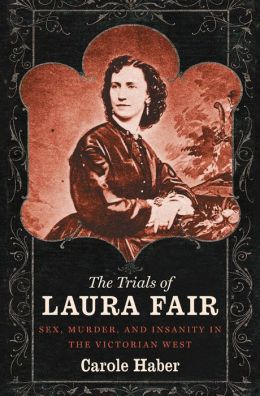
New Release: Haber, "The Trials of Laura Fair"

New from the University of North Carolina Press: The Trials of Laura Fair: Sex, Murder, and Insanity in the Victorian West, by Carole Haber (Tulane University). Here's a description:
On November 3, 1870, on a San Francisco ferry, Laura Fair shot a bullet into the heart of her married lover, A. P. Crittenden. Throughout her two murder trials, Fair's lawyers, supported by expert testimony from physicians, claimed that the shooting was the result of temporary insanity caused by a severely painful menstrual cycle. The first jury disregarded such testimony, choosing instead to focus on Fair's disreputable character. In the second trial, however, an effective defense built on contemporary medical beliefs and gendered stereotypes led to a verdict that shocked Americans across the country. In this rousing history, Carole Haber probes changing ideas about morality and immorality, masculinity and femininity, love and marriage, health and disease, and mental illness to show that all these concepts were reinvented in the Victorian West.
Haber's book examines the era's most controversial issues, including suffrage, the gendered courts, women's physiology, and free love. This notorious story enriches our understanding of Victorian society, opening the door to a discussion about the ways in which reputation, especially female reputation, is shaped.

Read more »

Custer on Married Women's Property Acts

Joseph A. Custer, Saint Louis University School of Law, has posted The Three Waves of Married Women's Property Acts in the Nineteenth Century with a Focus on Mississippi, New York and Oregon.  Here is the abstract:
Paper starts with a brief section on early America and social reform that provides a background on why married women's property acts (MWPA's) passed when they did in nineteenth century America. After laying the foundation, the paper delves into the three waves in which the MWPA's were passed in the nineteenth century focusing for the first time in the literature on one specific state for each wave. The three states; Mississippi, New York and Oregon, are examined leading up to passage. Next, the paper will look into the judicial reaction of each State’s highest court. Were the courts supportive of the passed married women’s property acts or did they trend back toward the previous common law approach or equity? In evaluating the courts’ rulings, an examination of the judicial decision-making process is undertaken.

Freedman, "Redefining Rape"

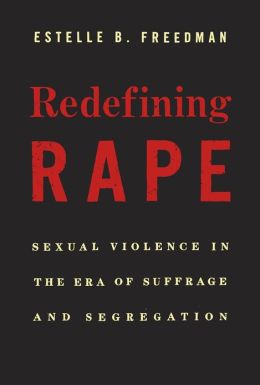
In last Sunday's book review round-up, Emily mentioned Estelle B. Freedman's new book, Redefining Rape: Sexual Violence in the Era of Suffrage and Segregation (Harvard University Press). A fuller description seemed worth posting. From the Press:
Rape has never had a universally accepted definition, and the uproar over "legitimate rape" during the 2012 U.S. elections confirms that it remains a word in flux. Redefining Rape tells the story of the forces that have shaped the meaning of sexual violence in the United States, through the experiences of accusers, assailants, and advocates for change. In this ambitious new history, Estelle Freedman demonstrates that our definition of rape has depended heavily on dynamics of political power and social privilege.
The long-dominant view of rape in America envisioned a brutal attack on a chaste white woman by a male stranger, usually an African American. From the early nineteenth century, advocates for women's rights and racial justice challenged this narrow definition and the sexual and political power of white men that it sustained. Between the 1870s and the 1930s, at the height of racial segregation and lynching, and amid the campaign for woman suffrage, women's rights supporters and African American activists tried to expand understandings of rape in order to gain legal protection from coercive sexual relations, assaults by white men on black women, street harassment, and the sexual abuse of children. By redefining rape, they sought to redraw the very boundaries of citizenship.
Freedman narrates the victories, defeats, and limitations of these and other reform efforts. The modern civil rights and feminist movements, she points out, continue to grapple with both the insights and the dilemmas of these first campaigns to redefine rape in American law and culture.

Read more »

Weekend Roundup

      • Prawfsblawg reports that Michael Lobban is moving from Queen Mary to the London School of Economics.
      Weekend Roundup is a weekly feature compiled by all the Legal History bloggers.

      Women in the Life and Law of the DC Circuit Courts

      Just up on the website of the Historical Society of the DC Circuit is a video of  Women in the Life and Law of the DC Circuit Courts, a program the Society sponsored in June.  The website explains:
      Led by the moderator, Professor Barbara Babcock,  panelists Justice Ruth Bader Ginsburg, Judge Gladys Kessler, Judge  Royce Lamberth, Nancy Mayer-Whittington, Michele Roberts, Judge Patricia Wald, and Helgi Walker assessed the role of women in the life and law of the Courts.  In so doing, they described their professional and personal experiences while providing insights into the participation of women in the Courts of the Circuit, hurdles encountered and remaining, and the impact of women participating in increasing numbers in the judicial process.

      Webster Williams on Justice Ginsburg's Equal Protection Clause

      My Georgetown colleague Wendy Webster Williams has posted Ruth Bader Ginsburg's Equal Protection Clause: 1970-80, which appears in Columbia Journal of Gender and Law 25 (2013): 41-49.  Here is the abstract:
      Credit: Columbia Law School
      Professor Ruth Bader Ginsburg of Columbia Law School was the leading Supreme Court litigator for gender equality in the crucial decade, 1970-80. In addition to teaching her classes, producing academic articles, and co-authoring the first casebook on sex discrimination and the law, she worked on some sixty cases (depending on how one counts), including over two dozen cases in the Supreme Court. Rumor has it she did not sleep for ten years; her prodigious output gives the rumor some credence. Her impact on the law during that critical decade earned her the title "the Thurgood Marshall of the women's movement" and secured her place in history-even before she became a federal appellate judge and Supreme Court justice.

      The author devotes her allotted space to two, intimately intertwined, topics: first, Ruth Ginsburg and the Supreme Court's standard of review in sex discrimination cases, and second, the substance of Ruth Ginsburg's concept of gender equality in law.

      New Release: Murphy, "Citizenship and the Origins of Women's History in the United States"

      New from the University of Pennsylvania Press: Citizenship and the Origins of Women's History in the United States, by Teresa Anne Murphy (George Washington University). Here's a description from the Press:

      Women's history emerged as a genre in the waning years of the eighteenth century, a period during which concepts of nationhood and a sense of belonging expanded throughout European nations and the young American republic. Early women's histories had criticized the economic practices, intellectual abilities, and political behavior of women while emphasizing the importance of female domesticity in national development. These histories had created a narrative of exclusion that legitimated the variety of citizenship considered suitable for women, which they argued should be constructed in a very different way from that of men: women's relationship to the nation should be considered in terms of their participation in civil society and the domestic realm. But the throes of the Revolution and the emergence of the first woman's rights movement challenged the dominance of that narrative and complicated the history writers' interpretation of women's history and the idea of domestic citizenship.

      In Citizenship and the Origins of Women's History in the United States, Teresa Anne Murphy traces the evolution of women's history from the late eighteenth century to the time of the Civil War, demonstrating that competing ideas of women's citizenship had a central role in the ways those histories were constructed. This intellectual history examines the concept of domestic citizenship that was promoted in the popular writing of Sarah Josepha Hale and Elizabeth Ellet and follows the threads that link them to later history writers, such as Lydia Maria Child and Carolyn Dall, who challenged those narratives and laid the groundwork for advancing a more progressive woman's rights agenda. As woman's rights activists recognized, citizenship encompassed activities that ranged far beyond specific legal rights for women to their broader terms of inclusion in society, the economy, and government. Citizenship and the Origins of Women's History in the United States demonstrates that citizenship is at the heart of women's history and, consequently, that women's history is the history of nations.
      A few blurbs:
      "Teresa Anne Murphy's fascinating and important book not only reshapes our understanding of the field of women's history but is a valuable contribution to the historical literature on the political, civil, and intellectual status of women in the revolution and early republic."—Carol Faulkner, Syracuse University

      "This thoughtful and stimulating intellectual history takes a fresh look at history writing by and about women between the American Revolution and Civil War. It makes an original and distinctive contribution by connecting changing narratives about women's history to larger debates about the nature of women's citizenship."—Anne M. Boylan, University of Delaware
      More information, including an excerpt and the table of contents, is available here.

      Overestimating the Black Population in the US


      A recent article in The Atlantic reported that the 2000 General Social Survey asked 1,000 White adults to estimate what percentage of the US population is Black. 95% of White women and 85% of White men overestimated that percentage, which at the time, was 12%.  The overestimation was stronger for women than men: 69% of women and 49% of men guessed that Blacks comprised more than 20% of the population. 

      Women, Aging, Fertility, and Statistics

      In the July/August, 2013 issue of The AtlanticJean M. Twenge, Professor of Psychology at San Diego State University and author of The Impatient Woman's Guide to Getting Pregnant wrote the article, "How Long Can You Wait to Have a Baby?" which explored her experience in getting pregnant. She discusses her search for information in the popular press and scientific journals and this section of her article is below.

      The widely cited statistic that one in three women ages 35 to 39 will not be pregnant after a year of trying is based on an article published in 2004 in the journal Human Reproduction. Rarely mentioned is the source of the data: French birth records from 1670 to 1830. The chance of remaining childless—30 percent—was also calculated based on historical populations.

      In other words, millions of women are being told when to get pregnant based on statistics from a time before electricity, antibiotics, or fertility treatment. Most people assume these numbers are based on large, well-conducted studies of modern women, but they are not. 

      Even some studies based on historical birth records are more optimistic than what the press normally reports: One found that, in the days before birth control, 89 percent of 38-year-old women were still fertile. Another concluded that the typical woman was able to get pregnant until somewhere between ages 40 and 45. Yet these more encouraging numbers are rarely mentioned—none of these figures appear in the American Society for Reproductive Medicine’s 2008 committee opinion on female age and fertility, which instead relies on the most-ominous historical data.

      In short, the “baby panic” is based largely on questionable data. We've rearranged our lives, worried endlessly, and forgone countless career opportunities based on a few statistics about women who resided in thatched-roof huts and never saw a lightbulb.

      Professor Twenge's article can be read here: http://www.theatlantic.com/magazine/archive/2013/07/how-long-can-you-wait-to-have-a-baby/309374/

      Women in the Life and Law of the D.C. Circuit Courts

      [We are moving this post up, because the symposium takes place tomorrow.]

      The Historical Society of the District of Columbia Circuit presents Women in the Life and Law of the D.C. Circuit Courts, a symposium to be held on Tuesday, June 18, 2013, from 4:30 – 6:00 p.m. in the Ceremonial Courtroom, 6th Floor, E. Barrett Prettyman U.S. Courthouse, 3rd Street & Constitution Avenue, N.W., Washington, D.C.

      Women in the Life and Law of the D.C. Circuit Courts will bring together participants in the life of the D.C. Circuit – judges, administrators, law clerks and practicing attorneys – to speak from their experience about the past, present and future of women in the Courts of the Circuit. The program will open with stage-setting remarks by Emerita Professor Barbara Babcock of Stanford Law School who clerked for Circuit Judge Henry Edgerton and writes and teaches about women’s issues. This will be followed by a panel discussion moderated by Professor Babcock.

      Participants in the panel will be Justice Ruth Bader Ginsburg (D.C. Circuit Judge 1980-93); Senior Judge Gladys Kessler   (Member of the District Court since 1994); Chief Judge Royce C. Lamberth (Member of the U.S. District Court since 1987); Nancy Mayer-Whittington (Clerk of the District Court 1991-2009); Michele A. Roberts (Partner, Skadden, Arps, Slate, Meagher & Flom and advocate before the District Court); Hon. Patricia M. Wald (D.C. Circuit Judge 1979-99, Chief Judge 1986-91); and Helgi C. Walker (Partner, Wiley Rein and advocate before the Court of Appeals for the D.C. Circuit).

      Trestman to Lecture on Bessie Margolin

      Marlene Trestman, the author of the forthcoming book, Fair Labor: The Remarkable Life and Legal Career of Bessie Margolin, will deliver the Donald S. Shire Lecture at the U.S. Department of Labor, 200 Constitution Avenue, NW, Washington, DC, on Friday, June 28th, 2013.  The lecture, which is open to the public, will take place at 1:00 p.m. in the Department’s César Chávez Memorial Auditorium, which may be accessed via 3rd and C Streets, NW, entrance.  Please RSVP to Patricia Morgan at 202-693-5772 or Morgan.Patricia@dol.gov.

      The Backhouse Backlist

      [We're moving up this updated post.]

      Constance B. Backhouse, a Distinguished University Professor on the University of Ottawa's Faculty of Law and an immediate Past President of the ASLH, has posted some of her backlist:

      "Pleasing Appearance...Only Adds to the Danger": The 1930 Insanity Hearing of Violet Hypatia Bowyer, Canadian Journal of Women and the Law 17:1 (2005) 1-13
      The state's legal authority to detain individuals within insane asylums in early twentieth-century Canada was deeply influenced by factors of gender, class, and race. Violet Hypatia Bowyer, a working-class, white woman who was just twenty-two years old in 1928, was initially incarcerated in Ontario for leading a 'dissolute' life. Wrongly diagnosed as 'insane' by prison officials, she tried valiantly, but failed, to secure her release through legal challenge. The expert testimony of the prison officials, the psychiatric 'experts,' and the decision of the court all testify to the terrifying coerciveness of law in Canadian history.
      'Don't You Bully Me - Justice I Want If There is Justice to Be Had': The Rape of Mary Ann Burton, London, Ontario, 1907, in People and Place: Historical Influences on Legal Culture, ed. Jonathan Swainger and Constance Backhouse (Vancouver: University of British Columbia Press, 2003), 60-94.
      In 1907, Mary Ann Burton launched a complaint of rape against Joseph Gray in London, Ontario. Judicial decisions and literature at the time claimed that rape was “an accusation easily to be made”, despite the common knowledge that rape was underreported. Mary Ann Burton's case sets no legal precedent; she was treated with suspicion and hostility, and the charges were ultimately dismissed by the court. Yet Mrs. Burton resisted the antagonism she experienced – namely tactics by defence counsel to attack her character, her image as a “worthy victim”, her credibility, and her recollection of every finite detail of the incident. She remained resolute in her testimony and her right to be protected from rape, in the face of pernicious commentary from acquaintances, and a courtroom that systematically discredited and ultimately dismissed her based largely on her gender and class.
      The Doctrine of Corroboration in Sexual Assault Trials in Early Twentieth-Century Canada and Australia, Queen's Law Journal 26 (2001): 297-338.
      The author compares two early twentieth century criminal cases, one Australian and one Canadian, involving carnal knowledge of a child. The cases illustrate the parallel development of the doctrine of corroboration in sexual assault cases in the two countries – a doctrine which was based on the belief that the testimony of women and girls in such cases was inherently suspect. By requiring that corroborating evidence be independent of the complainant's testimony, and by interpreting that requirement in an extremely rigid way to exclude particular items of evidence that strongly supported the complaints, the courts in both cases imposed unjustified obstacles to the conviction of men accused of sexual offences. This misuse of the doctrine of corroboration contradicted the ideals of evenhanded justice and gender equality in both Canada and Australia.
      'I Was Unable to Identify with Topsy' - Carrie M. Best's Struggle Against Racial Segregation in Nova Scotia, 1942, Atlantis 22 (Spring 1998) 16-26.
      This paper describes a court case that was buried in Canadian legal archives for fifty-six years. In 1942, Carrie Best brought a civil action for damages against a Nova Scotia theatre, claiming that the owners were enforcing a racially-segregated seating policy. The action was ultimately dismissed. Dr. Best, an African-Canadian who was a teacher, journalist, and founder of The Clarion (a newspaper that she began publishing in 1945) had been a long-time advocate for human rights and activist against racial discrimination and segregation in Nova Scotia. Carrie Best's decorated career as a journal and activist is public knowledge, but the history of her unsuccessful litigation calls for scrutiny. Such cases help us understand Canadian history to be deeply marked with racism. 
      Read more »

      Bessie Margolin (1909-1996)

      [My exam in American Legal History usually includes a biographical essay.  The 2012 exam, for example, had one on Marion Harron; the 2011 exam had one on Bernice Lotwin Bernstein, and the 2010 exam profiled Ida Klaus.  For this year's question, I drew heavily upon Marlene Trestman, “Fair Labor: The Remarkable Life and Legal Career of Bessie Margolin (1909-1996)," Journal of Supreme Court History 37 (2012): 42–74, as well as my own research.  See also Karen's essay, Portia's Deal, and her post on the Frankfurter quote below.]

      Bessie Margolin (credit)
      Bessie Margolin (1909-1996) was born in Brooklyn to Russian Jewish immigrants.  When she was two, the family moved to Memphis, where, when Bessie was four, her mother died in childbirth.  Her father felt incapable of carrying for his children, so Bessie and a brother were sent to live at the Jewish Children’s Home in New Orleans.  There she received an excellent education and was deemed “a very splendid girl, far above average in every way.”  At sixteen she left the Home and enrolled in a women’s affiliate of Tulane University.  After two years she enrolled in Tulane itself to complete her bachelor’s degree and a law degree.  She was the only woman in the Tulane Law School when she started.  She became Civil Law Editor of the Tulane Law Review.  In 1930, at the age of twenty one, she graduated second in her law school class of twenty three, “a fraction” behind the top student.

      Margolin impressed Tulane’s dean with her “unusual professional ability,” her “unusually charming personality,” and her “unusually broad, balanced, and progressive social outlook.”  She also impressed the Yale law professor Ernest Lorenzen, who published an article in her volume of the law review and hired her as his research assistant.  She would spend the next three years in New Haven, the last on a prestigious fellowship as a doctoral candidate in law.  Her thesis, directed by William O. Douglas, was on the French law of corporate reorganizations.  Douglas called it meticulous and “of the highest caliber,” with “an air of realism about it.”

      While at Yale, Margolin also wrote a comment on pending legislation on corporate reorganizations.  After the Yale Law Journal, edited that year by Abe Fortas, published it over her initials, partners of eminent law firms inquired after its author.  Their interest in a potential hire vanished when they learned that “B.M.” was a woman.  After receiving her legal doctorate in 1933, she took a temporary job at the Inter-American Commission of Women in Washington, where she researched the legal status of women in Latin America.  Then the creation of the Tennessee Valley Authority (TVA) presented her with a better alternative.  Lorenzen assured TVA’s personnel director that Margolin “is intent upon a legal career or professional career as a primary objective from which she will not be deflected by marriage.”

      In the late summer of 1933, Margolin started as a research attorney in TVA’s Knoxville office at a salary of only $2,000.  About that time, a TVA lawyer described her telegraphically: “Tulane, Yale, TVA.  One of the Washington ‘prima donnas.’  Excellent on research.  A good kid.  Sadly underpaid and a bit sore on things.”  He predicted that she “will be all right” under the newly appointed general counsel James Lawrence Fly, and in fact Fly promoted her to Associate Attorney and raised her salary to $3,600.

      The TVA’s legal division, one of Margolin’s coworkers recalled, was “an extraordinary able, brilliant group of relatively young lawyers, who had outstanding academic records and law school achievements.”  Fly considered his legal division TVA’s central policymaker.  He let it be known, a lawyer recalled, that “the legal division was going to be the key to the works.”

      Fly set Margolin to work organizing evidence, researching legal issues, and writing substantial portions of the briefs in two challenges to TVA that went to the U.S. Supreme Court.  Although she can be seen sitting, hatless, behind TVA’s lead counsel John Lord O’Brian, in a photograph of one trial, she never argued in any branch of the cases.  Although Fly promoted her to Senior Attorney and raised her salary to $4600, she only tried a few condemnation cases “of lesser importance.”

      In 1939 Margolin moved to the legal staff of the recently created Wage and Hour Division of the Labor Department, charged with implementing the Fair Labor Standards Act (FLSA).  She asked for $5600, even though she knew that the general counsel might “think this an awful lot ‘for a girl’”; she was pleased when she received $5000.  Save for six months in 1946, when she was in Germany helping organize trials of Nazis, she remained at Wage & Hour until retiring in 1972.   From the start, she appeared in court.  Her argument of motions in federal district court in New Orleans was extensively covered by the local press.  Margolin is “a brunette, with flashing black eyes and a stunning figure,” a newspaperman reported.  “When you see a face like Miss Margolin’s you almost immediately wonder what that ‘Miss’ is tacked on before for.”  At first, she declined to discuss her marital status.  “I’m interested in labor and I’m a New Dealer,” she said.  “Incidentally, I’m not a radical.”  When pressed, she finally responded that she “hadn’t had time for love.”
         
      A few months with time cards and payroll records in damp New England warehouses convinced Margolin that trial work was a “deadly bore,” so she transferred to Wage & Hour’s appellate division.  She would ultimately argue 150 cases before the U.S. Circuit Courts (winning 114) and 28 before the U.S. Supreme Court (winning 23).  Frankfurter, who sparred with her in oral argument, described her as “a very good girl & a good advocate but not a lawyer of unsettling brilliance apart from the deft use of her feminine charms.”  She was promoted to Assistant Solicitor of the Department of Labor, but she never became Solicitor or a federal judge, a post she coveted.  Instead, she remained an imposing presence in the Department of Labor.  One Solicitor described his selection process as having three stages: “I had to be nominated by the President, confirmed by the Senate, and interviewed by Bessie.”

      Regular visits to the Elizabeth Arden Salon, during which she sometimes edited briefs, kept her impeccably coiffed.  When she entered a courthouse, “she walked with absolute assurance that a door would be opened before she got to it.”  After the Equal Pay Amendment to the FLSA was passed in 1963, she became its greatest defender within the Department of Labor.

      [As you can see, the essay does not mention Margolin's affair with Fly, a married father of two, which commenced at TVA and continued after he became chairman of the Federal Communications Commission in September 1939.  Because I had not discussed sexuality and the legal profession in class, I thought the issue too challenging for students to tackle for the first time in the exam room.  FCC Commissioner Clifford Durr described the affair as "one of these things that was known but wasn’t known."  The chairman of an ad hoc investigation of the FCC threatened to make it public until House Speaker Sam Rayburn (like Fly, a Texan) instructed him not to.]

      Women in the Life and Law of the D.C. Circuit Courts

      [We have the following announcement.]

      "Women in the Life and Law of the D.C. Circuit Courts" is the upcoming Historical Society  program that will bring together judges, administrators, law clerks, and practicing attorneys, each with direct experience in our courts, to discuss the past, present, and future of women in the Courts of the D.C. Circuit. 

      Stanford Emerita Professor of Law Barbara Babcock will open the program with stage-setting remarks on the roles of women in this Circuit .  A panel discussion will follow in which  Justice Ruth Bader Ginsburg, former Chief Judge Patricia M. Wald, Chief Judge Royce C. Lamberth, former Clerk of the U.S. District Court Nancy Mayer-Whittington, and advocates Michele Roberts and Helgi Walker will respond to questions posed by Professor Babcock, the moderator, and to the comments of other panelists and program attendees.

      Please join us on Tuesday, June 18 at 4:30 p.m. in the Ceremonial Courtroom of the E. Barrett Prettyman U.S. Courthouse.  A reception will follow the program.  Everyone is invited; no reservations are required.

      Norgren's "Rebels at the Bar"

      Jill Norgren, professor emerita at John Jay College and the University Graduate Center, The City University of New York and the author of (among other books) Belva Lockwood: The Woman Who Would be President has recently published Rebels at the Bar: The Fascinating, Forgotten Stories of America's First Women Lawyers with the NYU Press, which is offering the book at a 20 percent discount (Promo code = REBEL13).  We learn from the press:
      In Rebels at the Bar, prize-winning legal historian Jill Norgren recounts the life stories of a small group of nineteenth century women who were among the first female attorneys in the United States. Beginning in the late 1860s, these determined rebels pursued the radical ambition of entering the then all-male profession of law. They were motivated by a love of learning. They believed in fair play and equal opportunity. They desired recognition as professionals and the ability to earn a good living.

      Through a biographical approach, Norgren presents the common struggles of eight women first to train and to qualify as attorneys, then to practice their hard-won professional privilege. Their story is one of nerve, frustration, and courage. This first generation practiced civil and criminal law, solo and in partnership. The women wrote extensively and lobbied on the major issues of the day, but the professional opportunities open to them had limits. They never had the opportunity to wear the black robes of a judge. They were refused entry into the lucrative practices of corporate and railroad law. Although male lawyers filled legislatures and the Foreign Service, presidents refused to appoint these early women lawyers to diplomatic offices and the public refused to elect them to legislatures.

      Rebels at the Bar expands our understanding of both women’s rights and the history of the legal profession in the nineteenth century. It focuses on the female renegades who trained in law and then, like men, fought considerable odds to create successful professional lives. In this engaging and beautifully written book, Norgren shares her subjects’ faith in the art of the possible. In so doing, she ensures their place in history.

      Read more »

      Female Economic Advancement


      The Economist's recent Graphic Detail post "Where to Be Female" discusses the results of the annual Women’s Economic Opportunity Index recently published by the Economist Intelligence Unit.  According to the report published by the Economist Intelligence Unit, "women are a key driver of economic growth" as their entry into the workforce has coincided with GDP growth in both the United States and Europe, yet "nearly one-half of working women are not currently active in the formal global economy."  The Women’s Economic Opportunity Index seeks to assess women's entry into the workforce and economic advancement using data released by a variety of major international organizations, including the United Nations and International Monetary Fund.  The Index ranges from 0 to 100 (100 being most favorable) and ranks 128 different countries.  As the chart from the Economist’s website shows (below), Sweden received the most favorable ranking of 90.4, followed by Norway and Finland at 88.3 and 88.2 respectively.  The United States was ranked 14that 78.4, only slightly below the United Kingdom, which was ranked 13that 78.9.  Sudan and Chad received the worse ranking (128th and 127th) with scores of 19.2 and 23.3 respectively.


      Blog Archive