Data Gone Wrong: Chart on Debt Increases

In one of last week's Washington Post "Fact Checker" blogs, Glenn Kessler gives a rather scathing review of a chart (above) created by the office of House Minority Leader Nancy Pelosi in May. The chart, based on data but not calculations made by the US Treasury Department, has gained attention in social media. As pointed out by Politifact and subsequently corrected by Pelosi's office, the original chart included a major math error by calculating debt increases as if Obama had taken office a year later than he did, cutting his actual debt increase by more than a half and increasing George W. Bush's significantly. Despite Politifact drawing attention to the error and the correction, the original chart is still being proliferated according to Kessler, who saw it in his Facebook "newsfeed" recently.

In addition to this more obvious error, Kessler points out the misleading nature of percent changes in raw debt figures - because Obama was faced with a substantially higher debt when he came into office than his predecessors, it would have taken a much greater nominal increase in the debt to achieve the same percentage increases. Kessler also points out use of gross debt measures rather than public debt measures. Although not technically "misleading," it is worth noting that had the chart used public debt figures rather than gross debt figures, Obama and George W. Bush would have had nearly the same debt increases (60% and 70% respectively) despite Bush's longer term. On his Pinocchio standard, which rates claims made by political figures or groups in fact-checking, Kessler gave Pelosi's chart "Four Pinocchios," which is reserved only for true "whoppers."
Kessler suggests that the debt increase as a percentage of gross domestic product as a more economically informative measure and, using White House Budget Office Historical Tables, calculated the following figures for each President:Although these figures are less flattering for Obama, Kessler notes that he is "battling a recession."

BL cf

Plurality of Americans Favor Palestinian State, but Sympathy Rests With Israel; Divisions Drawn Along Partisan Lines

A September 15-18 survey administered by the Pew Research Center for the People & the Press and The Washington Post reveals stark partisan differences on the issue of Palestinian statehood and Middle East relations. A plurality of Americans (42%) believe the United States should recognize Palestine as an independent nation, as compared with 26% who oppose U.S. recognition and nearly a third (32%) of respondents who state no opinion.

The numbers, however, change within partisan groups. A much higher percentage of Democrats (54%) say they are in favor of U.S. recognition, while only 14% oppose the action; and the numbers are similarly skewed among independents, 45% of whom are in favor of recognition and only 28% opposed. But there are more Republicans (38%) who believe the U.S. should not recognize Palestine than there are those who believe it should (27%).

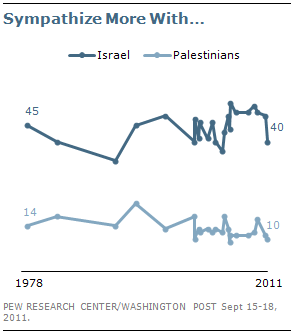
Views similarly fall along partisan lines when respondents are asked with which population they sympathize more. On the whole, 40% of Americans say they sympathize more with Israel, as compared with 10% who sympathize more with Palestinians; 21% say they do not sympathize with either side; and 25% express no opinion. The percentages are nearly unchanged since 1978.Far more Republicans (62%) sympathize with Israel than with Palestinians (4%), especially when compared to other partisan groups. 27% of Democrats sympathize with Israel and 15% with Palestinians; and among independents, 41% sympathize more with Israel than Palestinians (10%).

The report also addresses the "low visibility of the Israel-Palestinian dispute." According to the Pew Research Center’s Project for Excellence in Journalism (PEJ), coverage of the issue has been limited. Pew writes: "Last week, less than 2% of all news coverage was devoted to the debate over Palestinian statehood, far less than the amount of coverage devoted to the U.S. economy (20%) or the 2012 presidential campaign (12%)."

The survey was conducted in anticipation of the planned UN debate on Palestinian statehood this week.

NH cf

On Obama's Speech to the Schoolchildren

themostsearched collected three points mostly overlooked in mass media about Obamas speech yesterday to the schoolchildren.

(1) Parents of concerned children--afraid of indoctrination from a President who unapologetically appoints a radical Communist to his leadership--are mocked for their worry. This is unfair because what the parents were most afraid of was the content of the followup/discussion questions such as, "What can I do to help the President?" It was only AFTER concerned parents spoke up that the controversial discussion materials were removed. themostsearched feels these parents are paying attention to their child's education and praises them.

(2) In a story highlighted by Greta Van Susteren, Greta points out the unfair standards of the previous speech by Bush 41 to children: the Washington Post front page after Bush's speech front page story suggested the speech was staged for the president's political benefit. This turned into a Democratic witch hunt and an investigation was conducted to examine why $26K (read here $26K not $26M not $26B not $26T) was spent by the Bush administration "in an era of scarce resources" (Gephardt).

In contrast, today's front page Washington Post (see image, left) no such accusations of political malfeasance are made. themostsearched condemns such outrageous media hypocrisy.

(3) Final point: it is not the role of federal government to intervene in state affairs. The President could have addressed both parents and children using the internet, radio, or television; the point is he had other options. themostsearched feels that pending an immediate catastrophic national emergency (IE nukes from North Korea or Iran are on their way) really, an address to the schoolchildren of the state should be done by the state's chief executive, the governor. Obama's speech to the children is a mis-education in the proper separation of powers between our state and federal government.

Blog Archive